Healthcare in Thailand runs on two tracks. Thai citizens are covered by public schemes, and foreigners are not. Most foreigners use private hospitals, paid by insurance or out of pocket, while foreign employees get public cover through social security. Rules, hospitals and prices below were checked on 14 November 2026.
How healthcare in Thailand works: public and private
Thailand had 927 government hospitals and 363 private hospitals in 2019, plus thousands of small public health units and private clinics. Most public hospitals belong to the Ministry of Public Health. Universities, the army and the Red Cross run others, including the large teaching hospitals of Bangkok.
Universal coverage is for Thai citizens
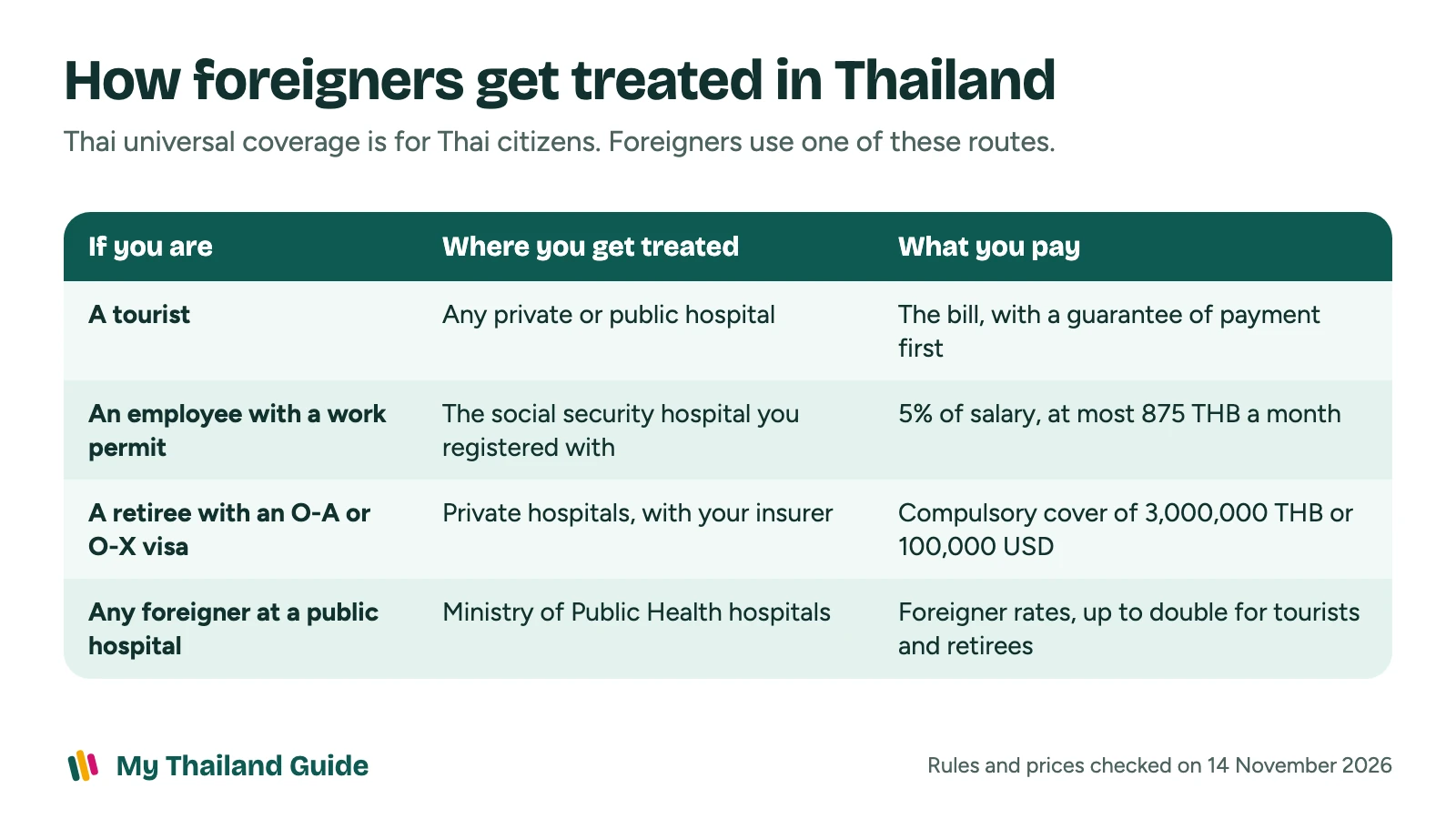
The universal coverage scheme of 2002, once called the 30 baht scheme, is open to Thai nationals only. Civil servants have their own scheme and private sector employees have social security, the one route that foreigners can also use. Expat guides that say a foreigner can join universal coverage are wrong.
| Public hospital | Private hospital | |
|---|---|---|
| Who uses it | Thai patients, insured workers, foreigners on a budget | Most expats and tourists |
| Price for a foreigner | Foreigner rates, up to double the Thai price | Full price, set by each hospital |
| Waiting time | Long, the hospitals are crowded | Short |
| English | Varies, often limited | International desks and interpreters in the large hospitals |
Thailand also has more specialists than general practitioners. In a private hospital you usually book a specialist directly, such as an internist for a fever or a cough, rather than seeing a family doctor first.
Can foreigners use public hospitals in Thailand?
Yes, and they do, mostly for routine care and in provinces with no private hospital nearby. The difference is the bill. Since 30 September 2019, Ministry of Public Health hospitals apply a separate price list to foreign patients, published in the Royal Gazette in August 2019 as ceiling prices.
- Workers and students on a Non-Immigrant B, ED or similar visa pay more than Thais.
- Tourists and retirees, on a tourist entry, a visa on arrival or a Non-Immigrant O visa, pay up to double the Thai price.
- Citizens of neighbouring countries have their own rates.
Unpaid bills explain the policy. In April 2026 the Ministry of Public Health put the debt left by foreign patients at at least 100 million THB a year. Bring your passport, which public and private hospitals both ask for.
Thailand's social security for foreign employees
A foreigner hired by a Thai company with a work permit is enrolled in the Social Security Fund under Section 33, like a Thai employee, as long as they are under 60 when they start. The employer handles the registration.
- Contribution. 5% of salary from the employee and 5% from the employer. The salary ceiling rose from 15,000 to 17,500 THB on 1 January 2026, so each side pays at most 875 THB a month. The ceiling is set for 2026 to 2028.
- When cover starts. Medical care needs at least three months of contributions in the 15 months before treatment.
- One hospital. Care is free at the hospital you chose on enrolment, public or private. You can change it once a year, from mid-December to the end of March.
- Emergencies elsewhere. The first 72 hours at another hospital are covered up to a lower limit, usually paid by you and claimed back.
- Dental. Up to 900 THB a year for cleaning, fillings and extractions. Since 1 May 2026, wisdom tooth surgery, dentures and some implant care have a budget of their own.
If you leave your job after more than 12 months of contributions, you can keep medical cover under Section 39, provided you apply within six months and still hold a valid visa. Retirees who never worked in Thailand and DTV holders working for foreign clients cannot join.
Best hospitals in Thailand by city
The hospitals foreigners use are private and concentrated in the cities where expats live. The safest marker of quality is accreditation by Joint Commission International (JCI), which each hospital renews every three years. We checked the status on each hospital's own site where it was published.
Private hospitals in Bangkok
- Bumrungrad International, Sukhumvit Soi 3. The first hospital in Asia accredited by JCI, in 2002, and re-accredited for the seventh time in 2024. It has 580 beds, more than 1,500 doctors and dentists and treats over 620,000 international patients a year.
- Bangkok Hospital, New Petchaburi Road. The flagship of the largest private group, accredited by JCI for the sixth time, with its own ambulance and medical evacuation service.
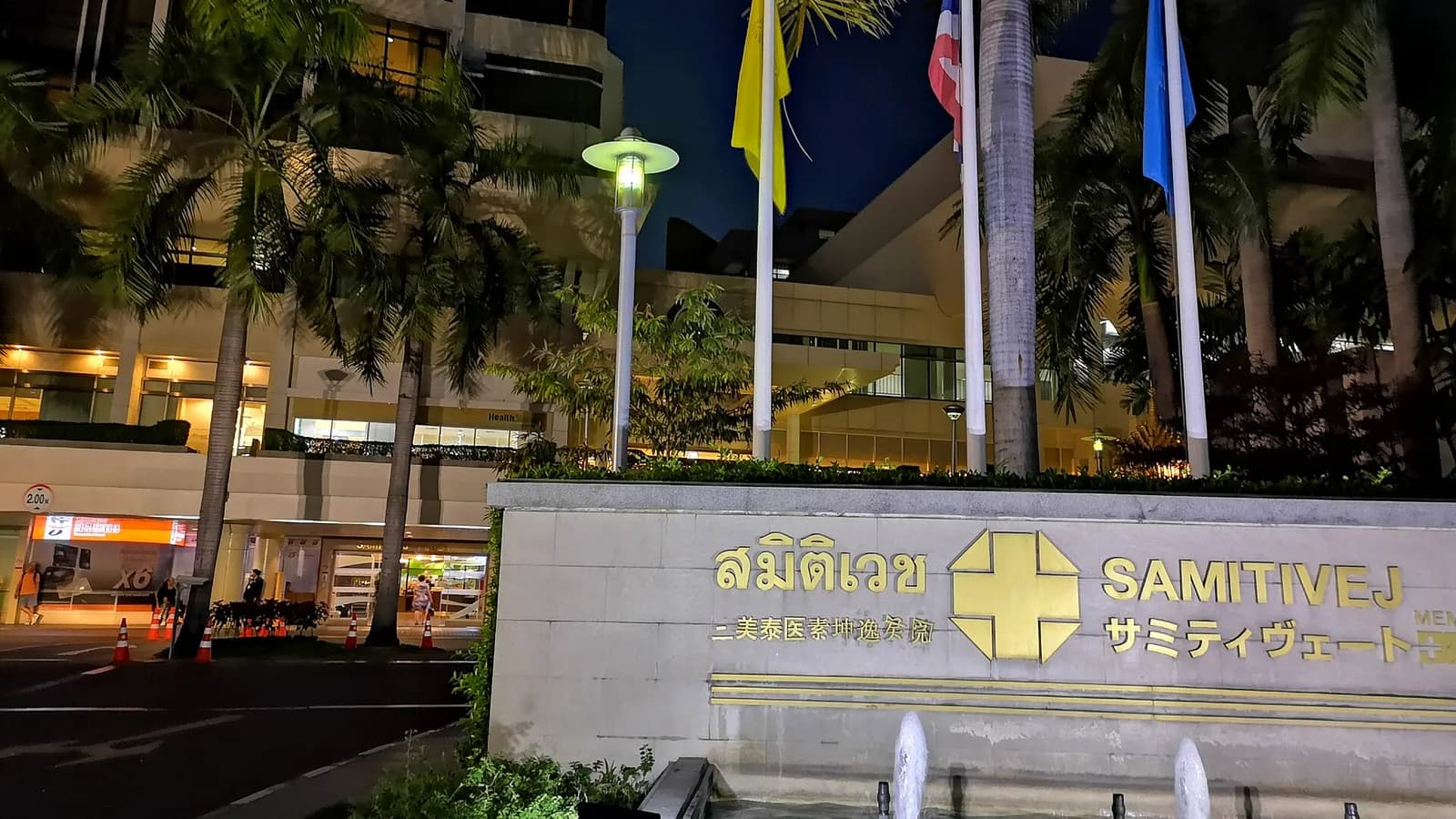
- Samitivej Sukhumvit. Samitivej says JCI accredits all three of its hospitals, Sukhumvit, Srinakarin and Sriracha.
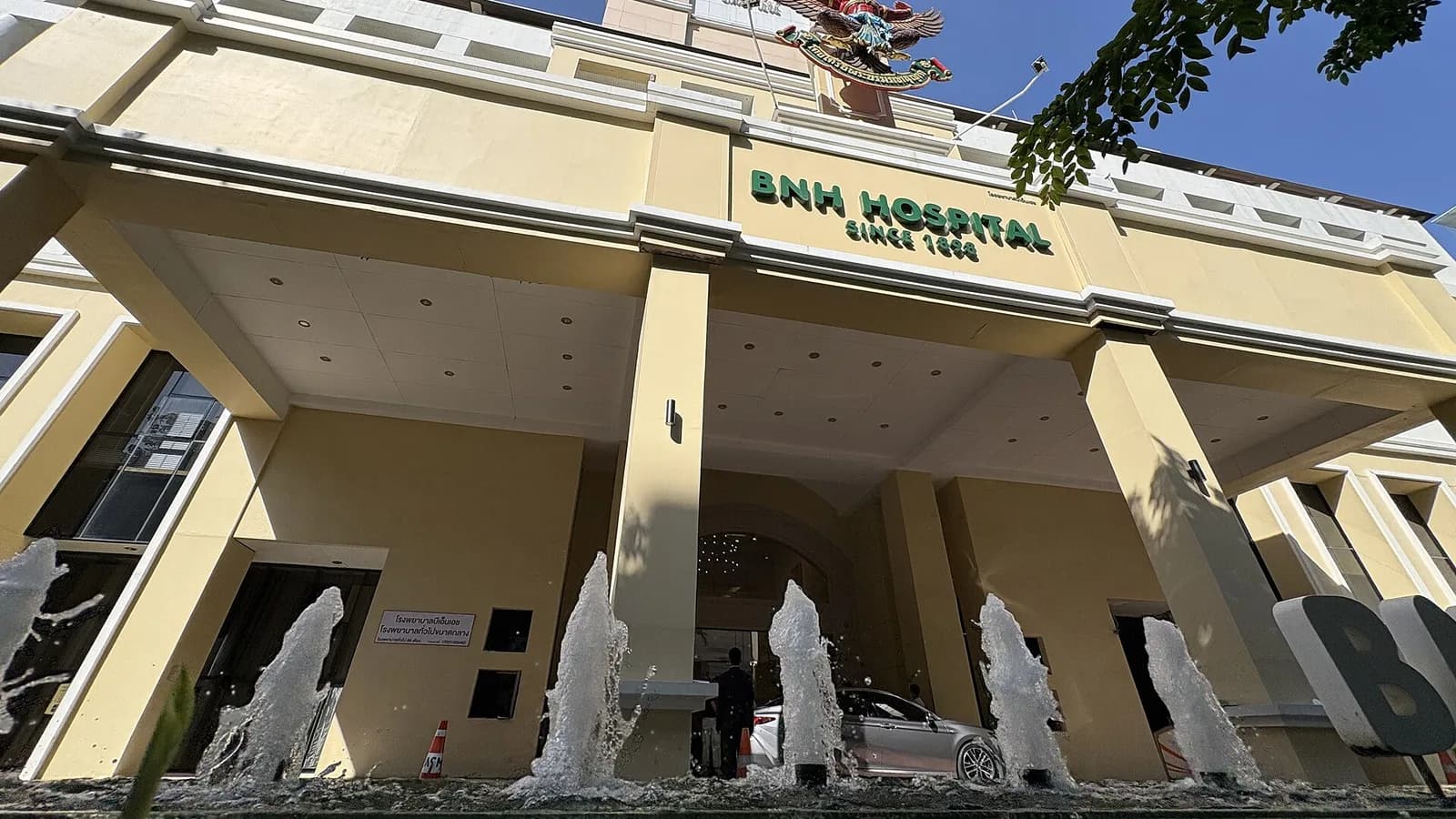
- BNH Hospital, Convent Road near Silom. Reported as JCI accredited by medical travel sites.
Bangkok also has the country's big teaching hospitals, Siriraj, King Chulalongkorn Memorial and Ramathibodi. Siriraj Piyamaharajkarun is the private wing of Siriraj.
Hospitals in Phuket
Bangkok Hospital Phuket has been JCI accredited since 2009, and its sixth cycle runs from 2025 to 2028. Bangkok Hospital Siriroj belongs to the same group. Vachira Phuket is the main public hospital on Phuket, and its director has reported about 10 million THB a year in unpaid bills from foreign patients.
Hospitals in Chiang Mai
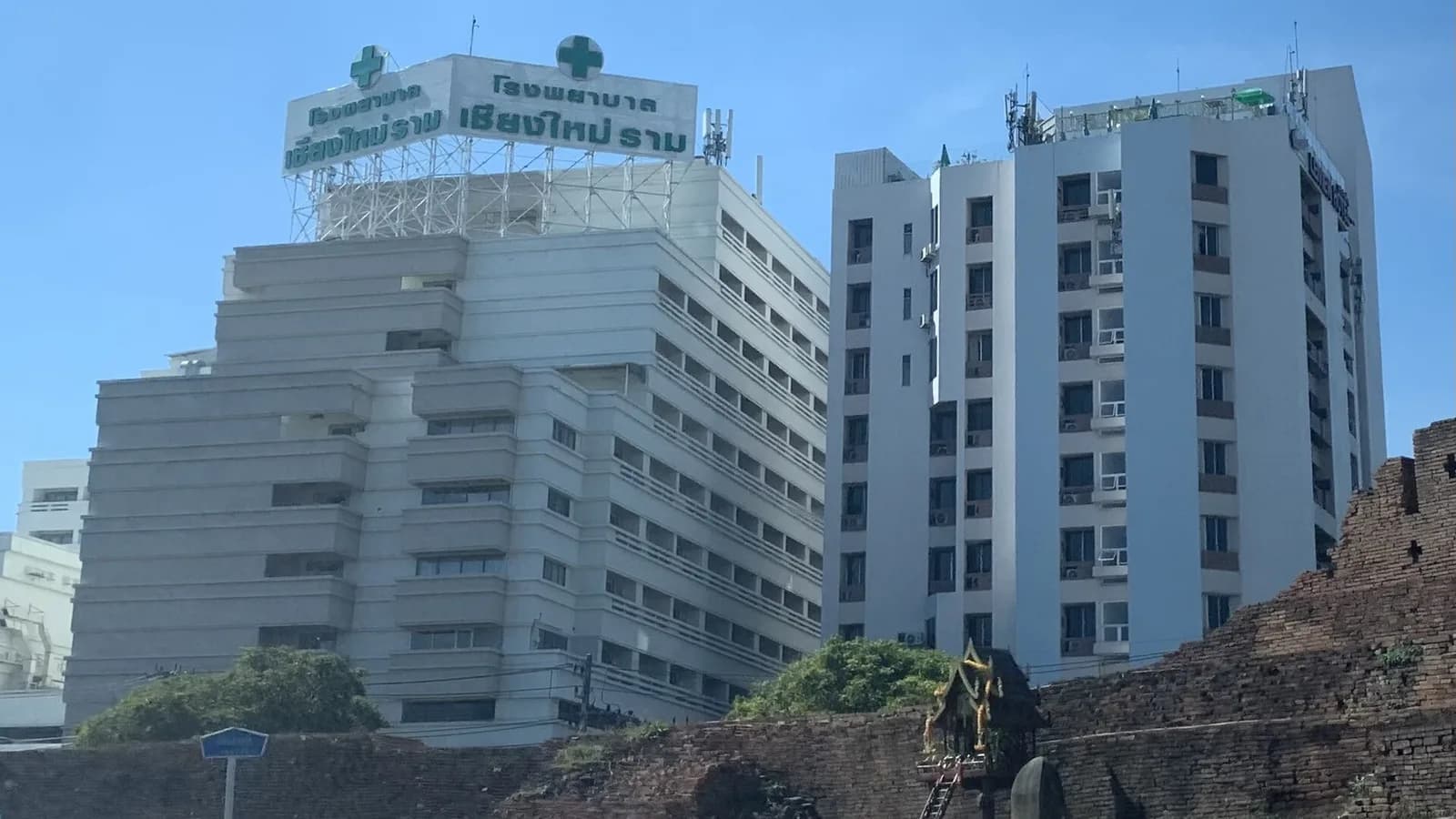
Bangkok Hospital Chiang Mai holds JCI accreditation for 2024 to 2027. Chiang Mai Ram, next to the old city, is reported to be the only other JCI accredited private hospital in Chiang Mai. The university's Maharaj Nakorn Chiang Mai Hospital is the large public option.
Hospitals in Pattaya and Hua Hin
Bangkok Hospital Pattaya lists JCI accreditation since 2022, and Bangkok Hospital Hua Hin since 1 March 2024. Both are retirement towns, and our comparison of the best places to live in Thailand weighs hospitals against rent and air quality.
| City | Private hospital | JCI status, as published |
|---|---|---|
| Bangkok | Bumrungrad International | Since 2002, 7th re-accreditation in 2024 |
| Bangkok | Bangkok Hospital | 6th accreditation |
| Bangkok | Samitivej Sukhumvit | Accredited, says the group |
| Bangkok | BNH Hospital | Reported, not on its own site |
| Phuket | Bangkok Hospital Phuket | 2025 to 2028 |
| Chiang Mai | Bangkok Hospital Chiang Mai | 2024 to 2027 |
| Chiang Mai | Chiang Mai Ram | Reported |
| Pattaya | Bangkok Hospital Pattaya | Since 2022 |
| Hua Hin | Bangkok Hospital Hua Hin | Since 1 March 2024 |
In Newsweek's World's Best Hospitals 2026, Bumrungrad came first in Thailand for the sixth year in a row and 96th worldwide. Samitivej Sukhumvit, King Chulalongkorn Memorial and Siriraj Piyamaharajkarun are reported among the next places.
Healthcare costs in Thailand in 2026
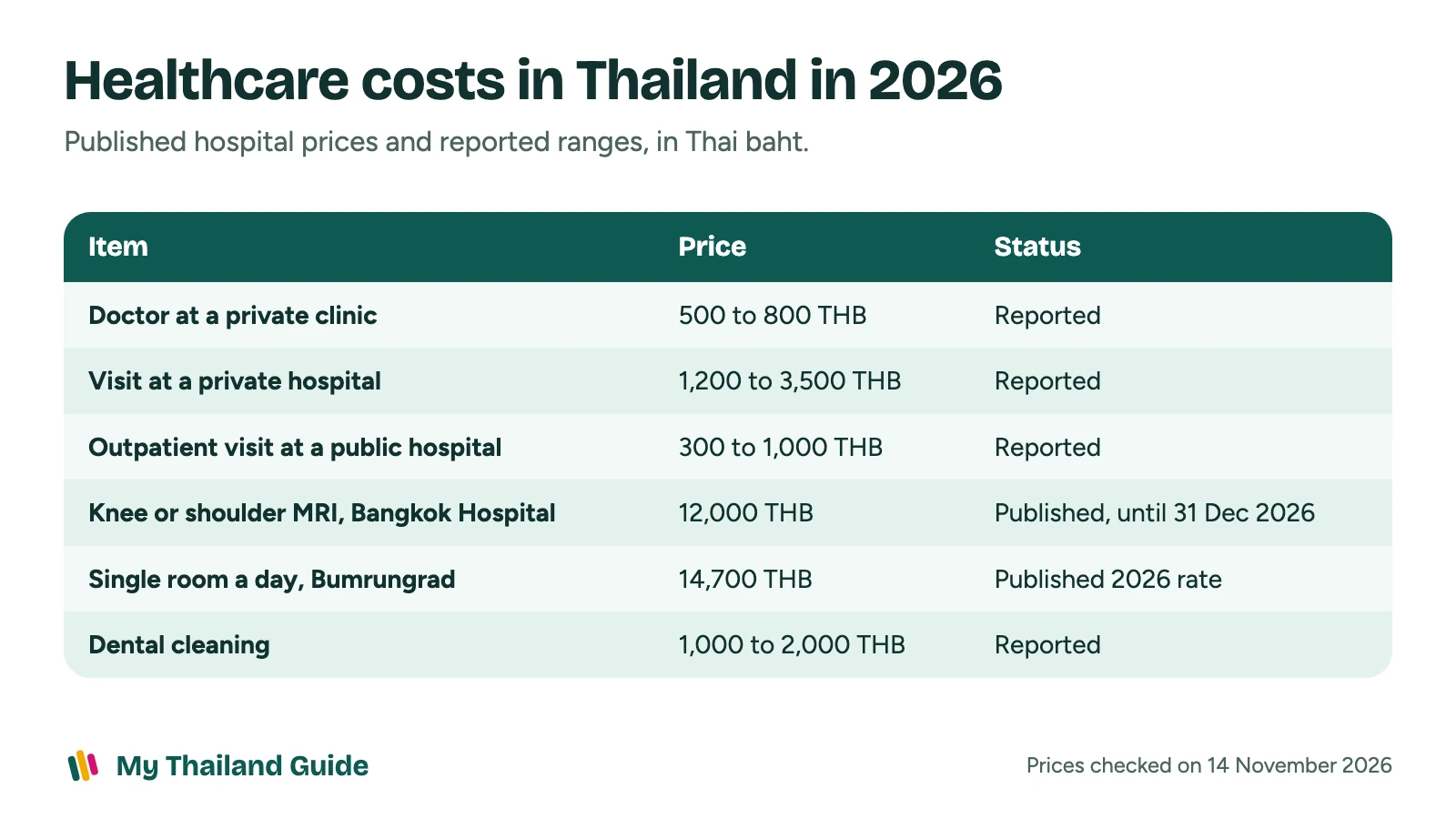
Few Thai hospitals publish a full price list. Bumrungrad publishes its room rates and Bangkok Hospital its scan packages. Consultation prices come from guides and patients, so they are marked as reported.
| Item | Price in THB | In USD | Source |
|---|---|---|---|
| Doctor at a private clinic | 500 to 800 | 15 to 24 | Reported |
| Specialist at a private clinic | 1,000 to 1,500 | 30 to 44 | Reported |
| Visit at a private hospital, all fees | 1,200 to 3,500 | 35 to 103 | Reported |
| Visit at a top private hospital | 2,000 to 6,000 | 59 to 177 | Reported |
| Outpatient visit at a public hospital | 300 to 1,000 | 9 to 30 | Reported |
| MRI of a knee or shoulder, Bangkok Hospital | 12,000 | 354 | Published, until 31 December 2026 |
| MRI of the spine, Bangkok Hospital | 13,500 to 15,900 | 399 to 470 | Published, until 31 December 2026 |
| Shared room for a day, Bumrungrad | 10,600 | 313 | Published 2026 rate |
| Single room for a day, Bumrungrad | 14,700 | 434 | Published 2026 rate |
| Intensive care bed for a day, Bumrungrad | 25,500 | 753 | Published 2026 rate |
Dollar amounts use 33.86 THB to the dollar. Bumrungrad's room rates cover the room, meals and nursing only, and the MRI packages include the radiologist's report but no further tests. Hospital stays are what turn a cheap health system into a large bill, and our guide to travel insurance for Thailand shows real cases.
For a monthly budget, health insurance is one line of the cost of living in Thailand, next to rent and food.
Pharmacies in Thailand and bringing your medicines
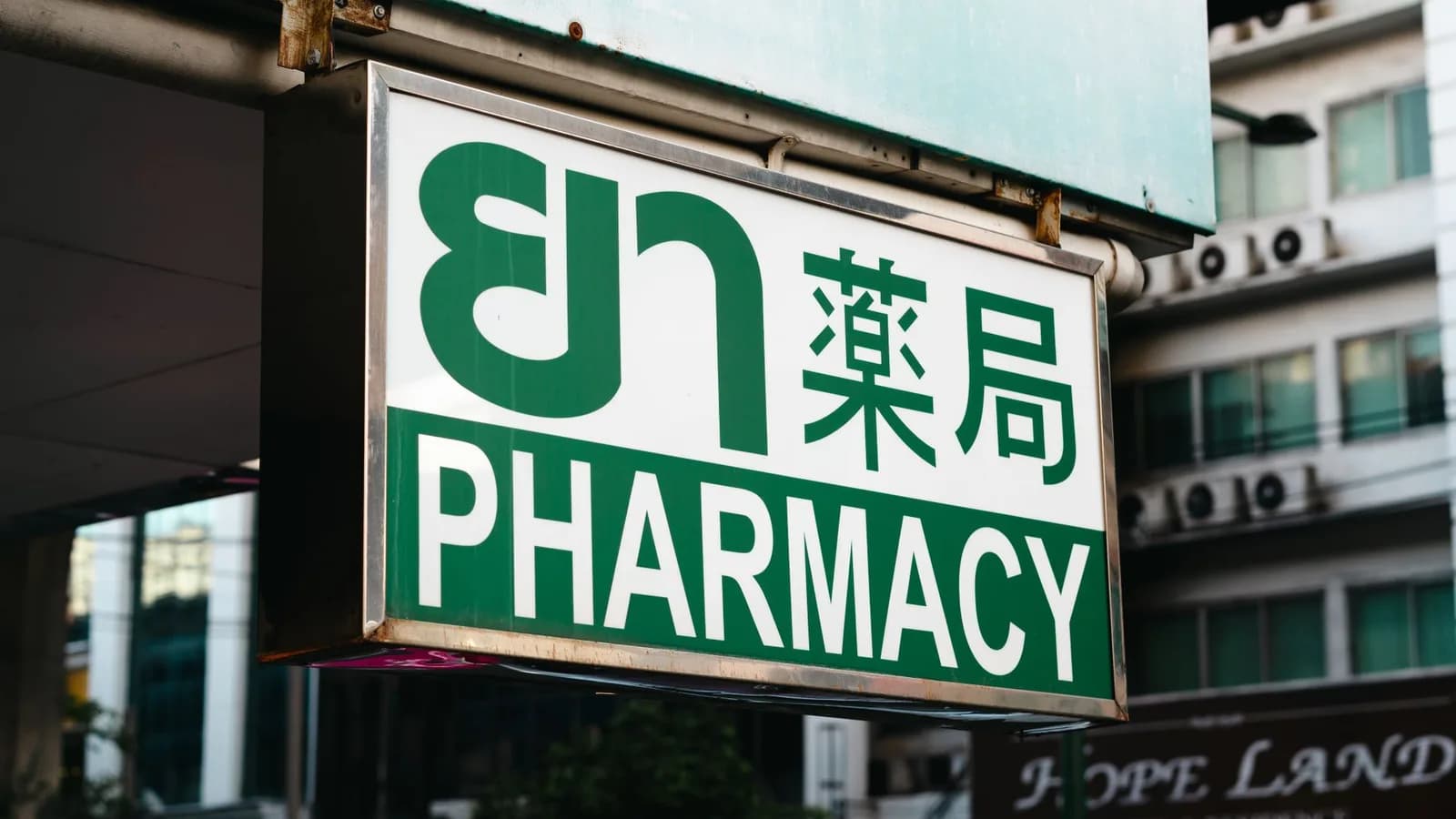
Pharmacies are everywhere in the cities, from chains such as Boots and Watsons to family shops marked ยา, the Thai word for medicine. Many pharmacists speak some English and many shops stay open late, but they are rarer in the countryside. Travel clinics in the big private hospitals also give the vaccinations for Thailand that newcomers often miss before leaving, such as rabies and Japanese encephalitis.
What you can buy without a prescription
Pharmacists sell many medicines that need a prescription in the US or the UK, common antibiotics included, at about 100 to 500 THB a course. Paracetamol costs under 50 THB. Private hospitals are reported to charge two to three times more for the same drugs. Sedatives, strong painkillers and other controlled drugs are dispensed by hospitals only.
Bringing prescription medicines into Thailand
- Ordinary prescription medicines. Up to 30 days of your prescribed use.
- Psychotropics, such as many sleeping pills and anxiety drugs. Up to 30 days with a prescription or a doctor's certificate. From 31 to 90 days you need a permit from the Thai Food and Drug Administration.
- Narcotic medicines in schedules II and III. Up to 90 days, with a permit.
- Banned outright. Amphetamine-based drugs such as Adderall are Category 1 narcotics in Thailand, and Thai embassies say no prescription makes them legal to bring.
Apply for the permit at least 15 days before you travel. The FDA says it usually issues it in about three working days. Declare the medicines at the red customs channel with the permit and the prescription.
Medical emergencies in Thailand: 1669 and private ambulances
Dial 1669 for the national emergency medical service, from any phone. Operators may not speak English. In Bangkok many first responders are volunteers from charities such as Poh Teck Tung and Ruamkatanyu.
- Bumrungrad ambulance: 02 011 5222, with English-speaking staff.
- Bangkok Hospital emergency: 1719 from a Thai mobile, or +66 2 310 3000.
- Tourist police: 1155, for help in English after an accident or theft.
Bangkok traffic slows every ambulance, so a taxi to the nearest emergency room is often faster for anything that is not life-threatening. Road accidents are the main risk for visitors, which our page on whether Thailand is safe covers in detail.
Dentists and medical tourism in Thailand
Thailand sells health care abroad on a large scale. Bumrungrad alone sees patients from more than 190 countries. Check-ups, dental work and cosmetic surgery are among the common reasons to come.
For dental care, a cleaning or a filling is reported at about 1,000 to 2,000 THB in a private clinic. Ask for a written quote that lists each tooth and material, and plan time to recover before a long flight after surgery or implants.
Language, interpreters and mental health care in Thailand
English is the working language of the international desks in large private hospitals. Bumrungrad lists more than 130 interpreters, and its FAQ says the service is free. In public hospitals and outside the cities, bring a Thai speaker or a written translation of your history and medicines.
For mental health, the Department of Mental Health runs 1323, a free hotline open 24 hours a day, in Thai.
Health insurance in Thailand for expats and travellers
Insurance is what decides which hospital you can afford. For a holiday it is not required, and travel insurance covers the trip. For residents, the rules depend on the visa.
- O-A retirement visa: compulsory cover of at least 3,000,000 THB or 100,000 USD. The Thai retirement visa guide explains which policies consulates accept.
- O-X visa: the same amount, from a Thai insurer only.
- Employees: social security covers the registered hospital. Many add private cover for other hospitals.
- Everyone else: local Thai policies cover Thailand only, international policies also cover trips home, and the costs by age are compared in expat health insurance in Thailand.
Buy cover before you move, while your medical history is still on file at home, and check the age limit for new customers. Health cover is also one of the steps of moving to Thailand.
In this section
 Sry85, CC BY-SA 4.0, via Wikimedia Commons
Health insurance in Thailand for expats in 2026: O-A, O-X and LTR visa rules, social security, local or international plans and yearly costs by age.
 Paul_012, CC BY-SA 3.0, via Wikimedia Commons
Thailand vaccinations in 2026: none required except yellow fever, what the NHS and CDC advise, dengue and rabies figures, and prices in the UK and Bangkok.