Health insurance in Thailand is compulsory for only a few long-stay visas: the O-A and O-X retirement visas need 3,000,000 THB of cover and the LTR needs 50,000 USD. Everyone else may live without it, but private hospitals ask for a guarantee of payment before they treat you. Expats choose between Thai social security, a local Thai policy and an international plan. Rules and prices were checked on 14 November 2026.
SafetyWing expat health insurance in Thailand: Essential or Complete
Essential is travel medical cover for stays of up to 364 days. Complete is a yearly health plan that also works in your country of residence, open to new customers aged 18 to 64. SafetyWing does not guarantee that either plan meets a visa requirement, and neither covers conditions you already have.
Nomad Insurance Essential
- Best for
- Remote workers and long-stay travellers up to age 69
- Duration
- 5 to 364 days, paid monthly
- Medical cover
- Up to 250,000 USD overall
- Good to know
- Conditions you already have are not covered
Nomad Insurance Complete
- Best for
- People living abroad, aged 18 to 64 when they sign up
- Duration
- 12-month commitment, renewable
- Medical cover
- Up to 1,500,000 USD a year
- Good to know
- Acceptance subject to approval, conditions you already have are not covered
Cover and age limits read on safetywing.com on 14 November 2026.
Is health insurance mandatory in Thailand? Rules by visa
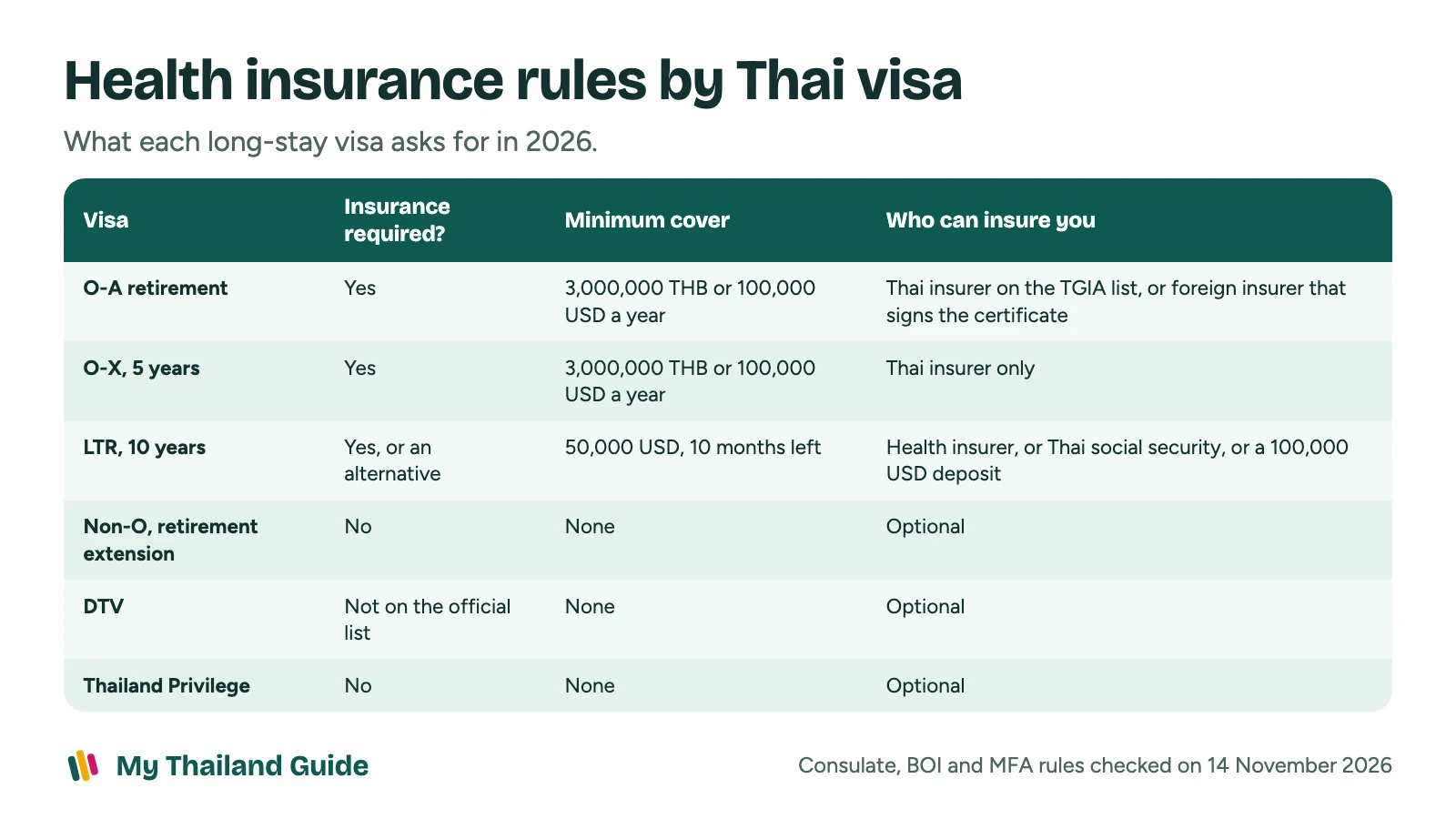
Not for most people. Tourists on the visa exemption, holders of the DTV visa for remote workers and Thailand Privilege members are not asked for a policy. Three visas are different, and their rules are often misquoted online.
O-A retirement visa: 3,000,000 THB a year
Since 1 October 2021, the policy must cover your whole stay for at least 3,000,000 THB or 100,000 USD per policy year, Covid-19 included. Insurer guides that still quote 40,000 THB for outpatient care and 400,000 THB for hospital care describe the old rule. A large international insurer's Thailand page goes further and says every visitor needs 100,000 USD of cover, which is not the case in 2026.
The policy can come from a Thai insurer on the official long-stay list, or from a foreign insurer that fills in and stamps the consulate's Foreign Insurance Certificate. A guide updated in August 2026 reports that the same amount is now checked at the yearly extension in Thailand. The full procedure is on our page about the Thai retirement visa.
O-X visa: a Thai insurer only
The five-year O-X asks for the same 3,000,000 THB or 100,000 USD in the Los Angeles consulate's rules, and only a Thai insurer is accepted. Some guides still give 400,000 THB inpatient and 40,000 THB outpatient for this visa, so confirm the amount with the consulate that handles your file.
LTR visa: 50,000 USD, social security or a deposit
The Board of Investment asks LTR applicants for health insurance of at least 50,000 USD for hospital and medical treatment in Thailand, with at least 10 months of cover left. Travel insurance and life insurance without health cover are refused. Two alternatives are accepted: Thai social security that covers your treatment, or a deposit of 100,000 USD held for 12 months, plus 25,000 USD per dependant.
The DTV's official checklist does not ask for insurance, although some embassies are reported to request it. Our travel insurance guide for Thailand covers short stays and the 450 THB tourist fee still under discussion.
Thai social security for foreigners: who is covered
Thai social security is for people who work in Thailand. A foreigner employed with a work permit is enrolled under Section 33, and the employer must register them within 30 days of hiring. Employee and employer each pay 5% of the salary.
- Contribution. The salary used for the calculation is capped at 17,500 THB since 1 January 2026, so the most you pay is 875 THB a month. The cap rises to 20,000 THB in 2029.
- Treatment. Routine care goes through the hospital you are registered with and its referral network.
- After a job ends. With at least 12 months of contributions, you can stay in the scheme under Section 39 for about 432 THB a month if you apply within six months.
- Retirees and remote workers. A foreign passport or an LTR visa alone does not give access to Section 40, the scheme for the self-employed. The free 30-baht scheme is for Thai citizens.
A private plan on top of social security buys the choice of hospital. If you are looking for a job in Thailand, ask whether the employer adds group health insurance, which is the type of policy most likely to cover a condition you already have.
Local Thai or international health insurance: the options for foreigners
Outside social security, an expat buys either a local Thai policy or an international plan. Thai insurers that sell to foreigners include Pacific Cross, Thai Health Insurance, AIA, Muang Thai and Bangkok Insurance. International plans come from insurers based abroad.
| Social security | Local Thai policy | International plan | |
|---|---|---|---|
| Who can join | Employees with a work permit | Residents, within age limits | Residents, within age limits |
| Where it covers | Your registered hospital and its network | Thailand, sometimes neighbouring countries | Thailand, Asia or worldwide, by option |
| Accepted for the O-A | No | Yes, if the insurer is on the TGIA list | Only with the signed certificate |
| Accepted for the O-X | No | Yes | No |
| Policy language | Thai | Often Thai, some in English | English |
| Price | 5% of salary, 875 THB a month at most | Lower when you are young | Higher, with more cover abroad |
Brokers describe four usual coverage areas: Thailand only, Southeast Asia without Singapore, worldwide without the US, and worldwide with the US. Each step up costs more. If you fly home every year, check how long a plan covers you there.
How much health insurance costs in Thailand by age
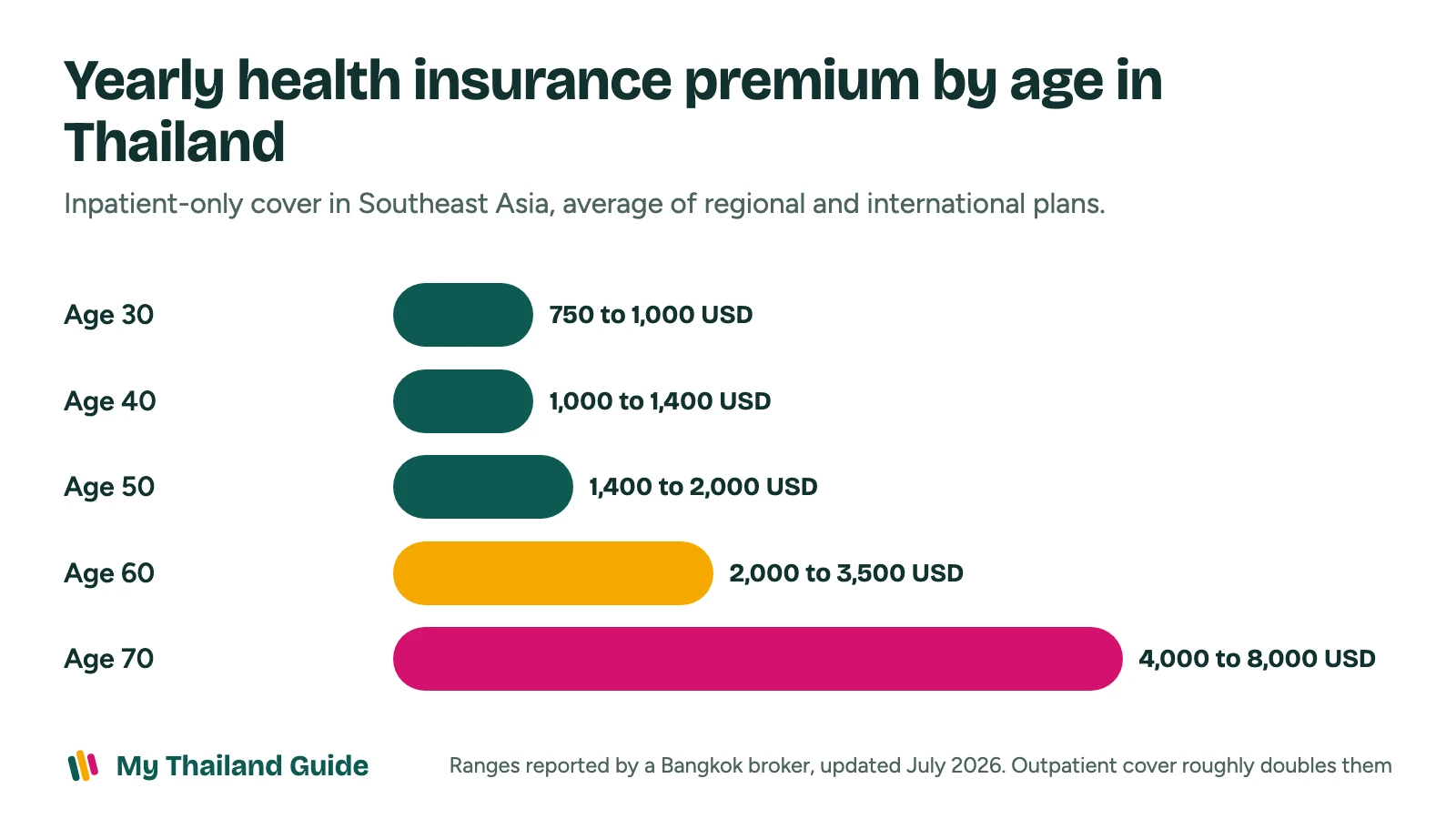
Age sets the price more than anything else. A Bangkok broker that works with more than 40 insurers published these averages in July 2026, for hospital-only cover in Southeast Asia. It adds that outpatient cover roughly doubles the premium.
| Age | Regional or international plan, hospital only | Local Thai plan, reported |
|---|---|---|
| 30 | 750 to 1,000 USD | 15,000 to 30,000 THB |
| 40 to 45 | 1,000 to 1,400 USD | 25,000 to 50,000 THB |
| 50 | 1,400 to 2,000 USD | About 25,000 THB in one example |
| 60 | 2,000 to 3,500 USD | 50,000 to 100,000 THB and more |
| 70 | 4,000 to 8,000 USD | Often not available |
Yearly premiums. The local column comes from an insurer's April 2026 guide, which gives a policy at 25,000 THB at 50 that can reach 80,000 THB or more at 60. At 33.86 THB to the dollar, 2,000 USD is about 67,700 THB. These are indications, and your own quote depends on health, deductible and coverage area.
SafetyWing publishes some of its prices. Complete costs 177.50 USD a month from 18 to 39, about 2,130 USD a year with outpatient care included. Essential costs 62.72 USD for four weeks between 10 and 39.
What going uninsured costs
Bumrungrad International charges 10,600 THB a day for a shared room and 14,700 THB for a single since 1 January 2026, before doctors, tests and surgery. An intensive care bed is 25,500 THB a day. Health cover belongs in the cost of living in Thailand from the first month, next to rent.
Health insurance in Thailand for retirees and over 60s
Age limits hit retirees hardest. Several 2026 sources say many Thai insurers stop taking new customers between 60 and 65, and fewer still accept them past 70. Buying before 60 and keeping the policy is the safest route.

- SafetyWing. Complete takes new customers up to 64 and is then renewable for life. Essential can be bought up to 69, but it is travel cover of up to 364 days at a time.
- Thai insurers with higher limits. Pacific Cross states a new entry age of up to 80 with guaranteed renewal to 99, and says its Premier Plus plan meets the 3,000,000 THB O-A minimum.
- International insurers. Some advertise no upper age for new customers. Read the renewal terms, not only the entry age.
A retiree on the Non-Immigrant O route, extended each year in Thailand, has no insurance requirement. Going without cover after 60 means paying hospital bills from savings, while the 800,000 THB held for the visa has to stay in the bank.
What expat health insurance in Thailand does not cover
- Conditions you already have. SafetyWing excludes any illness or injury for which you were treated or diagnosed in your life. Other insurers may accept a condition as normal, add a surcharge, exclude it, or refuse you. Pacific Cross says such conditions are usually excluded at the start.
- Motorbikes. SafetyWing Complete pays after a motor accident only if you are properly licensed, wear the safety equipment and are not intoxicated. On Essential, a scooter over 50cc needs the Adventure Sports add-on.
- Maternity. Complete pays up to 2,500 USD after a 10-month waiting period. Essential does not cover it.
- Your home country. Essential covers it only for short visits. Complete covers your country of residence, subject to SafetyWing's list of eligible countries.
Deductibles and co-payments
Many plans let you lower the premium by paying the first part of each claim or each year yourself. A broker in Bangkok describes the trade-off, and Pacific Cross offers annual deductibles as an option. A deductible makes sense for hospital-only cover, less so if you see a doctor often.
Direct billing at Thai private hospitals and how claims work
With direct billing, you show your card and the hospital bills the insurer. Pacific Cross reports a cashless network of over 550 hospitals in Thailand. Without it, you pay and claim the money back.
Brokers list the usual problems:
- direct billing often covers hospital stays but not outpatient visits
- the insurer's confirmation of cover can take time to reach the hospital
- some hospitals keep a credit card on file even with direct billing
SafetyWing works by reimbursement and, on Complete, a prepaid debit card for eligible medical costs up to its limit. Keep itemised bills, the medical report and proof of payment for every visit.
How to choose the best expat health insurance in Thailand
- Start with your visa. O-A, O-X or LTR set a minimum and sometimes the type of insurer. Check before you compare prices.
- Check the age you can renew until. A cheap plan that ends at 65 leaves you looking for cover when it is hardest to find.
- Declare your health history. Ask for the exclusions in writing before you pay.
- Ask your hospital which insurers it bills directly. It matters more than the brand.
- Pick the coverage area you need. Thailand only is cheaper, worldwide suits people who travel or may move on.
- Set the deductible against your savings. Pay small bills yourself and insure the large ones.
If you pay Thai income tax, premiums on your own health policy from an insurer operating in Thailand can be deducted up to 25,000 THB a year, within a 100,000 THB limit shared with life insurance. Hospital quality and insurance prices also differ between the places expats settle in Thailand, so ask for quotes once you know where you will live.