Foreigners can take jobs in Thailand on two conditions: the occupation is not reserved for Thai nationals, and a Thai employer sponsors a Non-Immigrant B visa and a work permit. In practice that points to teaching, specialist and management roles, and transfers within international companies. This page covers the permit, the forbidden jobs, the salary immigration expects, and what tax and social security take.
Jobs in Thailand for foreigners: what is open to you
- Teaching English. The largest employer of foreigners, from government schools to international schools.
- Specialist and management roles in Bangkok, in technology, finance, engineering, law and regional head offices.
- Company transfers. The best-paid expatriate jobs are filled by people sent by their employer, on a package negotiated at home.
- Tourism and hospitality, with diving instruction and liveaboard work around Koh Tao, Koh Phi Phi and Krabi, where the diving qualification can be earned on the spot.
- Property, recruitment and sales aimed at foreign customers.
- Your own company, which is subject to the same capital and staffing rules as any other employer.
Remote work for employers outside Thailand is a different case. It needs no work permit and is covered by the DTV visa.
Thailand work visa and work permit: how it works
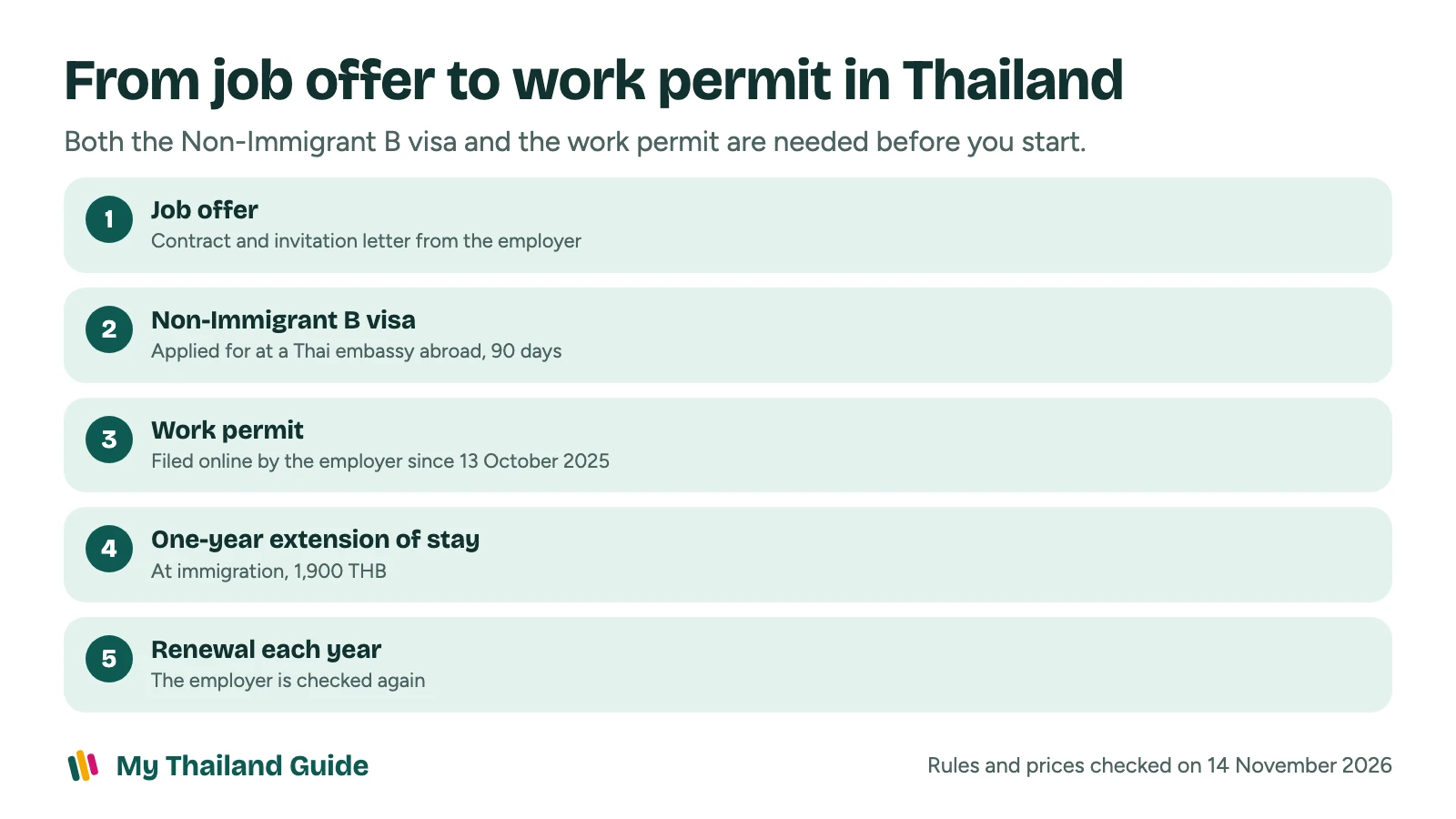
- Job offer. The employer issues a contract and an invitation letter.
- Non-Immigrant B visa, applied for on the Thailand e-Visa portal through a Thai embassy or consulate abroad. It gives 90 days. Washington charges 80 USD for a single entry, and the fee is reported at 2,000 THB elsewhere.
- Work permit, applied for by the employer once you are in Thailand. Since 13 October 2025 applications go through the online e-WorkPermit system, with a visit to a service centre for biometrics.
- One-year extension of stay at immigration, for 1,900 THB, tied to the job.
- Renewal each year, when the employer's situation is checked again.
What the employer must show
Under the standard rules reported by law and payroll firms, a company needs 2,000,000 THB of paid-up capital and four Thai employees registered with social security for each foreign work permit, checked again at each renewal. Companies promoted by the Board of Investment and holders of the LTR visa are exempt from the four-to-one ratio.
The work permit fee is reported at 3,000 THB for a permit of six to twelve months. Sources differ on processing: one gives 7 to 10 working days in Bangkok and 10 to 12 in the provinces, another 3 to 7 working days, and the whole process is put at four to eight weeks. The permit is tied to the employer that applied for it.
A temporary work permit, the WP.62, took effect on 1 July 2026, but an immigration law firm wrote on 30 September 2026 that it was not yet operational. Do not count on it.
Jobs foreigners cannot do in Thailand
The Ministry of Labour publishes a list of 39 occupations reserved for Thai nationals. The ones that matter to most readers:
- manual labour, and work in farming, forestry and fishing, apart from specialist or supervisory roles
- construction trades such as bricklaying and carpentry
- driving vehicles
- shop sales and street vending
- hairdressing and beauty treatments
- accounting, apart from occasional internal audit
- tour guiding
- traditional crafts, from wood carving to silk weaving
Workers from Cambodia, Laos and Myanmar are allowed manual and domestic work under separate agreements. Later regulations have reorganised the list, and sources describe versions of 40 and of 20 occupations. Law firms say exceptions are examined case by case for skills Thai candidates lack, so an employer should confirm with the Department of Employment before hiring.
Minimum salary for a foreigner on a work visa
The work permit itself sets no salary floor. Immigration applies one when it extends your stay for a year, and it depends on your nationality.
| Nationality | Monthly salary expected | In US dollars |
|---|---|---|
| US, Canada, Western Europe, Australia, Japan | 50,000 THB | $1,477 |
| Hong Kong, South Korea, Singapore, Taiwan | 45,000 THB | $1,329 |
| Other Asian countries outside ASEAN, Eastern Europe, South Africa, Latin America | 35,000 THB | $1,034 |
| Cambodia, Laos, Myanmar, Vietnam, other African countries | 25,000 THB | $738 |
Scale published by a business services firm in 2026. We could not read the immigration order itself, and other guides differ: one from 2022 gives 60,000 THB for the US, Canada and Japan, another puts Korea, Taiwan, Hong Kong and Singapore at 50,000 THB. Ask the employer which figure its immigration office applies. For comparison, the average Thai wage is 15,700 to 16,000 THB a month.
Sectors hiring foreigners, BOI companies and the LTR visa
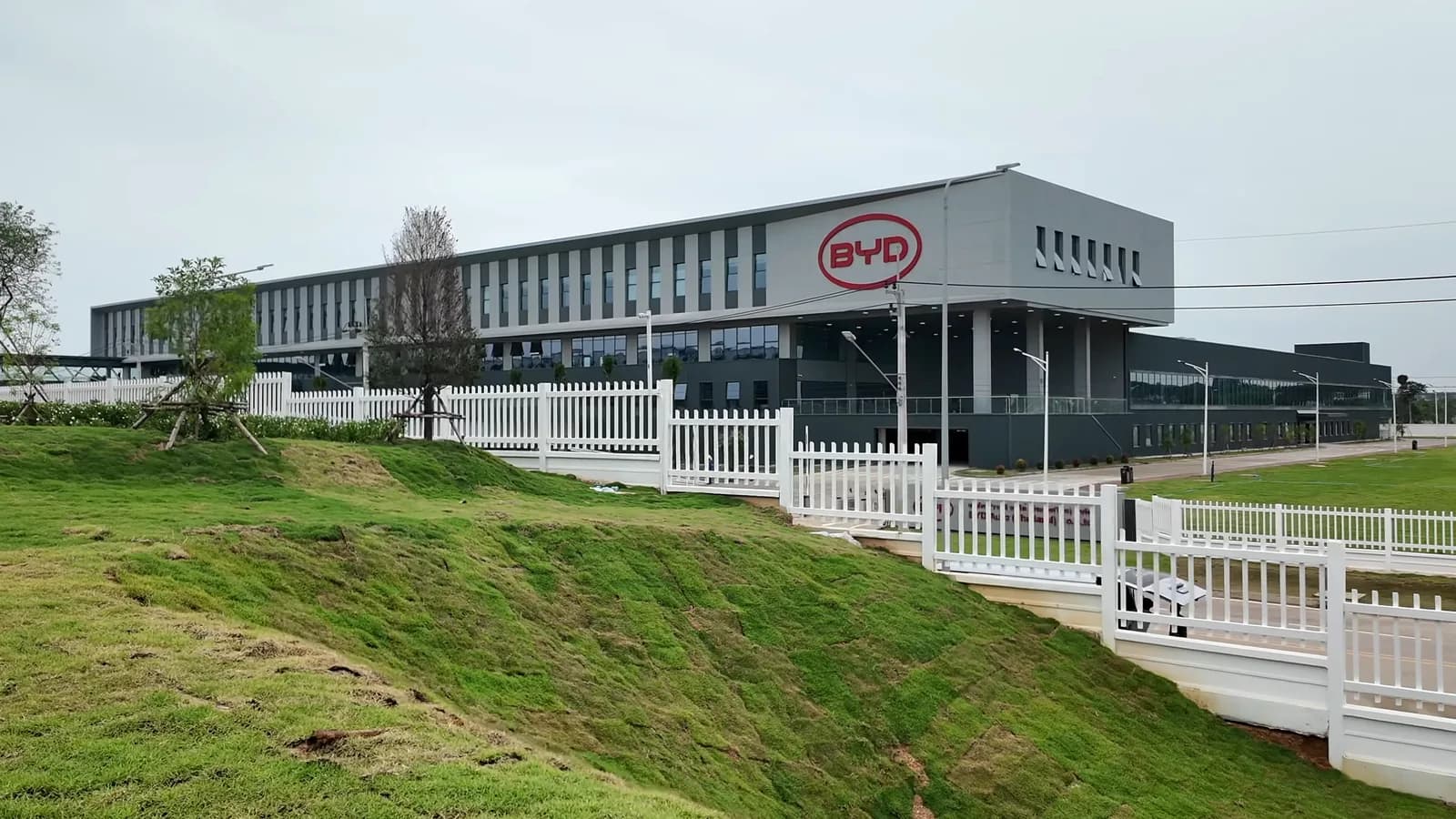
A Bangkok recruiter rates demand in 2026 as very high in AI and data, technology, and electric vehicles and automotive, and high in renewable energy, finance, legal, engineering and healthcare. A summary of the Robert Walters 2026 salary survey reports that two thirds of Thai companies say they face a skills shortage.
Companies promoted by the Board of Investment hire foreigners outside the capital and ratio tests, but must now show minimum monthly pay by role: 150,000 THB for an executive, 75,000 THB for a manager and 50,000 THB for an engineer or IT specialist. The thresholds apply from 1 October 2025, or 1 January 2026 for older certificates.
For senior profiles, the LTR visa for highly skilled professionals lasts ten years, costs 50,000 THB and comes with a digital work permit and a flat 17% income tax. It requires an income of 80,000 USD a year on average over two years, or 40,000 to 80,000 USD with a master's degree in science or technology, and a contract in a targeted industry. Keeping the digital work permit costs 3,000 THB a year.
Where to find jobs in Thailand
- Job boards. JobsDB, LinkedIn and Indeed. On 14 November 2026, LinkedIn showed more than 10,000 adverts for Thailand and Indeed about 700.
- Recruitment firms with Bangkok offices, such as Robert Walters, Michael Page, Adecco and JAC Recruitment.
- Ajarn.com for teaching jobs.
- Chambers of commerce, including the American and British chambers in Bangkok, for networking. Some employers do not advertise, so unsolicited applications are worth sending.
- Your current employer. The highest-paying expatriate jobs are found through transfers from abroad. Negotiate the salary in your home currency or in dollars.
Income tax and social security when you work in Thailand
| Net taxable income per year | Tax rate |
|---|---|
| Up to 150,000 THB | Exempt |
| 150,001 to 300,000 THB | 5% |
| 300,001 to 500,000 THB | 10% |
| 500,001 to 750,000 THB | 15% |
| 750,001 to 1,000,000 THB | 20% |
| 1,000,001 to 2,000,000 THB | 25% |
| 2,000,001 to 5,000,000 THB | 30% |
| Over 5,000,000 THB | 35% |
Tax guides state that employment income is reduced by an expense allowance of 50%, capped at 100,000 THB, and a personal allowance of 60,000 THB before the scale applies. On a salary of 50,000 THB a month, tax comes to about 1,800 THB a month. On 100,000 THB it is about 10,400 THB.
Social security costs the employee 5% of salary, capped since 1 January 2026 at 875 THB a month on a wage ceiling of 17,500 THB, and the employer pays the same. The ceiling is set to rise to 20,000 THB in 2029 and 23,000 THB in 2032. You become a Thai tax resident after 180 days in the country in a calendar year.
In this section

Teach English in Thailand with a degree and a TEFL: salaries from 25,000 THB a month by school type, Non-B visa, work permit, licence and hiring seasons.
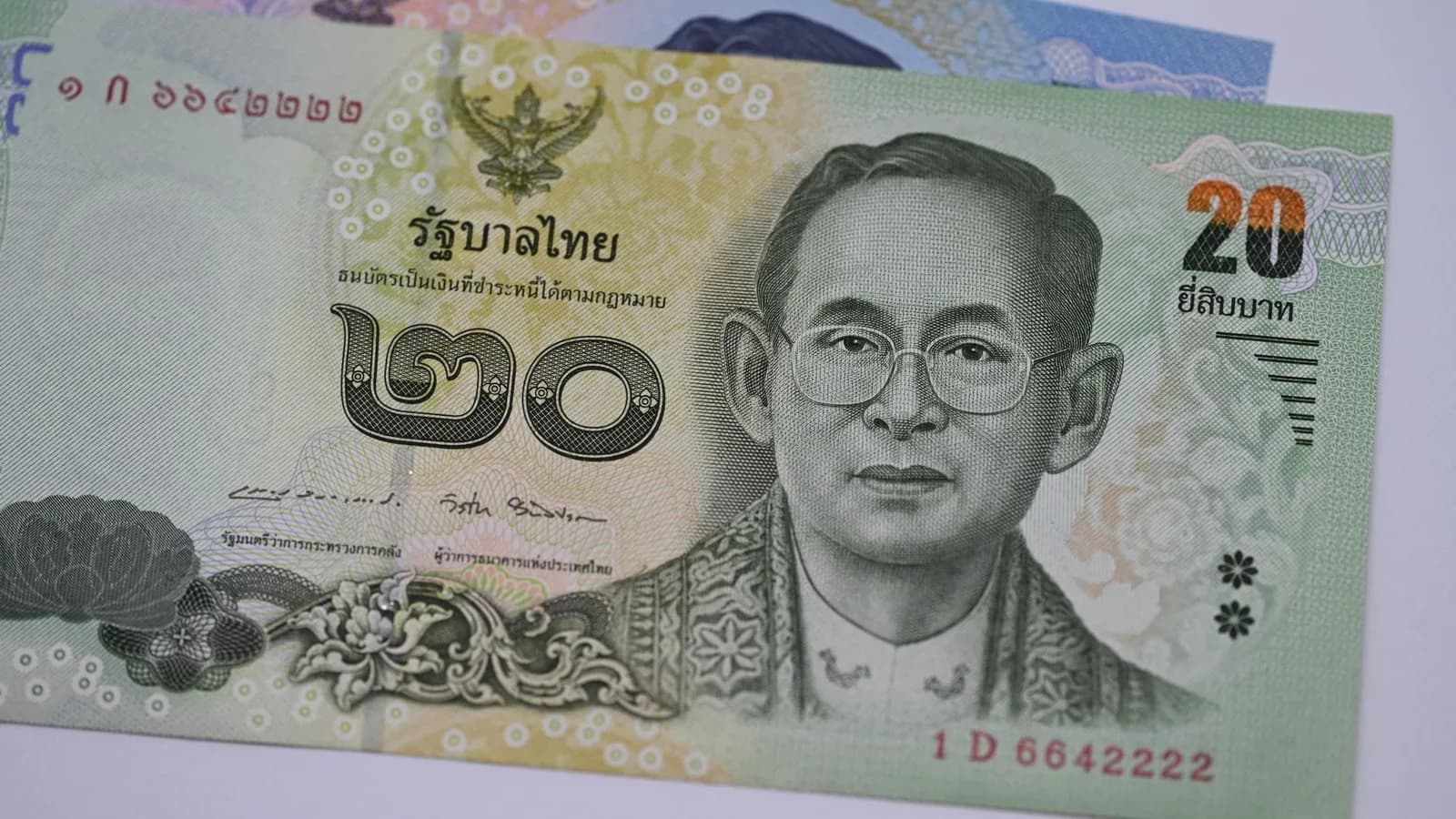
The average salary in Thailand is about 15,900 THB a month, around 470 USD. Minimum wage by province, pay by job, Bangkok vs provinces and take-home pay.