You can open a bank account in Thailand as a foreigner if you live there on a non-immigrant visa, a retirement extension, an LTR visa or a Thailand Privilege membership. As a tourist you almost certainly cannot. Banks closed that door in 2025 to fight scam accounts, and they now want a Thai address and a Thai phone number in your name. Rules below were checked on bank and official pages on 14 November 2026.
Can a foreigner open a bank account in Thailand in 2026?
Yes, but the visa decides everything. A Thailand bank account for foreigners is open to people who hold a long-stay status. Work, retirement, marriage, study, LTR and Thailand Privilege are the usual ones. Banks then look at where you live and why you need the account.
Can a tourist open a bank account in Thailand?
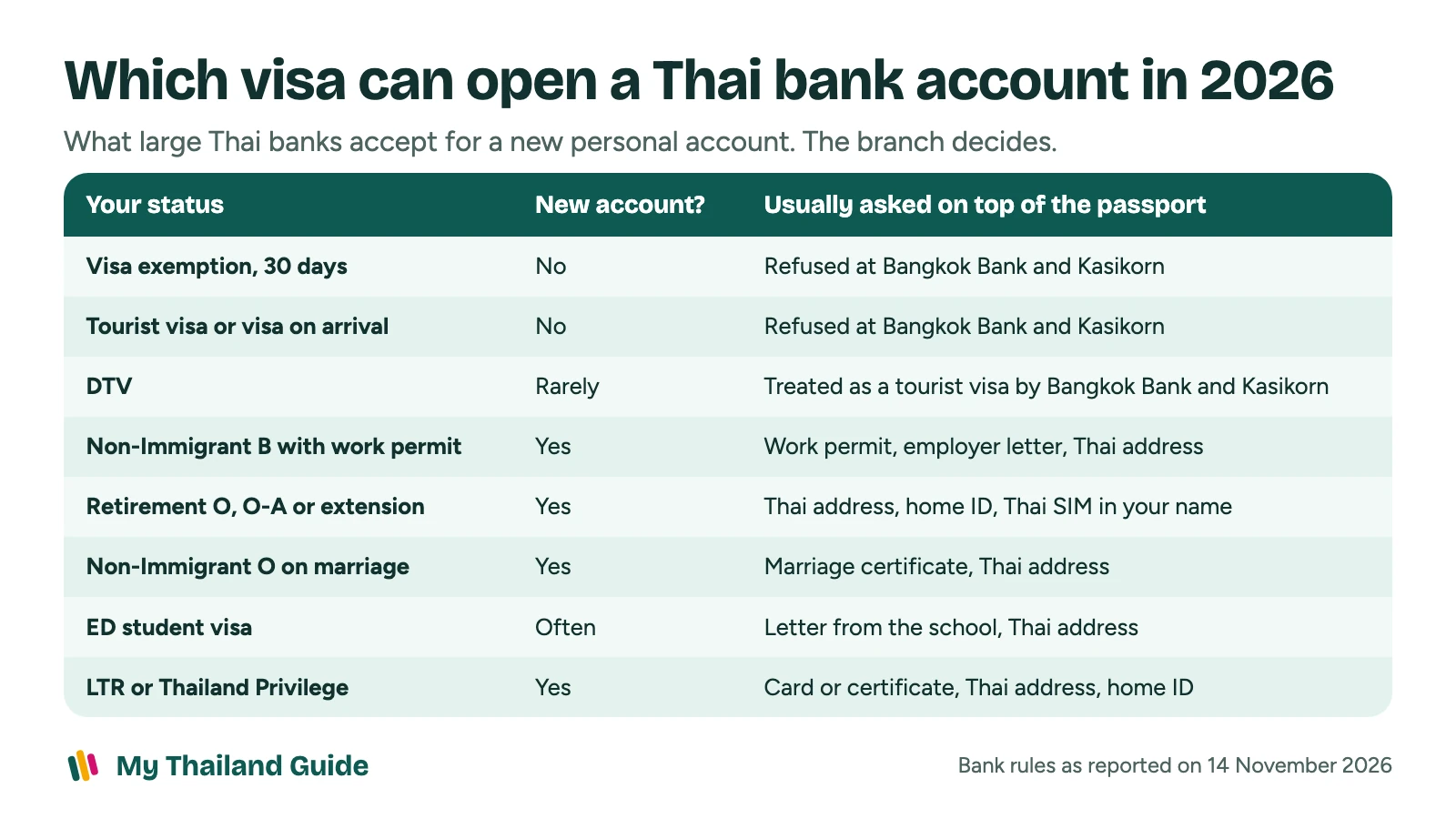
No, at the large banks. Kasikorn writes it in its rules for foreigners: no account for a tourist visa, visa on arrival, visa exemption or DTV. Bangkok Bank told the Russian agency TASS in May 2025 that it had stopped opening accounts for tourists in January 2025. Pages that still say a tourist can open a savings account with a passport describe the situation before that date.
The visa-free stay of 30 days is for tourism only, which is exactly the profile banks now turn away. A visitor is better served by a foreign debit card with low fees, a multi-currency account such as Wise or Revolut, or cash in Thai baht.
Opening a Thai bank account with a DTV visa
This is the case that surprises remote workers. The DTV visa lasts five years, but Bangkok Bank and Kasikorn both treat it as a tourist category and refuse new accounts on it. A few branches of other banks are reported to accept a DTV holder with a long lease. Nothing is guaranteed, so plan your money without a Thai account if the DTV is your only status.
Documents to open a bank account in Thailand, by visa
Every bank starts with the same core file. Bring originals and one copy of each, signed:
- Passport with the current visa or extension stamp.
- Proof of your status: work permit, retirement extension, LTR visa, Thailand Privilege card or a letter from your school.
- ID from your home country, such as a driving licence or national ID card. Kasikorn and Bangkok Bank both list it.
- Proof of a Thai address in your name. Hotel addresses and PO boxes are refused.
- A Thai mobile number registered in your name, ideally with a bill or certificate from the operator.
- An opening deposit, usually about 500 THB for a savings account.
| Your situation | Extra documents banks ask for |
|---|---|
| Employee on a Non-Immigrant B | Work permit, employment contract or employer letter with your salary |
| Retiree on an O, O-A or yearly extension | Proof of address, home-country ID, sometimes a reference letter from your home bank |
| Married to a Thai national | Marriage certificate, proof of address |
| Student on an ED visa | Letter from the school or university, proof of address |
| LTR visa holder | BOI certificate, home-country ID, proof of address with a recent utility bill |
| Thailand Privilege member | Membership card or certification letter, proof of residence, home-country ID |
These lists come from Kasikorn's published rules, the BOI page for LTR holders and the Thailand Privilege guide of May 2026. An embassy letter on its own no longer carries much weight, according to Pattaya Mail's April 2026 report on branch practice. Banks may also ask where your money comes from.
Certificate of residence and Thai address
The easiest proof is a lease in your name, ideally for a year or more, with a recent utility bill. Without one, ask the immigration office for a certificate of residence. It is issued against the TM30 address report that your landlord or hotel must file first.
Bangkok Bank goes further for LTR holders. It refuses TM6 and TM30 forms as proof, refuses a lease when the purpose is retirement and asks you to open in the same city as your registered address. A title deed or house registration (Tor Ror 14) is accepted by both Bangkok Bank and Kasikorn.
Which Thai bank is best for foreigners?
The best bank is the one with a branch near your home whose staff accept your visa. Only Kasikorn publishes a full list for foreigners. The others leave it to the branch, so a refusal at one branch says little about the next.
| Bank | Rules for foreigners | Tourist or DTV | App |
|---|---|---|---|
| Bangkok Bank | Decided at the branch, LTR list published by the BOI | Refused since January 2025 | Bangkok Bank Mobile Banking |
| Kasikorn (KBank) | Published: passport, non-immigrant visa, home ID, proof of purpose | Refused in writing | K PLUS |
| SCB | Decided at the branch, Thai mobile number needed for the app | Reported refused | SCB EASY |
| Krungsri | Decided at the branch, no English list found | Reported refused | Krungsri app (KMA) |
| Krungthai | Decided at the branch, no English list found | Reported refused | Krungthai NEXT |
| TTB | Face data taken at the branch, app transfers capped for foreigners | Reported refused | ttb touch |
All six apps have an English interface. The real differences are the documents and how you use the account. TTB caps transfers in ttb touch at 49,999 THB a day for foreign customers since 8 July 2025, which matters if you pay rent or tuition from the app. Larger payments go through a branch or an ATM.
Bangkok Bank account for a foreigner
Bangkok Bank is the largest Thai bank and the one with the most branches abroad, which made it the expat default. Since 2025 it only opens accounts for foreigners with a long-stay visa, a Thai spouse or property in Thailand, according to statements reported by the Thai press. Expect to show proof of address, a phone bill in your name and one document that explains why you need the account.
Kasikorn bank account for a foreigner
Kasikorn asks for a passport, a non-immigrant visa of any type, a government ID from your home country and a document that matches your reason for being in Thailand. The bank lets you book a document check and a branch time slot online before you go. Thailand Privilege reports that both Kasikorn and Bangkok Bank take about 7 days to check a member's documents before the account is opened.
How to open a bank account in Thailand, step by step
- Settle your visa first. A non-immigrant visa, a retirement extension, the Thailand Privilege membership or an LTR visa. A job with a work permit makes the rest easier.
- Get a Thai number in your name. Register a Thai SIM or eSIM with your passport at AIS, True or NT. A SIM lent by a friend will block your banking app later.
- Sort out proof of address. Lease, title deed or certificate of residence.
- Go to a branch near your home with originals, copies and the opening deposit.
- Sign the forms and have your face scanned. The bank matches it with your passport. You set a PIN and usually leave with the debit card.
- Activate the app and PromptPay before leaving, with the staff, on the phone number of your SIM.
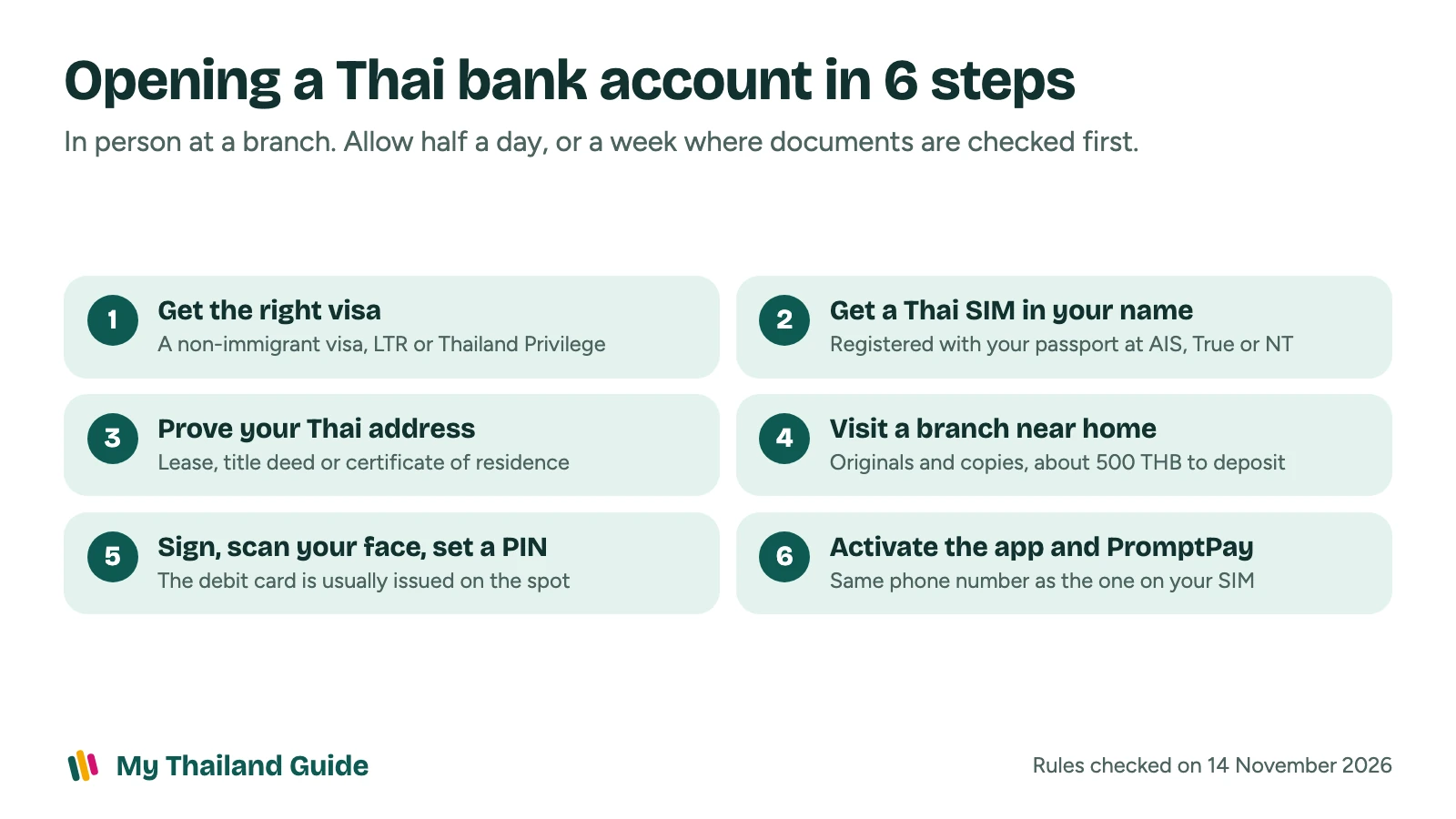
Count on half a day at the branch. Where documents are checked in advance, as for Thailand Privilege members, the whole process takes one to two weeks. If you are still preparing the move, our moving to Thailand checklist puts the bank account after the visa and the lease.
Thai banking apps, face scan and PromptPay
The account is only half the job. The app is where most problems now start, because it is tied to your phone number and your face.
Your SIM must be in your own name
The Ministry of Digital Economy and Society, the NBTC telecom regulator, AMLO and the Bank of Thailand require the name on the SIM to match the name on the banking app. Apps with a mismatch were suspended from 30 April 2025. Bangkok Bank explains the fix: correct the owner's name at AIS, True, dtac or NT, ask for a certificate of number ownership, then go to a branch with your passport and passbook.
Face verification above 50,000 THB
Since a 2023 Bank of Thailand rule, the app asks for a face scan for any transfer of 50,000 THB or more, once your transfers reach 200,000 THB in a day, and when you raise your transfer limit. Bill payments are exempt. Your face has to be on file first. TTB asks foreign customers to register it at a branch with their passport, and SCB registers faces at any branch.
More is coming. A Bank of Thailand draft of 23 July 2026 would end SMS one-time codes for confirming transactions. Public comments closed on 24 August 2026 and the final text had not been published when we checked.
PromptPay for foreigners
PromptPay links your account to your mobile number, or to your passport number at the branch, so people can pay you without your account number. One mobile number can be linked to one account across all banks. Register it at the branch if the app refuses a foreign ID. Once active, you pay shops and market stalls by scanning their Thai QR code in the app.
Thai bank account fees in 2026
Opening a savings account is free beyond the deposit, which stays your money. The costs are the card and, if you leave, the dormant account fee. Both were capped by the Bank of Thailand in 2026.
- Basic debit card. Entry fee and annual fee together are capped at 200 THB a year from 1 September 2026, and 150 THB for a basic ATM card, as reported by Thairath. Premium cards with insurance or cashback cost more.
- Dormant account. After a year with no movement and a balance under 2,000 THB, banks may now charge up to 20 THB a month, down from the 50 THB that SCB and Bangkok Bank charged.
- Transfers abroad and incoming SWIFT transfers carry bank commissions that vary by bank, usually 0.25% of the amount received with a minimum, as compared bank by bank for sending money to Thailand. Ask for the fee schedule at the branch.
The same notification bars banks from adding new fees or raising interest rates to make up for the cuts. The changes phase in until October 2026, so a fee charged before that may still follow the old schedule.
Thai bank account for the retirement visa (800,000 THB)
Retirees who use the savings route of the Thailand retirement visa need a Thai account in their own name holding 800,000 THB.
- Before the first extension: the money sits in the account for at least two months, three at some immigration offices.
- After approval: it stays at 800,000 THB for three months, then never below 400,000 THB until the next renewal, as law firms describe current practice.
- On the day: bring a bank letter confirming the balance and a passbook updated in the past week, as visa agents advise. The letter is dated, so ask for it shortly before your appointment.
A worked example: money that lands on 1 March reaches 60 days on 30 April. Applying on 29 April means 59 days, and some officers count days. Move the deposit a week earlier than the minimum.
Closing a Thai bank account and dormant accounts
An account with no transaction for 12 months becomes dormant. One deposit or withdrawal at the branch reactivates it, and SCB says the status changes the next day. If the balance falls to zero through monthly fees, Bangkok Bank closes the account automatically.
To close an account yourself, go to a branch of the same bank with your passport, passbook and debit card. Withdraw or transfer the balance first. If you keep the account after leaving Thailand, keep the SIM alive too. The app is tied to that number, and fixing it means a branch visit.
Selling or renting a Thai bank account: the law
Some people are offered cash to sell or rent out their account. Doing it turns the account into a mule account, used to move stolen money. Thai police warned in February 2025 that it is punishable by up to three years in prison and a 300,000 THB fine, after 2,495 arrests in such cases.
The emergency decree on technology crime was amended in April 2025, and banks now share liability for fraud losses when they fail to meet security standards. That is why they question foreigners closely and close accounts at the first doubt. Never hand over your card, PIN or app login, even to a landlord or an employer.