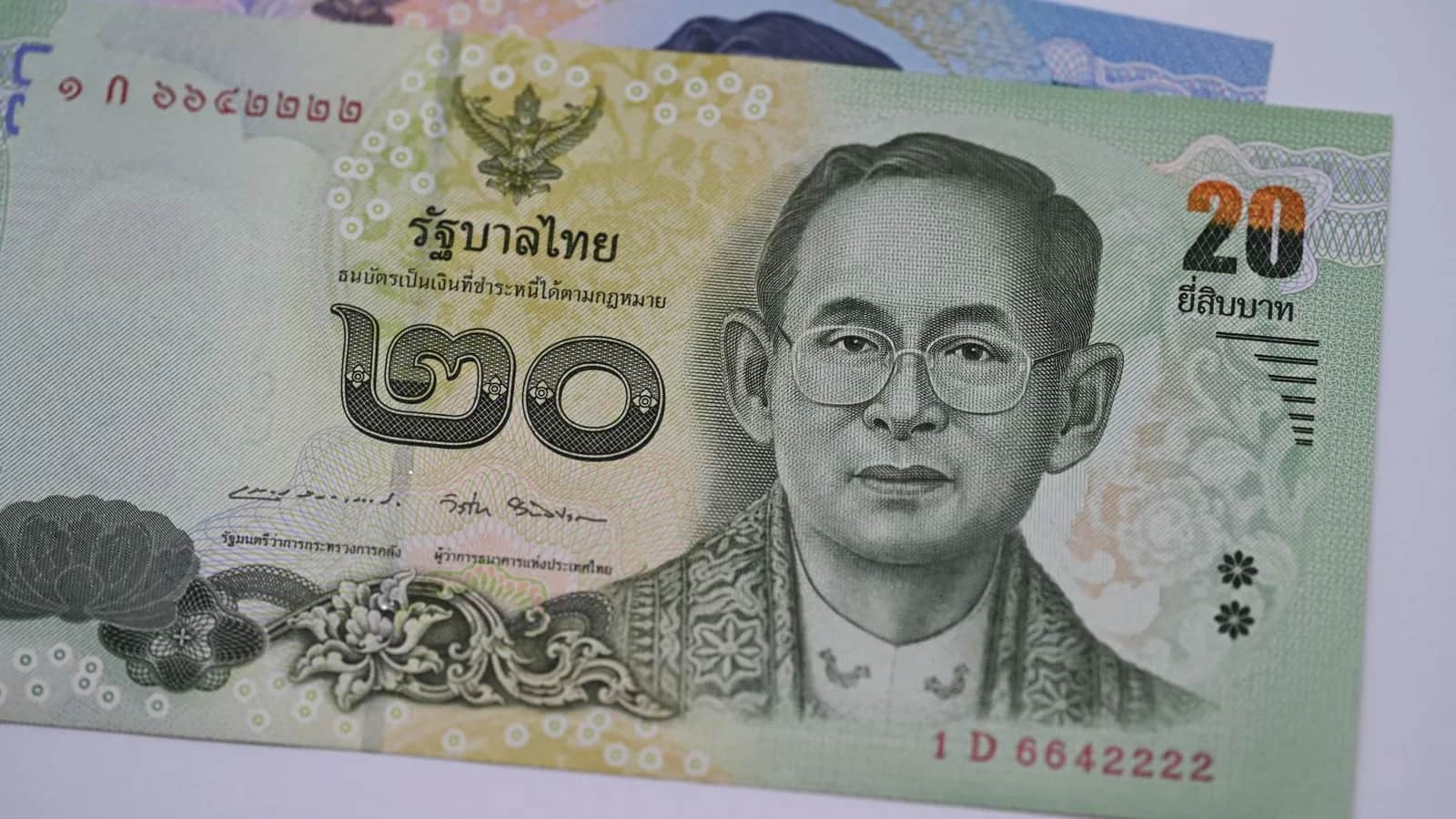
The Thailand currency is the Thai baht (THB, ฿). On 13 November 2026 the Bank of Thailand put it at 33.86 baht to the US dollar and about 44.86 baht to the pound, which makes 100 dollars worth some 3,386 THB. Cash still pays for street food, markets and tuk-tuks, cards work in malls and hotels, and ATMs charge foreign cards up to 350 THB a withdrawal. Rules and fees below were checked on 14 November 2026.
Thai baht: banknotes and coins in circulation in 2026
One baht is divided into 100 satang. Five banknotes are in use: 20 baht (green), 50 (blue), 100 (red), 500 (purple) and 1,000 (brown). Coins come in 1, 2, 5 and 10 baht, plus 25 and 50 satang that you will mostly see as change in supermarkets.
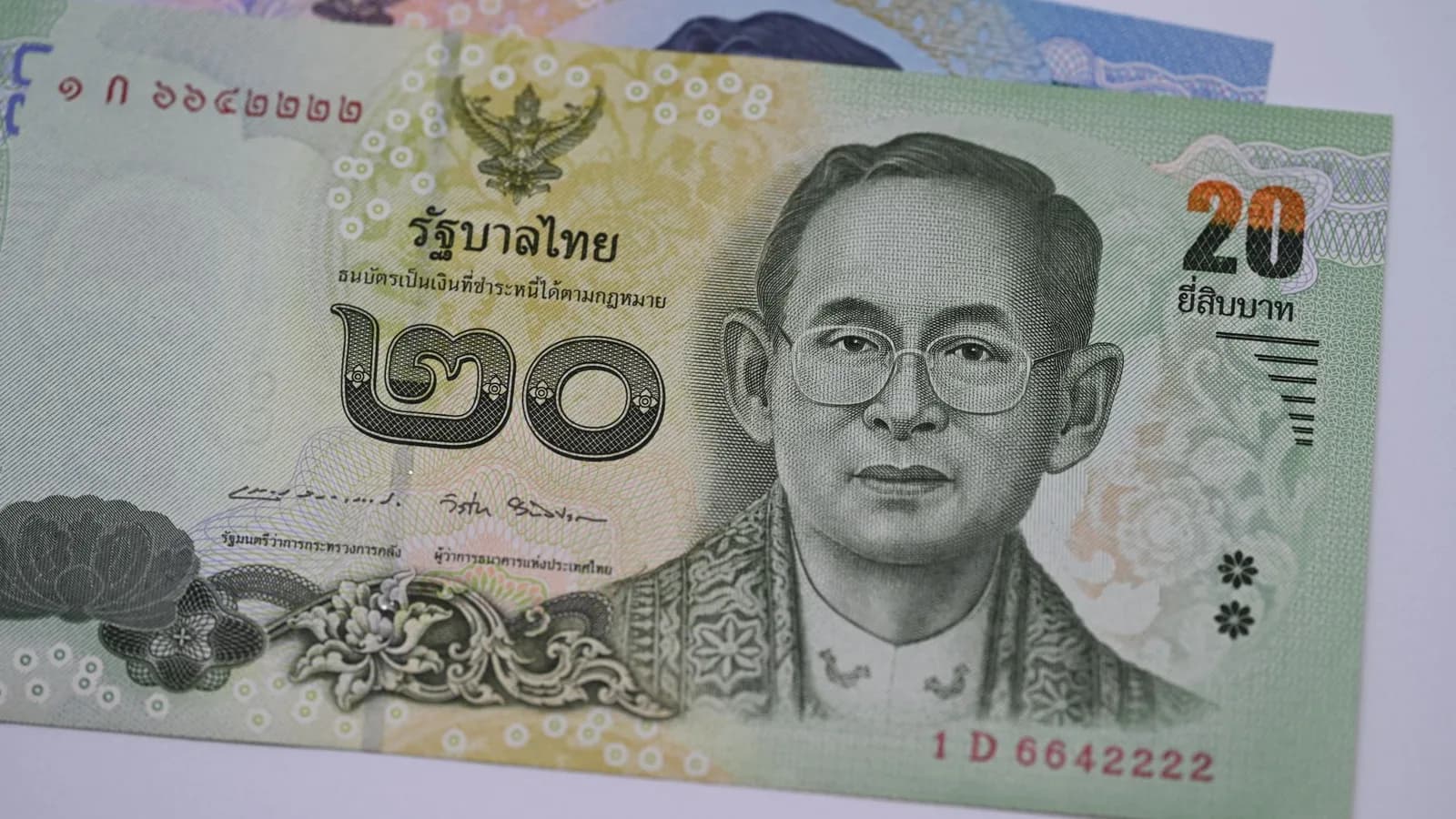
The current notes are the Bank of Thailand's Series 17, with the portrait of King Maha Vajiralongkorn, issued on 28 July 2018. The 20 baht note became polymer in March 2022, and polymer 50 and 100 baht notes followed on 21 November 2025. Older notes with King Bhumibol, like the one above, are still in everyday use.
Two new commemorative 100 baht notes, honouring Queen Sirikit and Princess Bajrakitiyabha, are announced for 21 December 2026, with 10 million of each design. They are ordinary money at face value, so do not pay a premium if someone sells one to you as a souvenir.
The king's portrait is on every note and coin. Never step on money to stop it rolling or blowing away, and do not tear or deface notes: in Thailand that is read as disrespect to the monarchy.
Thai baht exchange rate: how much is $100 in Thailand
| Amount | In Thai baht or back |
|---|---|
| 1 US dollar | 33.86 THB |
| 100 US dollars | 3,386 THB |
| 100 pounds | About 4,486 THB |
| 100 THB | 2.95 USD or 2.23 GBP |
| 1,000 THB | 29.50 USD or 22.30 GBP |
These are reference rates of 13 November 2026. The dollar figure is the Bank of Thailand's weighted interbank average and the pound figure the middle of bank counter rates. What you receive in a shop is a little lower, and the rate moves by one to three percent in a month. A thousand baht pays for about ten simple restaurant meals, which is why the cost of living in Thailand looks low next to US or UK prices.
Where to exchange money in Thailand: SuperRich, Vasu and the airport
The best rates come from the private exchange chains in Bangkok, not from banks or hotels. On 14 November 2026 SuperRich at its Ratchadamri head office bought 100 and 50 dollar notes at 33.80 THB, within 0.2% of the central bank rate. The same shop paid 33.54 THB for one-dollar notes, so bring large bills.
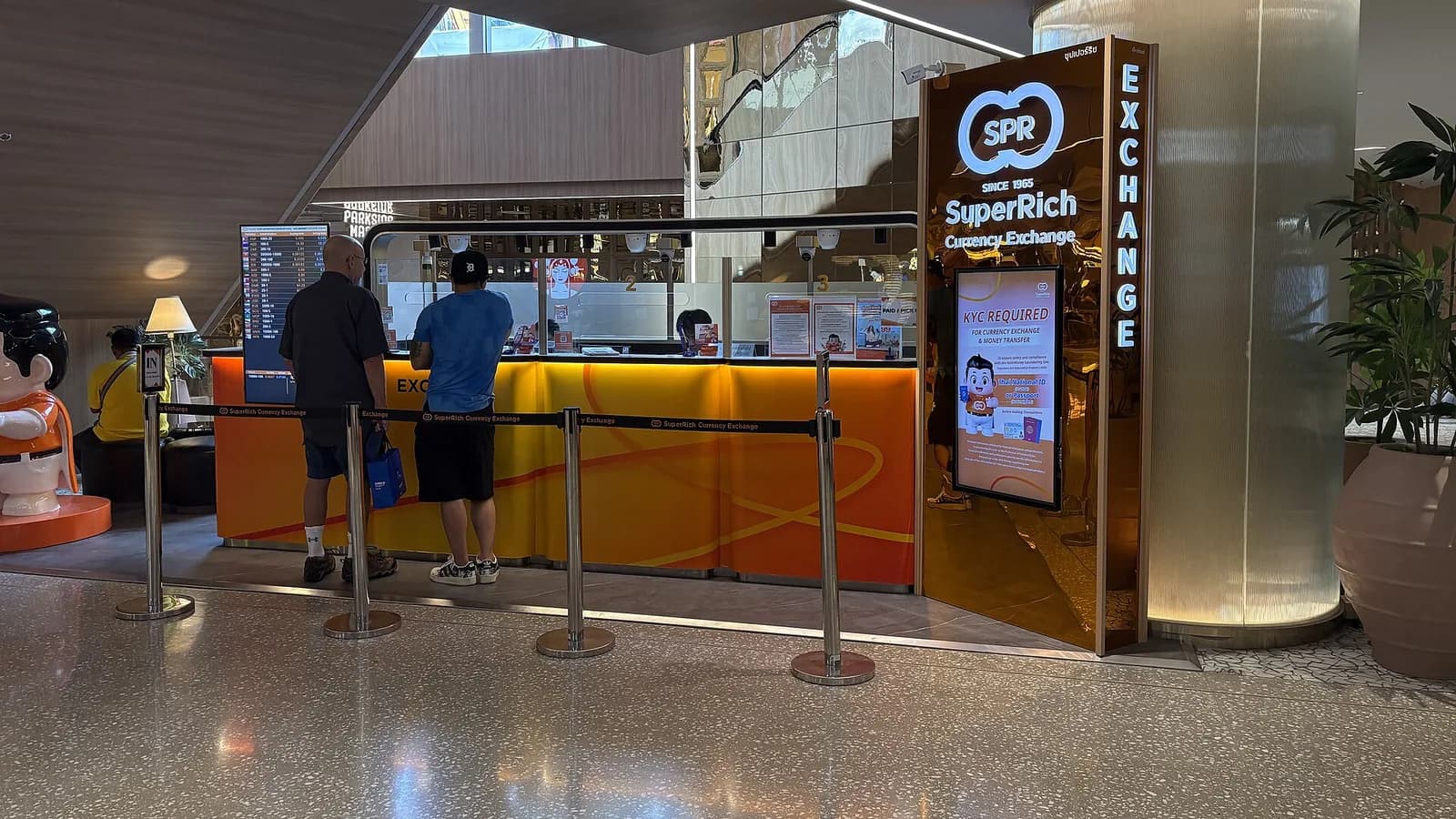
- SuperRich has branches in malls and near Skytrain stations across Bangkok. Every exchange needs your passport, as the "KYC required" sign above says.
- Vasu Exchange, on Sukhumvit Soi 7/1 near Nana BTS station, is the other name Bangkok regulars use. It also asks for your passport and is reported closed on Sundays.
- Suvarnabhumi Airport. The counters in the arrivals hall pay less. Go down to level B, beside the Airport Rail Link, where SuperRich and Value Plus have booths reported open from 05:30 to 23:30.
- Banks change money at their branches and booths, at slightly lower rates. On 13 November 2026 the average bank counter bought dollars at 33.72 THB.
Changing at home usually gets you fewer baht than Bangkok exchange shops, so change only enough for the first day before you fly. Bring clean notes without tears or ink: shops refuse damaged bills or pay less for them. Count your baht at the window before you step away. Outside Bangkok, in Phuket, Pattaya or Chiang Mai, look for licensed exchange shops and compare two boards before changing a large sum.
ATM fees in Thailand for foreign cards
Thai banks charge a foreign card a flat fee on each withdrawal. The figure of 220 THB still quoted in many guides is out of date. Kasikornbank's fee schedule effective on 22 September 2026 charges 250 THB with a Visa or UnionPay card and 350 THB with a Mastercard. Krungsri charges the same 250 and 350 THB since 11 March 2026.
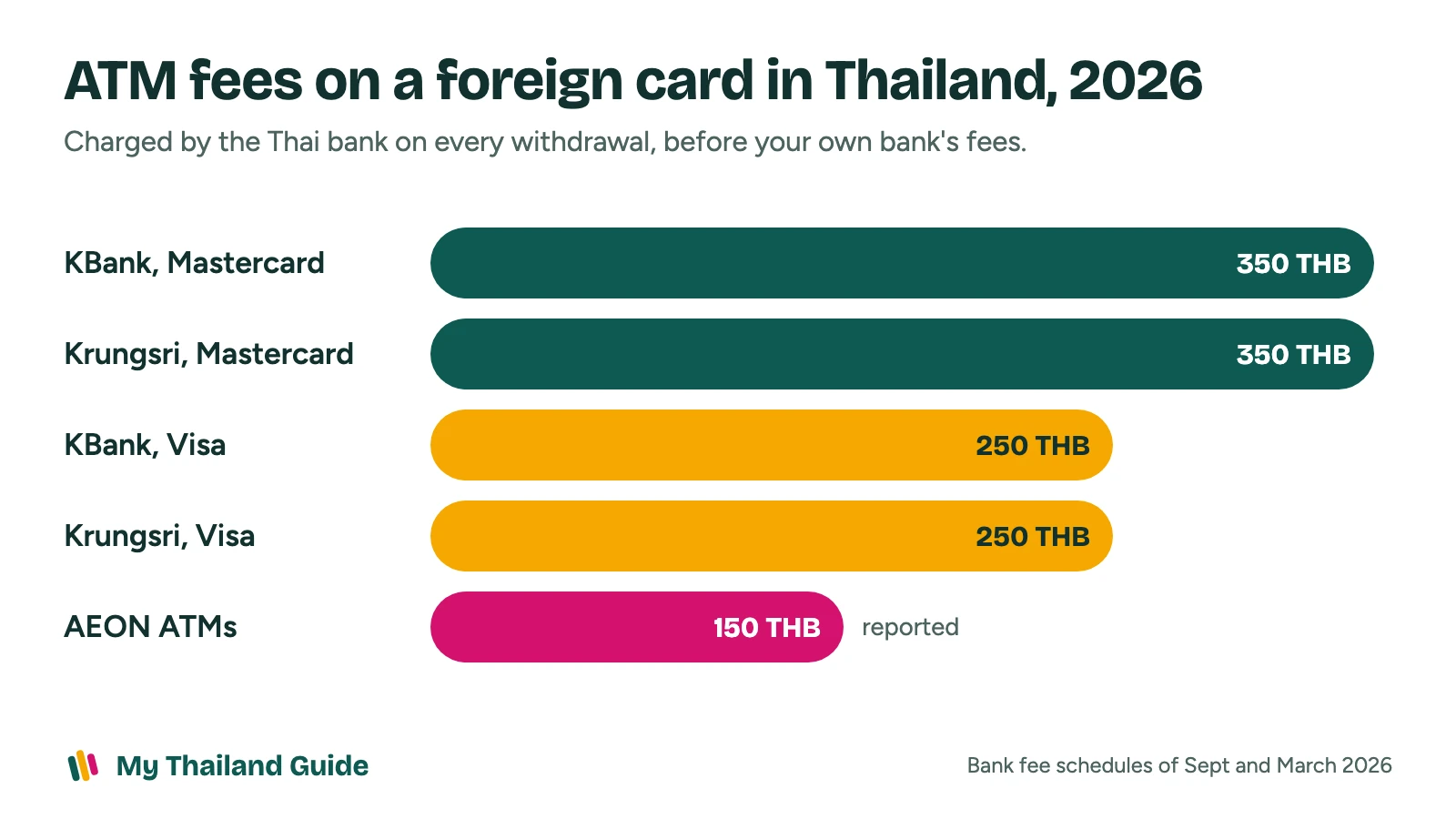
AEON machines, inside Big C, Lotus's and MaxValu stores, are reported at 150 THB, with a lower ceiling of 20,000 THB per withdrawal. Bank ATMs are reported to pay out 20,000 to 30,000 THB at a time. Your own bank then adds its foreign fee, often a percentage plus a fixed charge.
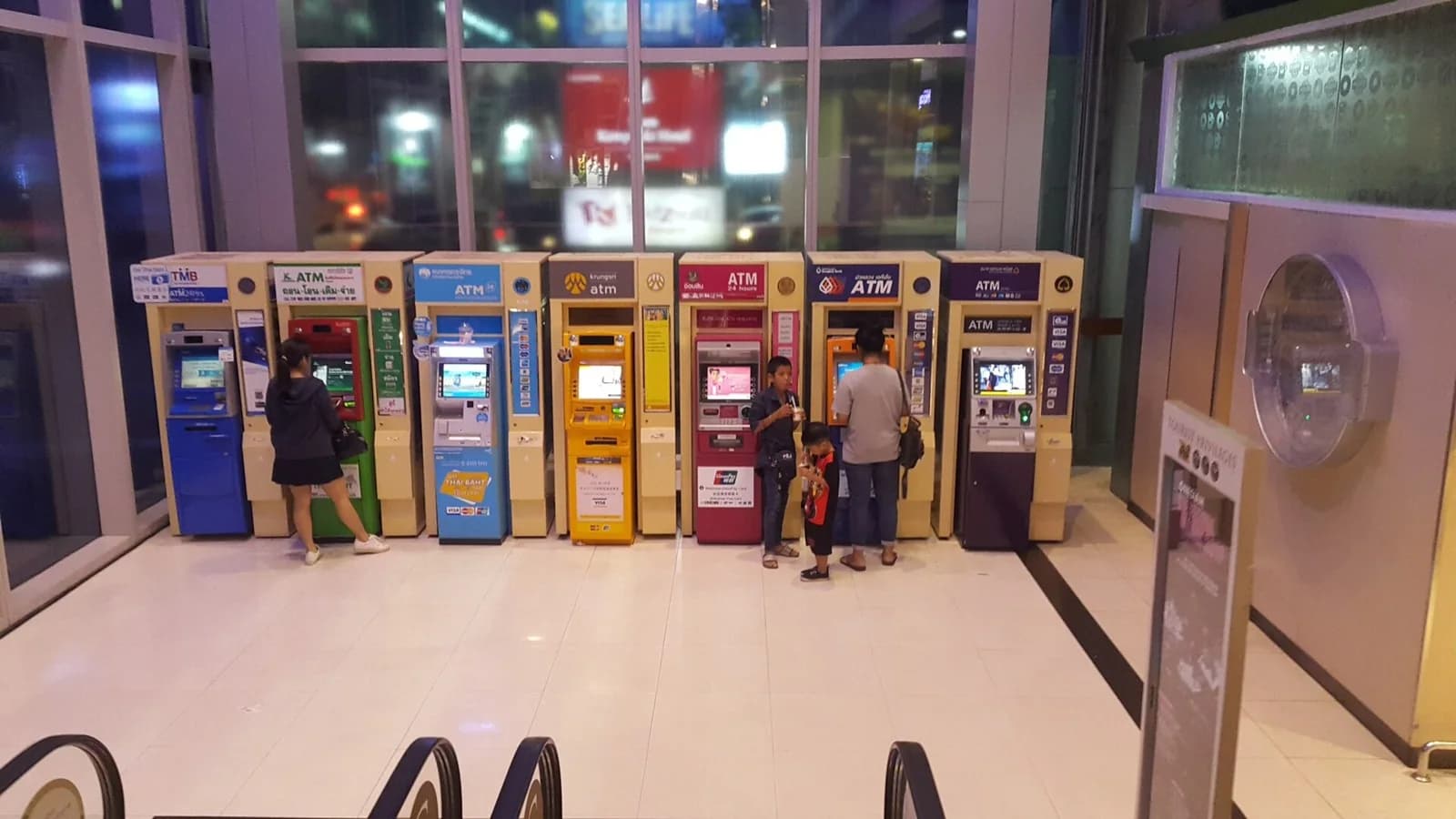
The fee is per withdrawal, so the amount you take out decides what it costs you. Drawing 10,000 THB on a Mastercard at a KBank machine costs 350 THB in fees, 3.5% of the cash. Drawing 30,000 THB on a Visa card at a Krungsri machine costs 250 THB, under 1%.
How to avoid ATM fees in Thailand
- Withdraw less often, in larger amounts, and keep the cash in your hotel safe.
- Use a Visa card rather than a Mastercard at KBank and Krungsri, which saves 100 THB a withdrawal.
- Change cash instead. Exchange shops charge no fee, only the spread in their rate.
- Check your own card. Some US accounts, such as Charles Schwab's checking account, refund ATM operator fees. Multi-currency cards such as Wise or Revolut replace your home bank's foreign fee with their own pricing, and the Thai fee still applies.
- Pay by card wherever it is accepted, and keep cash for places that need it.
Cash or card in Thailand: Visa, Mastercard and contactless
Use both. Visa and Mastercard are accepted in malls, chain restaurants, most hotels and airlines, and contactless payment is common in Bangkok. Apple Pay and Google Pay work wherever the terminal takes contactless cards. American Express is accepted in far fewer places.
Cash is still needed for street food, markets, small guesthouses, tuk-tuks, songthaews, longtail boats, many island businesses and national park gates, so plan cash for the stops on a trip around Thailand. Some small shops add a surcharge for cards or ask for a minimum spend. Ride-hailing apps such as Grab take a foreign card in the app, but they need mobile data, so set up an eSIM for Thailand before you land.
Break 1,000 baht notes in supermarkets and convenience stores. A taxi driver or a noodle stall early in the day will often have no change for one.
PromptPay and QR payments in Thailand for tourists
Thais pay almost everything by scanning a PromptPay QR code with a banking app, from market stalls to coffee shops. PromptPay needs a Thai bank account, so a US, UK or European banking app cannot scan these codes.
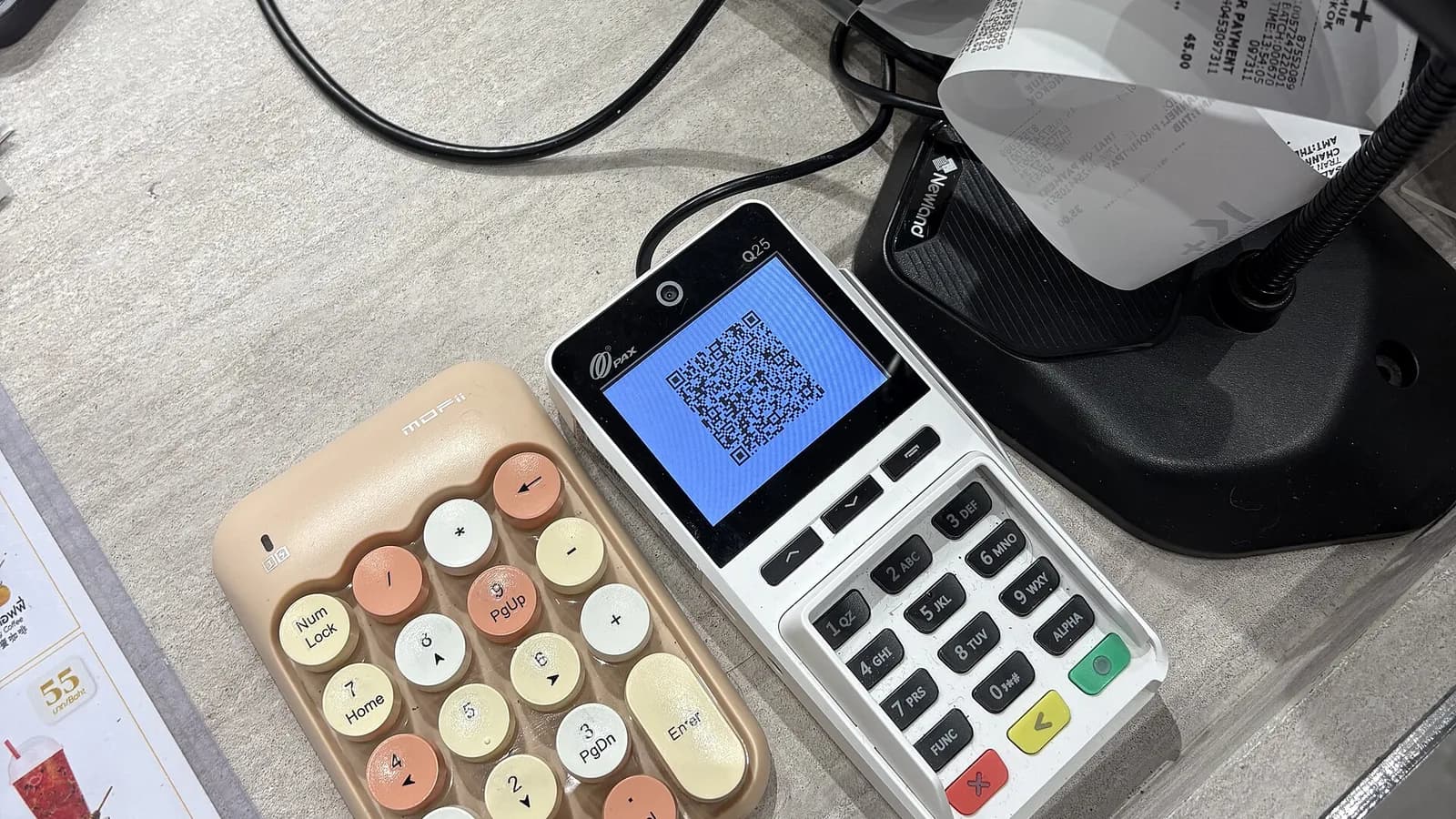
Visitors from some Asian countries can pay through Bank of Thailand links between national QR systems. Users of Alipay, WeChat Pay and UnionPay in China have been able to pay Thai QR codes since 30 October 2025, and links exist with Malaysia, Indonesia, Vietnam, Cambodia, Laos and Hong Kong.
Western visitors can use the PAY&TOUR prepaid card that Kasikornbank issues with the TAGTHAi app. You apply with your passport at a KBank exchange booth, top it up in cash, and scan Thai QR codes from the app. The free sign-up offer ended on 22 July 2026: the card now costs 150 THB, and a withdrawal at a KBank ATM 20 THB.
Tipping in Thailand: how much and when
Tipping is not expected in Thailand, but small tips are welcome and common in tourist areas. First read the bill. Prices marked "++" add a 10% service charge and 7% VAT, and the 7% rate has been extended to 30 September 2027. Where a service charge is already on the bill, an extra tip is optional.
| Service | Usual tip reported in 2026 |
|---|---|
| Street food and simple restaurants | None, or leave the coins |
| Restaurant without service charge | 20 to 50 THB, or about 10% in tourist places |
| Thai massage, one hour | 50 to 100 THB, given to the therapist |
| Taxi, tuk-tuk, Grab | Round up the fare |
| Hotel porter | About 20 THB per bag |
| Tour guide or boat crew, full day | Left to you, more for a private guide |
Massage therapists are reported to keep only 30 to 40% of the price in standard shops, which is why a tip there counts. Hand it to the person, in cash.
How much cash to bring to Thailand, and the rules at the border
You can bring any amount of cash into Thailand, but large sums must be declared. The Bank of Thailand sets the limits below, and they apply in both directions.
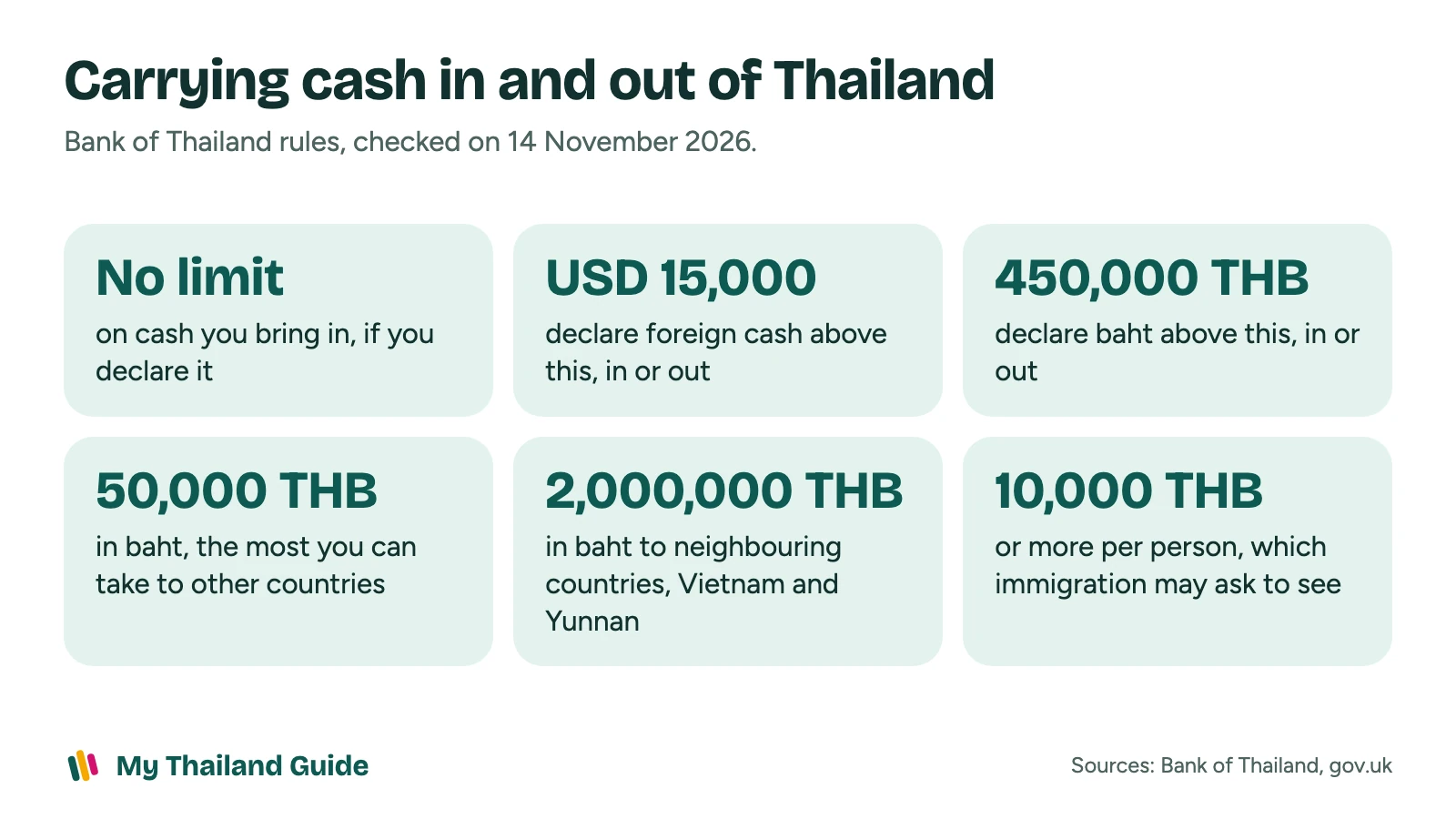
- Foreign currency over USD 15,000 or its equivalent must be declared to customs, on arrival and on departure. Older pages, including some Thai embassy sites, still say 20,000 dollars.
- Thai baht over 450,000 THB must be declared as well.
- Taking baht out is capped at 50,000 THB, or 2,000,000 THB to the countries bordering Thailand, Vietnam and China's Yunnan province.
Declaring is done in the red channel, on a currency declaration form. Since 8 October 2026 a Bank of Thailand notice is reported to ask people who exchange more than USD 15,000 in notes to show that the cash entered Thailand legally, and the stamped form is that proof. Failing to declare is reported to carry a fine of up to 20,000 THB and up to three years in prison.
Immigration can also ask you to show funds on arrival. The UK government gives at least 10,000 THB per person or 20,000 THB per family, and some Thai consulates quote 20,000 THB per person for visa-free visitors. Checks are rare, but they happen. Arrive with that sum in cash or another currency, plus enough baht for the train or taxi into town.
Money in Thailand for residents: banks, transfers and tax
For anyone moving to Thailand, a Thai bank account saves the ATM fee on every withdrawal and gives you PromptPay. In 2026 banks ask for a long-stay visa, proof of address, a Thai mobile number in your name and a visit in person. A tourist entry is reported as no longer enough at most branches.
- Visa deposits. The Thai retirement visa asks for 800,000 THB held in a Thai bank, or 65,000 THB of monthly income, so the account comes first.
- Transfers. Money reaches a Thai account by bank wire or through transfer services such as Wise or Revolut. Compare the baht that arrive, not the advertised fee: on 1,000 GBP the gap between the cheapest and the dearest way of sending money to Thailand runs to more than 2,000 baht.
- Tax. Spending 180 days or more in Thailand in a year makes you a tax resident, and foreign income earned from 2024 is taxable when you bring it into the country.
Money scams in Thailand: skimming, short change and fake notes
Money tricks are among the commonest risks in Thailand for visitors, and most follow a script you can spot.
- Card skimming. Use ATMs inside banks and malls rather than lone machines on the street. Cover the keypad, and walk away if the card slot looks loose or bulky.
- Forgotten cards. Take your card and your cash before you leave the machine, and keep your bank's number to block a card at once.
- Short change. Count the baht at the exchange window and the change at the till. Keep 20 and 100 THB notes apart from 500 and 1,000 THB notes, which look alike in a dim tuk-tuk.
- Fake notes. Change money only at banks and licensed shops. Check a large note by touching the raised print, holding it to the light for the watermark and tilting it to see the colours shift.
- Conversion at the till. A card machine that shows your home currency is offering dynamic conversion. Ask for baht.
In this section
 กสิณธร ราชโอรส, CC BY-SA 3.0, via Wikimedia Commons
Can you open a bank account in Thailand as a foreigner in 2026? Who qualifies, documents by visa, the big banks compared, steps, PromptPay and fees.
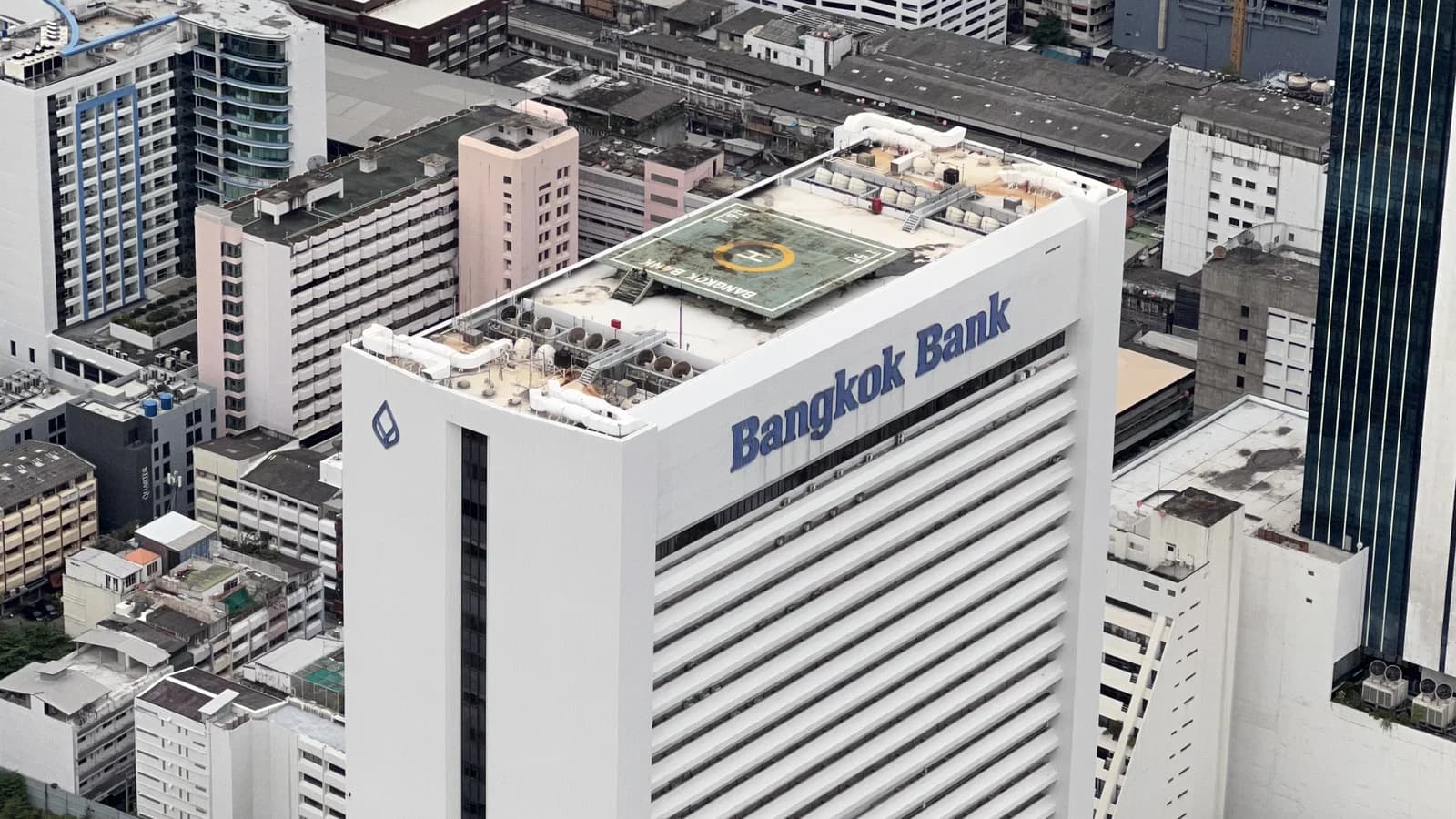 Bigcitydata, CC BY-SA 4.0, via Wikimedia Commons
Send money to Thailand for less: £1,000 and $1,000 compared across 10 services, Thai bank fees, the FET form for a condo, limits and the 2024 tax rule.