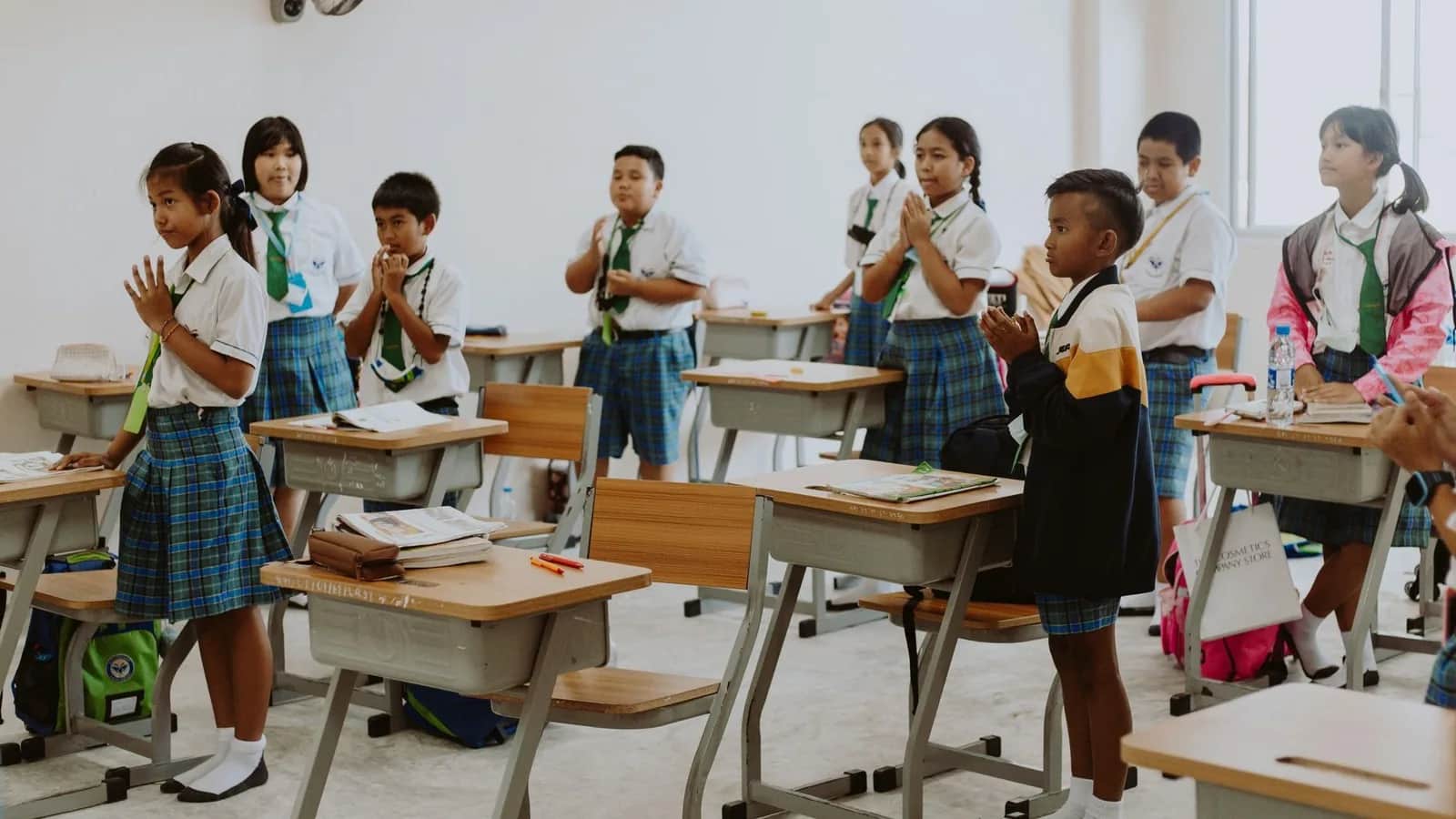
Teaching English in Thailand takes a bachelor's degree, a clean police certificate and a school willing to sponsor your visa. Pay runs from about 25,000 THB a month in a government school to well over 100,000 THB in an international school. The paperwork is where people go wrong: the visa, the work permit and the teaching licence are three different things.
Requirements to teach English in Thailand
- Bachelor's degree in any subject, with the original certificate and transcript, legalised. Recruiters agree that it is required for the visa and the work permit.
- TEFL certificate. 120 hours is what schools expect. It is a market standard, not a legal requirement.
- Police certificate from your home country, apostilled and valid for three to six months. An FBI check can take from two to sixteen weeks, so order it early.
- Medical certificate for the work permit, at a cost of about 500 to 1,000 THB.
- English level. Schools prefer passport holders from the US, the UK, Ireland, Canada, Australia, New Zealand and South Africa. Other nationalities are hired and may be asked for a TOEIC or IELTS score.
Universities often ask for a master's degree. We found no legal age limit. Some government schools are reported to prefer teachers under 50.
Teach English in Thailand: salary by type of school
| Employer | Monthly salary quoted | In US dollars | Good to know |
|---|---|---|---|
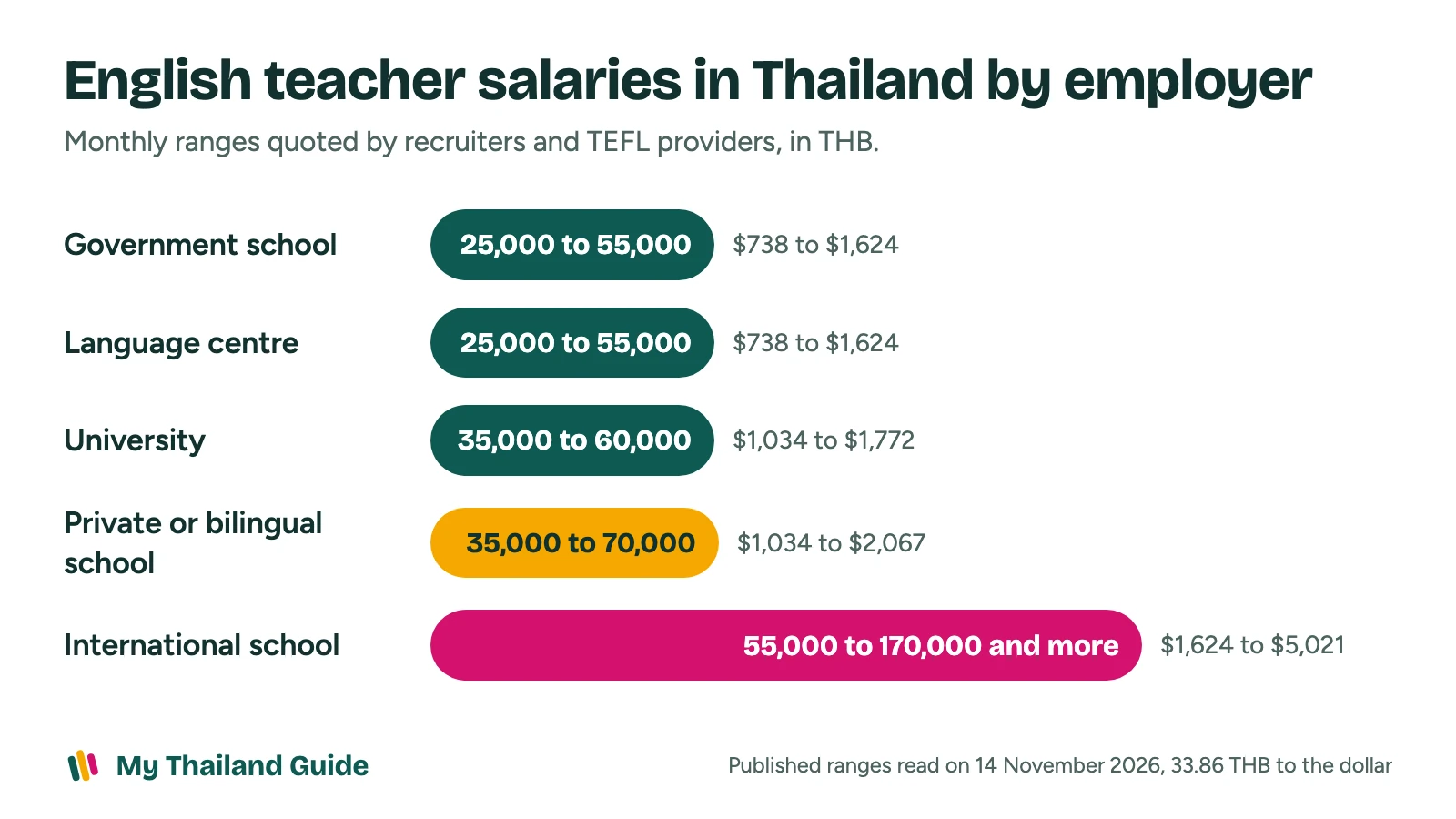
| Government school | 25,000 to 55,000 THB | $738 to $1,624 | Hires for the May term |
| Language centre | 25,000 to 55,000 THB | $738 to $1,624 | Also 400 to 1,000 THB an hour part time |
| Private or bilingual school | 35,000 to 70,000 THB | $1,034 to $2,067 | Licence or waiver from the Teachers' Council |
| University | 35,000 to 60,000 THB | $1,034 to $1,772 | Often a master's degree |
| International school | 55,000 to 170,000 THB and more | $1,624 to $5,021 | Widest pay range of all |
| Private tutoring | 300 to 1,500 THB an hour | $9 to $44 | Check that your permit allows it |
These ranges combine what five recruiters, TEFL providers and guides have published, three of them dated 2026, converted at 33.86 THB to the dollar on 13 November 2026. Specialists in business English, exam preparation or young learners are quoted 20 to 35% more. There is no official salary survey for foreign teachers, and the sources do not agree: one puts government schools at 26,000 to 35,000 THB, another at up to 55,000 THB.
Live job adverts give a better idea of the floor. On 14 November 2026, the main teaching job board listed a primary teacher position near Bangkok from 22,000 THB, a kindergarten post from 50,000 THB and a native-speaker English teacher from 60,000 THB.
What you take home
Social security takes 5% of salary, capped at 875 THB a month since January 2026. Income tax is light at this level. On 35,000 THB a month, after the standard deductions, the tax comes to roughly 5,500 THB a year, about 460 THB a month. A teacher on 35,000 THB keeps around 33,700 THB.
Is a teacher's salary enough to live on in Thailand?
Recruiters promise savings of 300 to 700 dollars a month. The arithmetic is tighter. Numbeo reports living costs of 23,700 THB a month for one person in Bangkok before rent, and 11,500 THB for a one-bedroom flat outside the centre. That is 35,200 THB, slightly more than a 35,000 THB salary before tax.
At that salary the budget only balances with a cheaper flat, even though 35,000 THB is more than twice the average Thai wage. One TEFL provider puts a one-bedroom at 10,000 to 20,000 THB in Bangkok, 8,000 to 15,000 THB in Chiang Mai and 4,000 to 10,000 THB in the north-east. In Chiang Mai, Numbeo's figures give about 28,900 THB a month, rent included. On 50,000 THB, the same Bangkok budget leaves about 12,000 THB after tax. Allow 50,000 to 80,000 THB to get through the first month before the first salary.
Non-B visa, work permit and teaching licence
- Get the job offer first. The school provides the documents for the visa.
- Apply for a Non-Immigrant B visa at a Thai embassy or consulate abroad, through the Thailand e-Visa portal. It gives 90 days.
- The school applies for your work permit. Applications have been filed online since 13 October 2025. The permit is tied to that employer.
- Extend your stay to one year at immigration, for 1,900 THB, then report your address every 90 days.
- The school requests your teaching licence or a waiver from the Teachers' Council of Thailand.
The Teachers' Council licence
Formal schools, whether government, private or international, must employ licensed teachers. Language centres are generally outside this rule. A foreign teacher without a degree in education works under a temporary permission requested by the school, described as valid for two years. Sources disagree on the training required and on how many times it can be renewed, so ask the school what its own teachers have been granted.
The law is not symbolic. Teaching without a licence carries a penalty of up to one year and 20,000 THB, and employing or presenting an unlicensed teacher up to three years and 60,000 THB.
When Thai schools hire English teachers
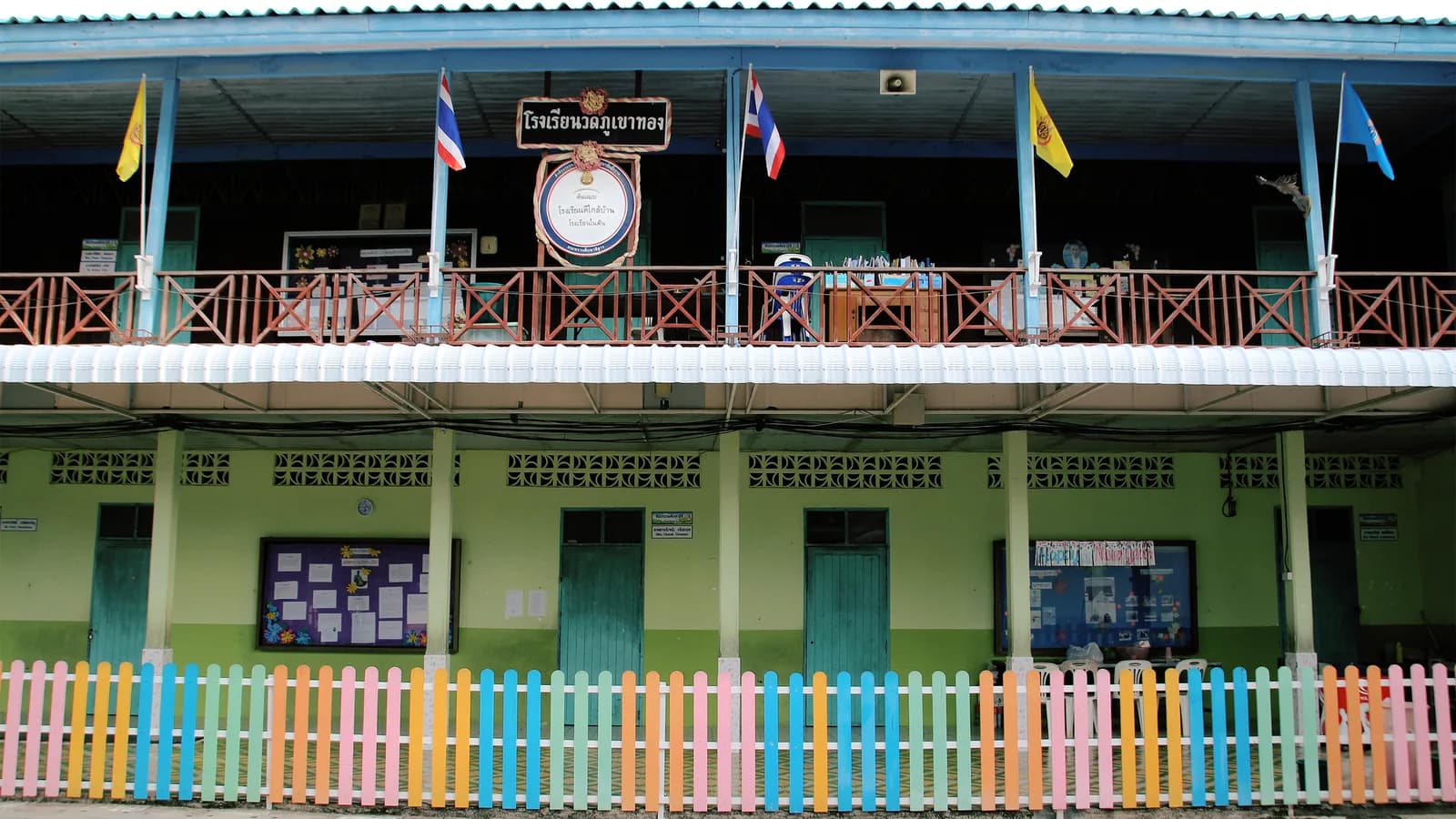
The Thai school year runs from May to March, with a break in October. Schools recruit hardest in February and March for the May term. A smaller intake follows for the second term, in October or November depending on the source. Language centres hire all year, with June to January the busiest period. Universities recruit in July and August.
Where to find English teaching jobs in Thailand
- Ajarn.com, the long-running job board for teachers in Thailand, with salaries shown in baht.
- Language centre chains, which recruit all year.
- Placement agencies. A serious agency is paid by the school. Programmes that charge the teacher a fee for a guaranteed placement exist and are a choice, not a necessity.
- LinkedIn and JobsDB for international schools and corporate training.
Pitfalls of teaching English in Thailand
- Schools or agencies that will not sponsor the Non-B visa and work permit. Ask for this in writing before you accept.
- Changing school without a new permit. The permit names one employer.
- Contracts with a clause banning private tutoring, which removes the usual way of topping up a salary.
- Unlicensed schools. The April 2026 raid ended with the arrest of the teachers, not only of the school.