
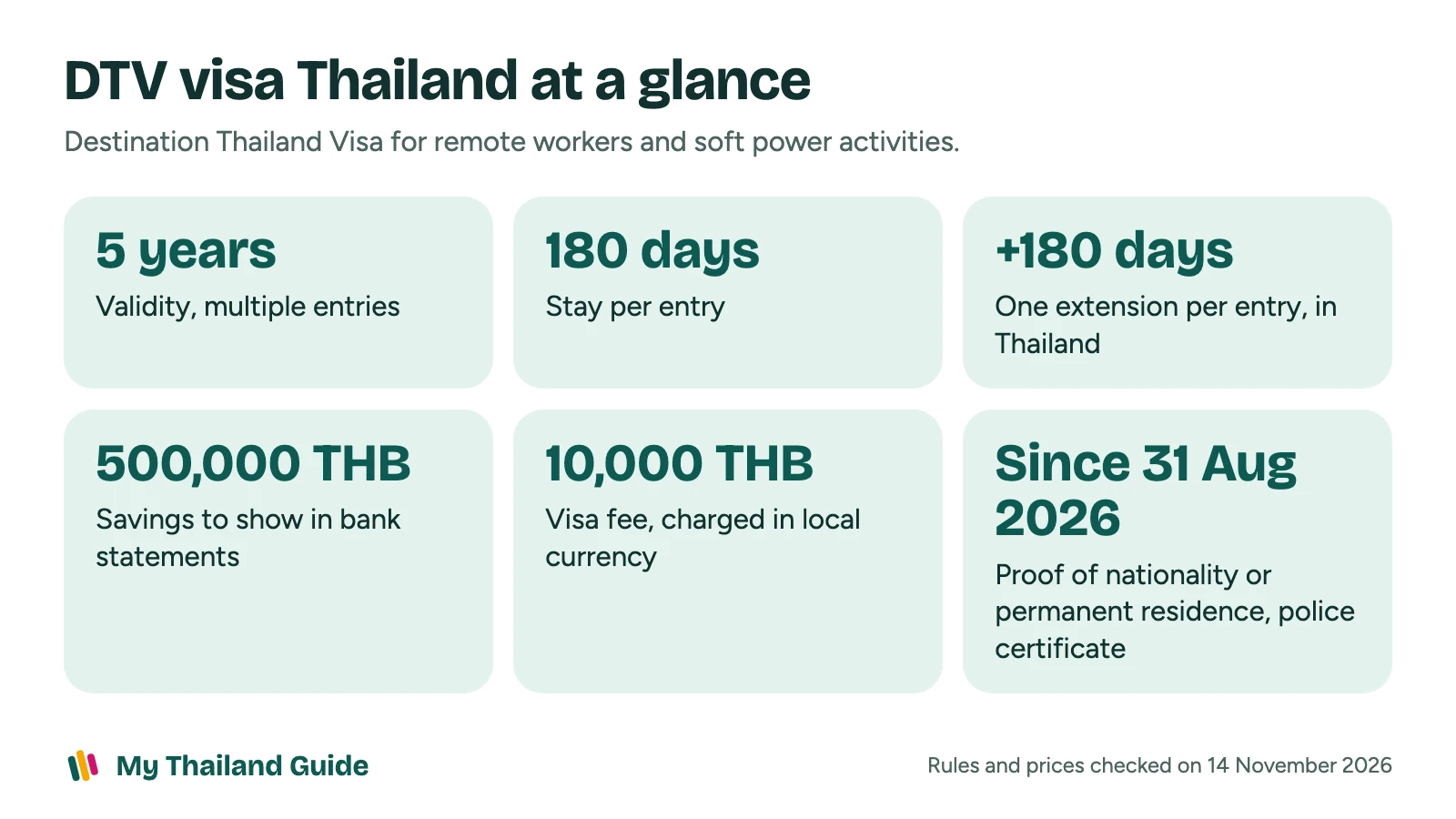
The Destination Thailand Visa (DTV) is the visa most remote workers now use to stay in Thailand. It is valid for five years, allows unlimited entries and gives 180 days per entry. In exchange you show 500,000 THB in savings, about a year of living costs for one person in Bangkok, and pay a 10,000 THB fee. The rules tightened on 31 August 2026, and that change decides where you can apply.
Who is eligible for the DTV visa in Thailand
Thai embassies describe three groups. You must fit one of them and hold the funds described below. Guides add that the main applicant must be at least 20 years old.
| Category | Who it covers | Main proof |
|---|---|---|
| Workcation | Digital nomads, remote employees, freelancers, foreign talent | Employment contract or letter, or a portfolio and invoices |
| Thai soft power | Muay Thai, Thai cooking courses, sports training, medical treatment, seminars, music festivals | Acceptance letter from the school, hospital or organiser |
| Dependants | Spouse and children under 20 of a DTV holder | Marriage or birth certificate |
Workcation: remote workers, freelancers and digital nomads
This is the Thailand digital nomad visa in everyday language. Your income has to come from outside Thailand. An employee needs a contract or a letter from the employer that confirms remote work and continued pay. A freelancer shows a portfolio, invoices and profiles on the platforms they work through. A business owner shows company registration and a tax return.
Embassies differ on the detail. The consulate in Los Angeles states that pay stubs are not accepted as proof of employment and asks for a letter signed by HR or a manager. A job offer alone is not enough there.
Thai soft power: Muay Thai, cooking classes and medical treatment
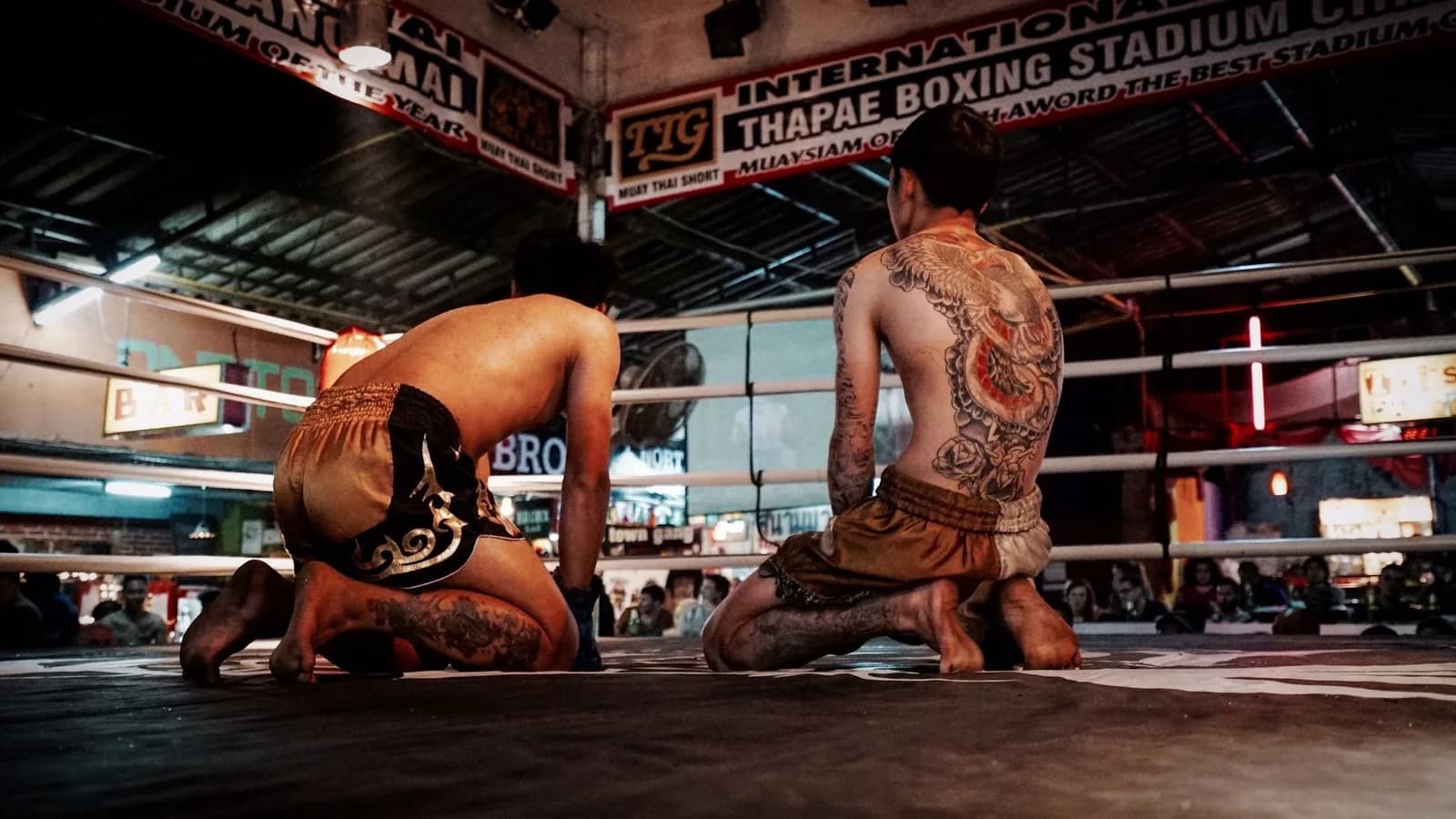
The soft power route covers Muay Thai training, Thai cooking courses, sports training, medical treatment, seminars and music festivals. The embassy in Budapest warns that an activity shorter than six months risks a refusal, and asks for the business registration of the school along with its letter. For Muay Thai, Los Angeles requires an acceptance letter backed by the Sports Authority of Thailand and a gym it has certified.
Thai language courses are widely reported to have been dropped from the list in 2025, and current embassy pages no longer mention them. A language student should look at the education visa instead. The DTV does not cover a child's schooling either.
DTV visa cost and the 500,000 THB proof of funds
The visa fee is 10,000 THB, paid in the currency of the embassy and not refunded if the application is refused. Each dependant pays the same fee.
| Embassy | Visa fee | Funds to show | Bank statements |
|---|---|---|---|
| London (UK and Ireland) | 300 GBP | At least 12,000 GBP | Period not stated |
| Los Angeles (western US) | Not shown on the page | 500,000 THB at each month end | Last 3 months |
| Budapest (Hungary) | 350 EUR | 500,000 THB | Official 6-month statement |
Embassy pages read on 14 November 2026. The gap between three and six months of statements is the reason to read the page of your own embassy and not a general guide.
Which money counts towards the 500,000 THB
Embassies want cash in a personal bank account. Savings, current or fixed deposit, in any currency as long as the balance reaches the equivalent. Budapest refuses crypto and investments. Visa firms report refusals for shares, pension pots, credit limits and company accounts. Los Angeles accepts a statement in the name of a family member if you prove the relationship.
A large deposit made just before the application is the classic reason for a refusal. Los Angeles asks for the statements of the last three months, each showing the threshold at the end of the month, so the money has to sit in the account for the whole period.
What a DTV costs from start to finish
Take a US freelancer applying alone. The fee is commonly reported at 400 USD, to confirm with the consulate. The FBI background check costs 18 USD, and fingerprinting adds 50 to 100 USD. That makes roughly 470 to 520 USD before any certified translation, plus 1,900 THB later if they extend a stay in Thailand. A UK applicant pays 300 GBP plus an ACRO police certificate.
DTV visa requirements: the documents to prepare
- Passport valid for at least six months, and a photo taken in the last six months.
- Proof of where you live. Driving licence, utility bill or bank statement with your address.
- Proof of permanent residence if you are not a citizen of the country where you apply, such as a residence card.
- Police certificate. An FBI check less than three months old in Los Angeles, an ACRO certificate less than six months old in London.
- Bank statements showing 500,000 THB, for the period your embassy sets.
- Proof for your category. Employment letter or portfolio, or the acceptance letter for a soft power activity.
- For dependants. Marriage or birth certificate, and the passports of both parents for a minor.
Documents that are not in English or Thai need a certified English translation, and Los Angeles asks for them to be notarised as well. A non-citizen applying in the US shows a US visa valid for at least six months, and a child travelling alone needs a notarised consent from the parents. Blurry scans and screenshots lead to a request for new files and add days to the process.
How to apply for the DTV visa online
- Find your embassy. It is the Thai embassy or consulate for your country of nationality or permanent residence. In the US, the consulate depends on your state.
- Read its DTV page. Note the fee, the length of bank statements and the police certificate it wants.
- Order the police certificate first. It expires, three months after issue in Los Angeles, and an FBI check alone can take weeks.
- Create an account on the official Thailand e-Visa portal, thaievisa.go.th, choose the DTV and upload your files. You must be outside Thailand.
- Pay the fee and answer any email from the embassy asking for more documents.
- Receive the e-visa by email, print it, and fill in the Thailand Digital Arrival Card before each flight.
Processing times are not published by most embassies. The Los Angeles consulate is reported to take up to 15 working days, and longer when documents are missing. Apply at least a month before you travel.
How long can you stay in Thailand on a DTV
Each entry gives 180 days. The London embassy confirms one extension of 180 days per entry, requested at an immigration office in Thailand. The extension fee is reported at 1,900 THB. The 10,000 THB sometimes quoted for it is the visa fee, not the extension.
That makes up to 360 days in a row. After that you leave Thailand and come back on the same visa, which starts a new 180 days. No waiting period is reported between two entries. Immigration offices do not all ask for the same papers for the extension, so bring recent bank statements and your proof of work or course.
Two obligations apply while you are in the country. You report your address to immigration every 90 days of continuous stay, and you fill in the arrival card at every entry. The DTV itself cannot be renewed after five years: you apply again under the rules in force at that time.
Working and paying tax in Thailand on a DTV

The DTV allows remote work for employers and clients outside Thailand. It comes without a work permit, so a job with a Thai company or freelance work for Thai clients is not allowed. That takes a Non-Immigrant B visa and a work permit.
The visa gives no tax break. You become a Thai tax resident once you spend 180 days or more in the country in a calendar year. Since 1 January 2024, a tax resident is taxed on foreign income brought into Thailand, whatever the year it arrives, when that income was earned from 2024 onwards. Income earned before 2024 stays exempt. A proposal to soften this rule has been discussed and is not in force.
Two long stays in the same calendar year are enough to cross the 180-day line, and a long stay usually means renting a condo on a lease. Tax treaties and home-country rules change the result, and US citizens keep filing in the US, so ask a tax adviser who knows both countries before you move money.
DTV vs tourist entry, retirement visa and Thailand Privilege
The visa-free stay for tourists was cut from 60 to 30 days on 15 September 2026 for around 60 countries, with two land entries a year. That makes the DTV the practical choice for anyone who wants more than a few weeks at a time without border runs. A remote worker planning three months in Thailand now gets 30 days visa-free, against 180 days per entry on a DTV, for a fee of 300 GBP in London.
| Option | Stay | Main condition | Best for |
|---|---|---|---|
| DTV | 180 days per entry, 5 years | 500,000 THB in savings, remote income or soft power activity | Remote workers and long-stay students of Muay Thai or cooking |
| Visa exemption and tourist visa | 30 days visa-free for most visitors | Passport from an eligible country | Holidays and first scouting trips |
| Retirement visa | One year, renewable | Age 50 or over, 800,000 THB or a monthly income | Retirees who stay year-round |
| Thailand Privilege | 5 years and more | Paid membership | People who want no paperwork and can pay for it |