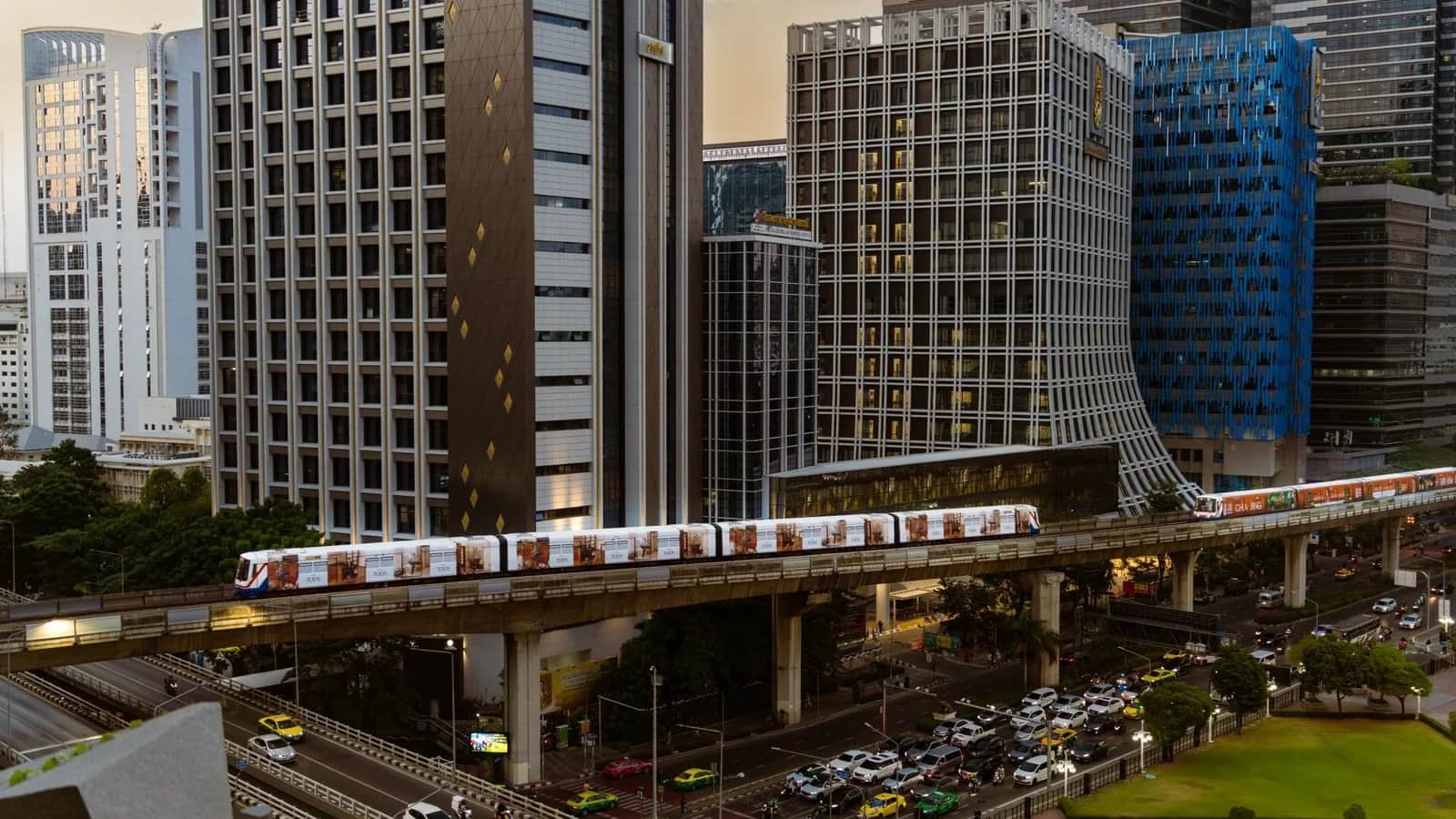
Moving to Thailand is a question of order. The visa comes first, because it decides how long you can stay, whether you can open a bank account and whether your belongings enter free of duty. Then money, then the town, then the paperwork of the first weeks. This guide is written for every nationality and gives the rules as they stood on 14 November 2026.
How to move to Thailand: the steps in order
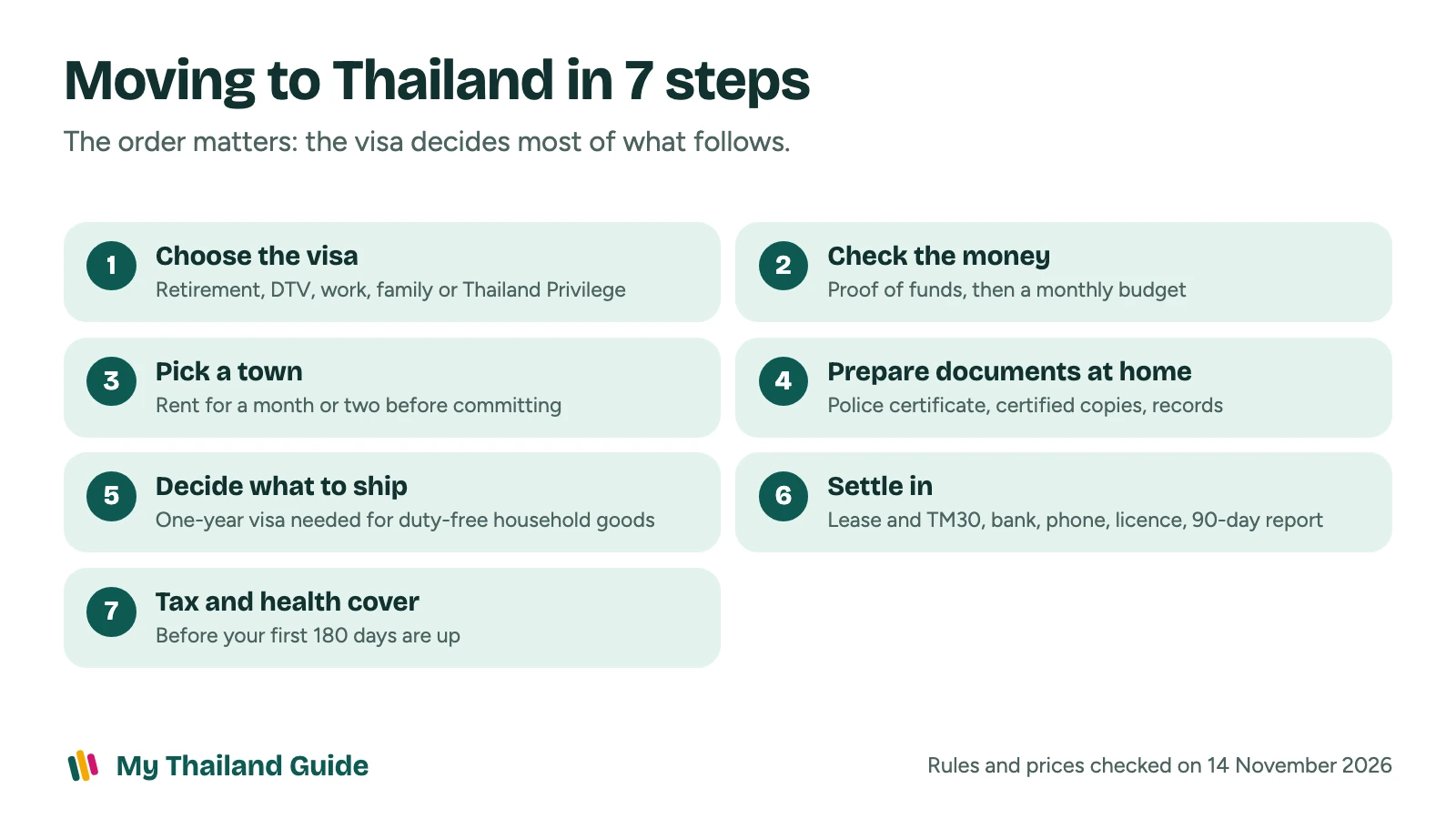
- Choose the visa that matches your age, income and plan.
- Check the money. Proof of funds for the visa, then a monthly budget.
- Pick a town, and rent there for a month or two before committing.
- Prepare documents at home. Police certificate, certified copies, medical records.
- Decide what to ship and arrange pets.
- Settle in. Lease and TM30, bank account, phone, driving licence, 90-day report.
- Sort out tax and health cover before your first 180 days are up.
Step 1: choose your visa to live in Thailand
A tourist entry is no basis for a move. The visa-free stay is 30 days since 15 September 2026, with an extension at the officer's discretion and two land entries a year. These are the routes people use:
| If you are | Visa | Main condition |
|---|---|---|
| 50 or over | Retirement visa | 800,000 THB in the bank or 65,000 THB a month |
| Working remotely for foreign clients | DTV | 500,000 THB in savings, 180 days per entry |
| Hired by a Thai employer | Non-Immigrant B visa and work permit | The employer sponsors you |
| Married to a Thai national | Non-Immigrant O family visa | 40,000 THB a month or 400,000 THB |
| Able to pay for convenience | Thailand Privilege | From 650,000 THB for five years |
Visas are applied for on the Thailand e-Visa portal before you leave, through the embassy that covers where you live. For the DTV, embassies ask for proof of nationality or permanent residence in that country.
Step 2: how much money you need to move to Thailand
There are two separate amounts.
- Proof of funds for the visa. 500,000 THB for the DTV and 800,000 THB for retirement. The retirement deposit has to sit in a Thai bank, so it is money you cannot spend.
- Monthly budget. About 855 to 1,420 USD for one person and 1,230 to 1,660 USD for a couple, rent included, depending on the city.
Add the set-up costs of the first month: flights, a hotel for two weeks, then three months of rent on signing a lease, usually two months of deposit and one in advance. For a condo at 20,000 THB, that is 60,000 THB.
Step 3: decide where to live
Bangkok has the jobs, schools and hospitals. Chiang Mai is the cheapest of the main choices and smoky from February to April. Hua Hin is the quiet retirement town, Phuket the island with full services, Pattaya the affordable seaside option. Test your shortlist before you commit: a month in each place, in the bad season as well as the good one.
Step 4: what to prepare before you leave
- Passport valid for at least six months, with blank pages. Washington asks for 18 months for the O-A retirement visa.
- Police certificate, required for the DTV and the O-A retirement visa, and less than three months old in several consulates. Order it first.
- Certified copies of birth, marriage and degree certificates, with certified English translations. Teachers and work permit applicants need the degree.
- Bank statements for the months your embassy requires, and a letter from your bank if asked.
- Medical records and prescriptions. Check that your medicines are allowed into Thailand.
- Driving licence and an International Driving Permit.
- Arrival card. Fill in the free Thailand Digital Arrival Card in the three days before you fly.
- First 90 days. Draw up a cash budget, book temporary housing, note two hospitals near it and carry two working payment methods.
- Home banking. Keep an account and a card at home, and make sure security codes reach a phone number that will still work abroad.
- Tax. Tell your home tax authority you are leaving, if your country requires it.
Step 5: shipping belongings and bringing pets to Thailand
Household goods and customs
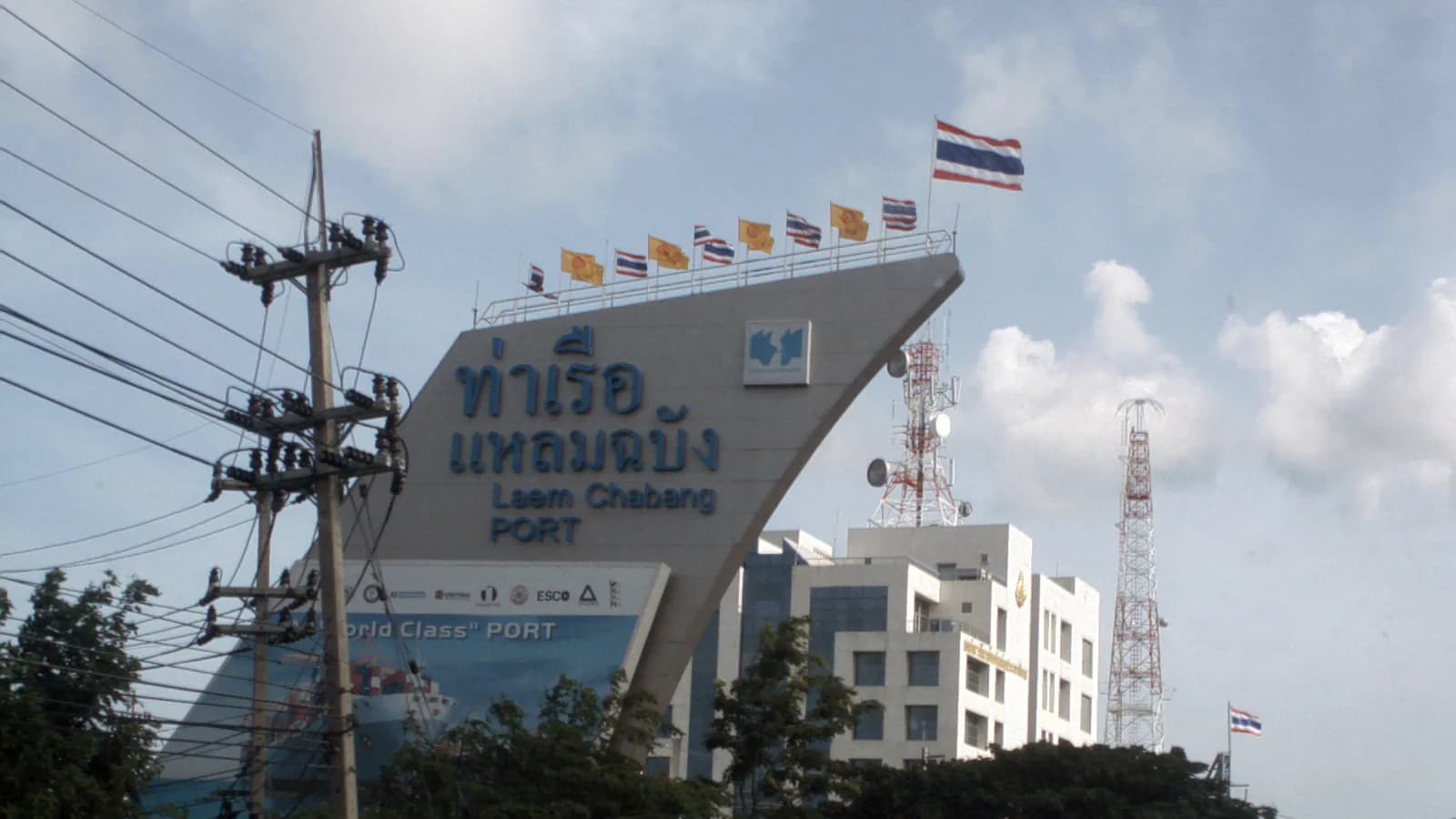
Used household effects can enter free of duty, under conditions set by Thai Customs on a page last updated in 2018. A foreigner must hold a one-year non-immigrant visa or a work permit. The shipment must arrive no more than one month before and six months after you do. Only one of each electrical appliance is exempt, two for a family. Cars are excluded.
The trap is shipping a container before you hold the right visa. On a tourist entry, and possibly on a DTV, the exemption is not guaranteed and duty plus 7% VAT applies. Furnished rentals are the norm in Thailand, so most people arrive with suitcases and buy the rest. Vapes and e-cigarettes are illegal to bring in.
Dogs and cats
Pets need an import permit from the Department of Livestock Development. Pet shippers report that it is requested 7 to 60 days before travel and valid for 60 days, with a fee of about 500 THB per animal on arrival. The animal must be at least four months old, microchipped before its rabies vaccination, and vaccinated at least 21 days before the permit is requested. A health certificate issued by the veterinary authority of your country completes the file. Requirements differ by country of departure, so confirm them with the Thai embassy and your own authority.
Step 6: your first weeks in Thailand
Lease and TM30
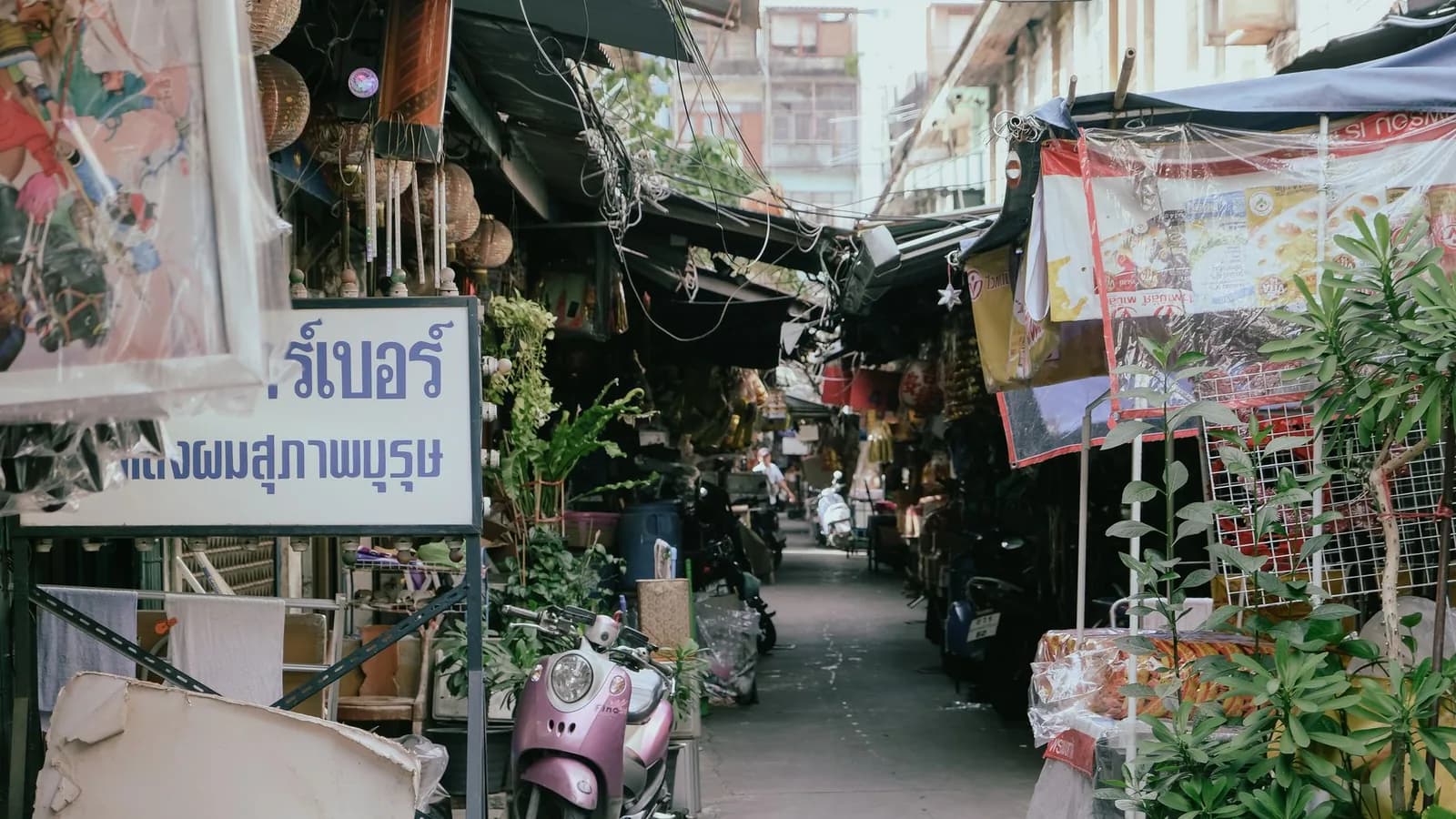
Sign a lease only after seeing the place. Your landlord must then report your address to immigration within 24 hours, on a form called the TM30. Ask for the receipt: some immigration offices want it before they accept a 90-day report or an extension, and banks may ask for it as proof of address.
Thai bank account
Banks tightened their checks in 2026. Opening an account on a tourist entry is reported as all but suspended, and DTV holders are widely reported as refused. Press reports describe checks on the origin of funds over six months and a face match against the passport chip. With a non-immigrant visa, bring your passport, proof of address, such as the lease, the TM30 receipt or a residence certificate, and a Thai mobile number in your name. Opening is done in person, and branches of the same bank do not all apply the same rules. Until you have an account, a multi-currency card and your home account do the job, at a cost of about 300 THB per withdrawal from a Thai cash machine.
Phone and internet
Get a Thai SIM in your own name early. Banks ask for a Thai mobile number registered to you before they open an account.
Thai driving licence
Your foreign licence with an International Driving Permit covers the first months. To obtain a Thai licence you need a non-immigrant visa, your passport, your licence with a certified translation or the permit, a medical certificate and proof of address, then an appointment at the Department of Land Transport for eyesight, reaction and theory tests and a safety video. The practical test is not always waived, and offices do not all accept the same proof of address. Tourist entries are refused.
90-day report
Every foreigner who stays more than 90 days in a row reports their address to immigration every 90 days. The window opens 15 days before the due date, and reporting in person is accepted up to 7 days after. The first report is made in person. Later ones can be filed online if you have not left the country or moved. Since May 2025 the form also asks for the number of your arrival card. Late reports are fined, with amounts of 800 to 2,000 THB reported. The report does not extend your visa.
Step 7: tax and health cover
Thailand has internationally accredited private hospitals in Bangkok, Chiang Mai, Phuket and Pattaya, and they are paid for privately. Public cover is tied to Thai employment, so most newcomers need private health insurance. It is compulsory for the O-A and O-X retirement visas, at 3,000,000 THB of cover. Buy it before you travel, while you can still declare your medical history at home, and check the age limit for new customers.
Mistakes people make when relocating to Thailand
- Arriving visa-free and hoping to sort it out later. With 30 days on arrival, there is no time, and most long-stay visas must be requested from your home country.
- Moving the visa money too late. Banks and immigration count the days a deposit has been in the account.
- Signing a one-year lease from abroad. Photos hide noise, floods and distance.
- Shipping a household before holding a one-year visa.
- Working on the wrong visa. A job for a Thai employer without a work permit can end in deportation.
- Forgetting the 90-day report and the TM30. Both surface at the worst moment, when you extend your visa.
- Skipping health insurance because daily life is cheap.
In this section

One person lives in Thailand on $855 to $1,420 a month, rent included. Budgets for couples and families, rents by city, food, bills and school fees.

Bangkok, Chiang Mai, Phuket, Pattaya, Hua Hin, Koh Samui, Chiang Rai and Krabi compared for expats: rent, hospitals, schools, air quality and drawbacks.
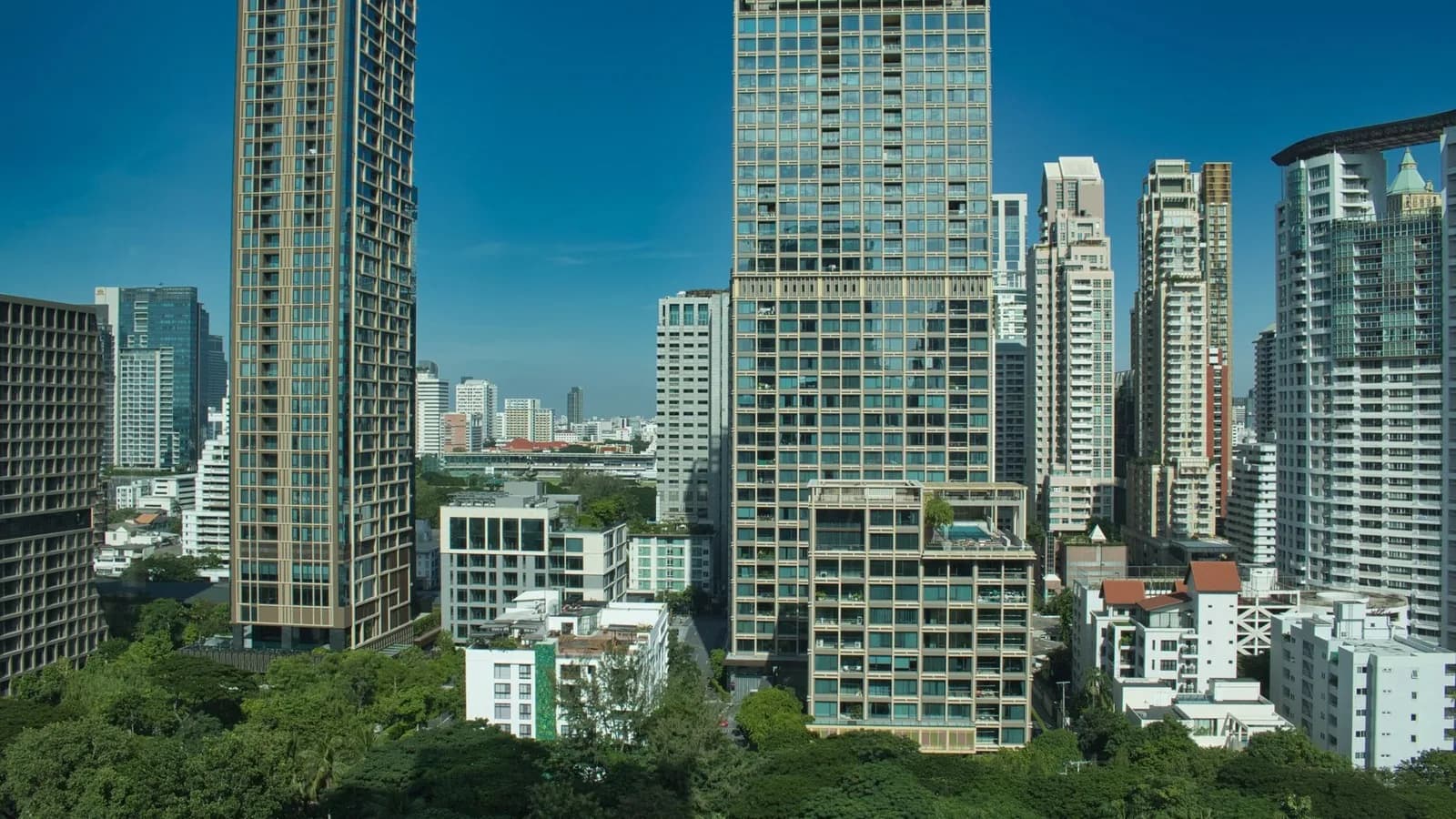
Rent a condo in Thailand from 11,500 THB a month. Prices by city and Bangkok BTS station, deposit rules since 2025, TM30, bills and scams to avoid.