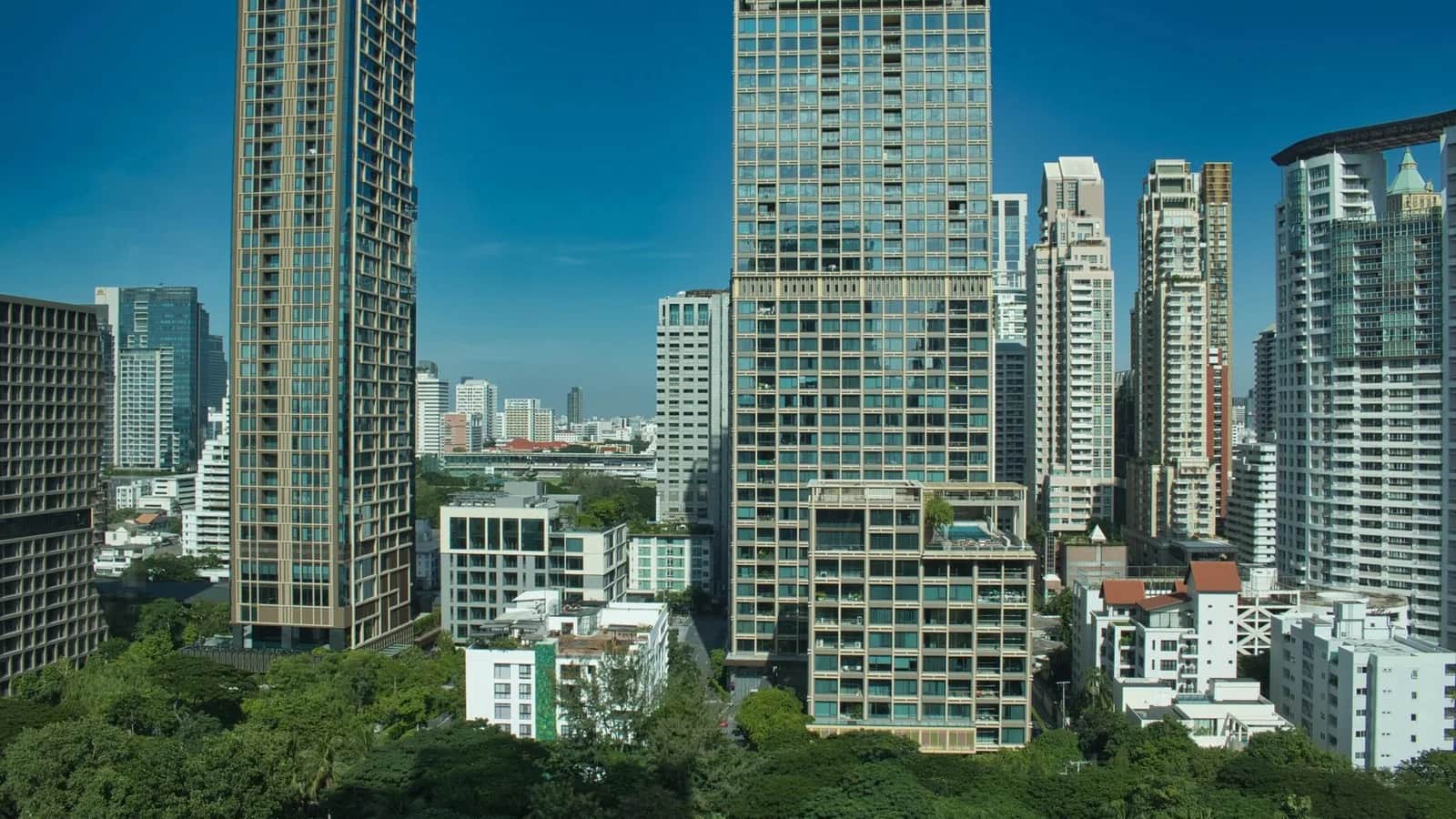
Renting in Thailand as a foreigner is simple: a passport, a one-year lease, and often two months of deposit plus one month in advance. A one-bedroom condo costs about 11,500 THB a month outside the centre of Bangkok and 24,300 THB in the centre. The parts that catch newcomers are the electricity rate, the TM30 form and getting the deposit back, and the law changed on two of the three in September 2025.
Rent prices in Thailand by city
| City | 1 bedroom, centre | 1 bedroom, outside the centre | 3 bedrooms, centre | 3 bedrooms, outside the centre |
|---|---|---|---|---|
| Bangkok | 24,300 THB (16,000 to 40,000) | 11,500 THB (8,000 to 20,000) | 78,400 THB | 30,100 THB |
| Chiang Mai | 16,600 THB (12,000 to 22,000) | 10,600 THB (8,000 to 15,000) | 35,100 THB | 22,600 THB |
| Phuket | 24,000 THB (15,000 to 35,000) | 16,600 THB (10,000 to 20,000) | 65,400 THB | 47,200 THB |
| Pattaya | 19,900 THB (12,000 to 28,200) | 13,500 THB (10,000 to 21,200) | 59,600 THB | 32,600 THB |
Monthly averages reported by Numbeo contributors, read on 14 November 2026, with the range in brackets. There is no official rent index, so use these as orders of magnitude. At 33.86 THB to the dollar, 11,500 THB is about 340 USD and 24,300 THB about 717 USD. Rent is the largest line of a monthly budget in Thailand.
Condo, apartment, house or villa
- Condo. A unit owned by an individual in a building with a pool and gym. The standard choice for foreigners in cities, furnished in most cases.
- Apartment. A whole building owned by one landlord and let by the month. Cheaper, simpler, with fewer facilities.
- House or townhouse. More space for the price, usually further from public transport and often unfurnished.
- Villa. The family and beach option in Phuket, Koh Samui and Hua Hin, at a much higher rent.
Rent a condo in Bangkok: prices along the BTS
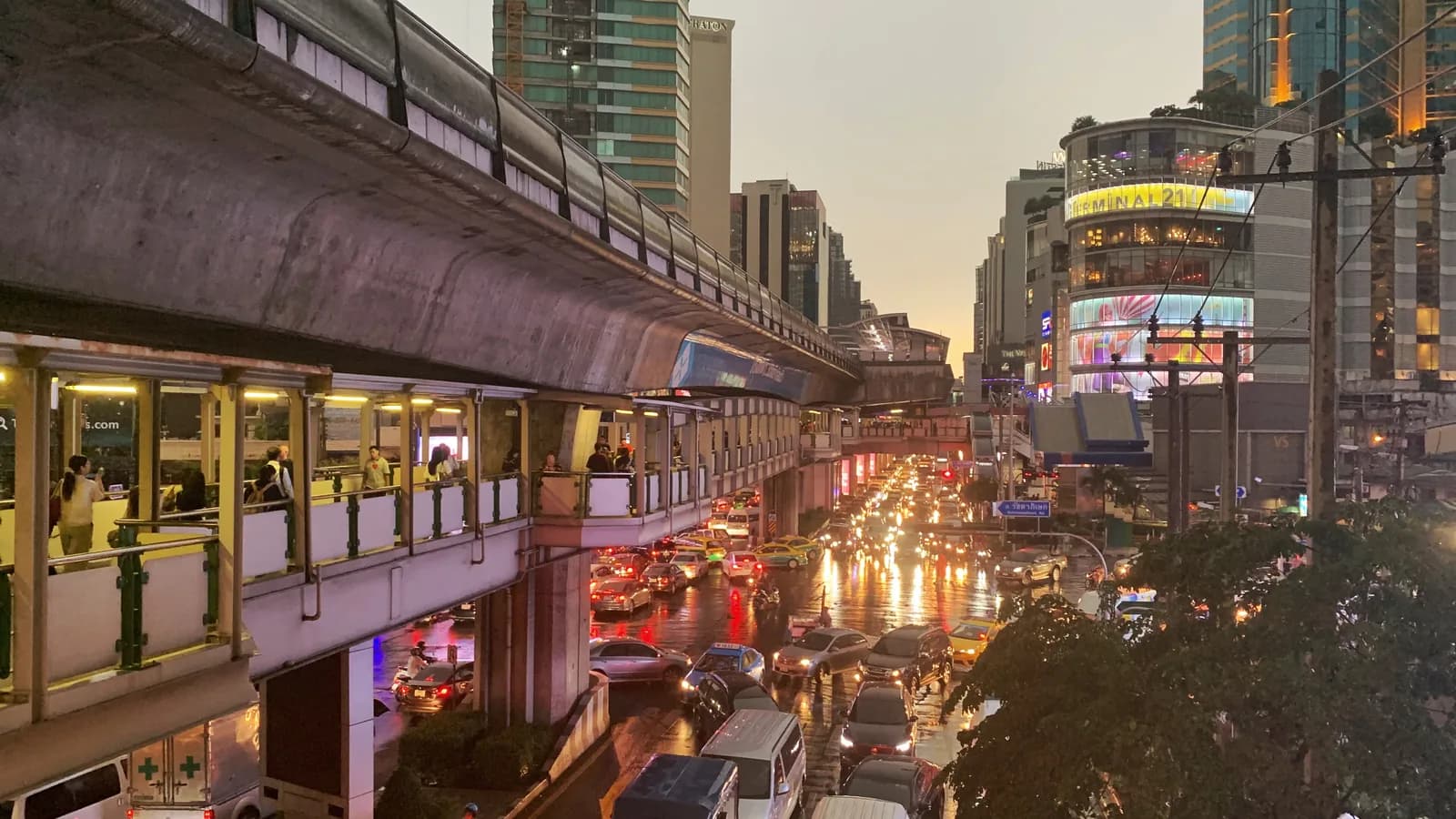
In Bangkok the rent follows the Skytrain. The closer to the centre of the Sukhumvit line and to a station, the higher the price. One rental agency published these ranges in June 2026:
| Area (station) | Studio | 1 bedroom | 2 bedrooms |
|---|---|---|---|
| Phrom Phong, Thong Lo | 16,000 to 24,000 | 22,000 to 35,000 | 45,000 to 80,000 |
| Silom, Sathorn (Sala Daeng, Chong Nonsi) | 16,000 to 24,000 | 25,000 to 35,000 | 50,000 to 70,000 |
| Nana, Asok | 14,000 to 20,000 | 18,000 to 28,000 | 35,000 to 55,000 |
| Ekkamai | 12,000 to 18,000 | 15,000 to 22,000 | 35,000 to 55,000 |
| Phra Khanong | 10,000 to 16,000 | 14,000 to 22,000 | 28,000 to 40,000 |
| On Nut | 10,000 to 15,000 | 15,000 to 25,000 | 28,000 to 42,000 |
| Bang Chak | 8,000 to 14,000 | 12,000 to 18,000 | 22,000 to 32,000 |
| Bang Na | 8,000 to 14,000 | 10,000 to 18,000 | 18,000 to 30,000 |
Prices in THB per month. They reflect what one agency sees, not a data set. The pattern is clear all the same: a one-bedroom is quoted at 22,000 to 35,000 THB around Thong Lo and 15,000 to 25,000 THB at On Nut, a few stations further out. A second agency, writing in April 2026, is lower for On Nut at 12,000 to 18,000 THB, and quotes 15,000 to 22,000 THB in Ari, 12,000 to 20,000 THB at Saphan Taksin and 11,000 to 16,000 THB around Ladprao.
How to rent in Thailand as a foreigner: where to look
- Book two weeks in a hotel or serviced apartment and choose the area on foot. Photos say nothing about noise, flooding or the walk to the station.
- Search the listing portals. DDproperty, FazWaz, Dot Property and Renthub show most condos on the market, with the same unit often listed by several agents.
- Use an agent. The commission is paid by the landlord, so the service costs the tenant nothing. Confirm that before the first visit.
- Walk into buildings you like. The management office usually knows which units are free and can call the owners.
- Visit, then negotiate. Rent, furniture and the length of the lease are all open to discussion, more so in low season in beach towns.
Landlords ask for a passport, sometimes with the page that shows your Thai visa. There is no credit check and no proof of income in the usual case.
Lease, deposit and notice: what Thai law says since 2025
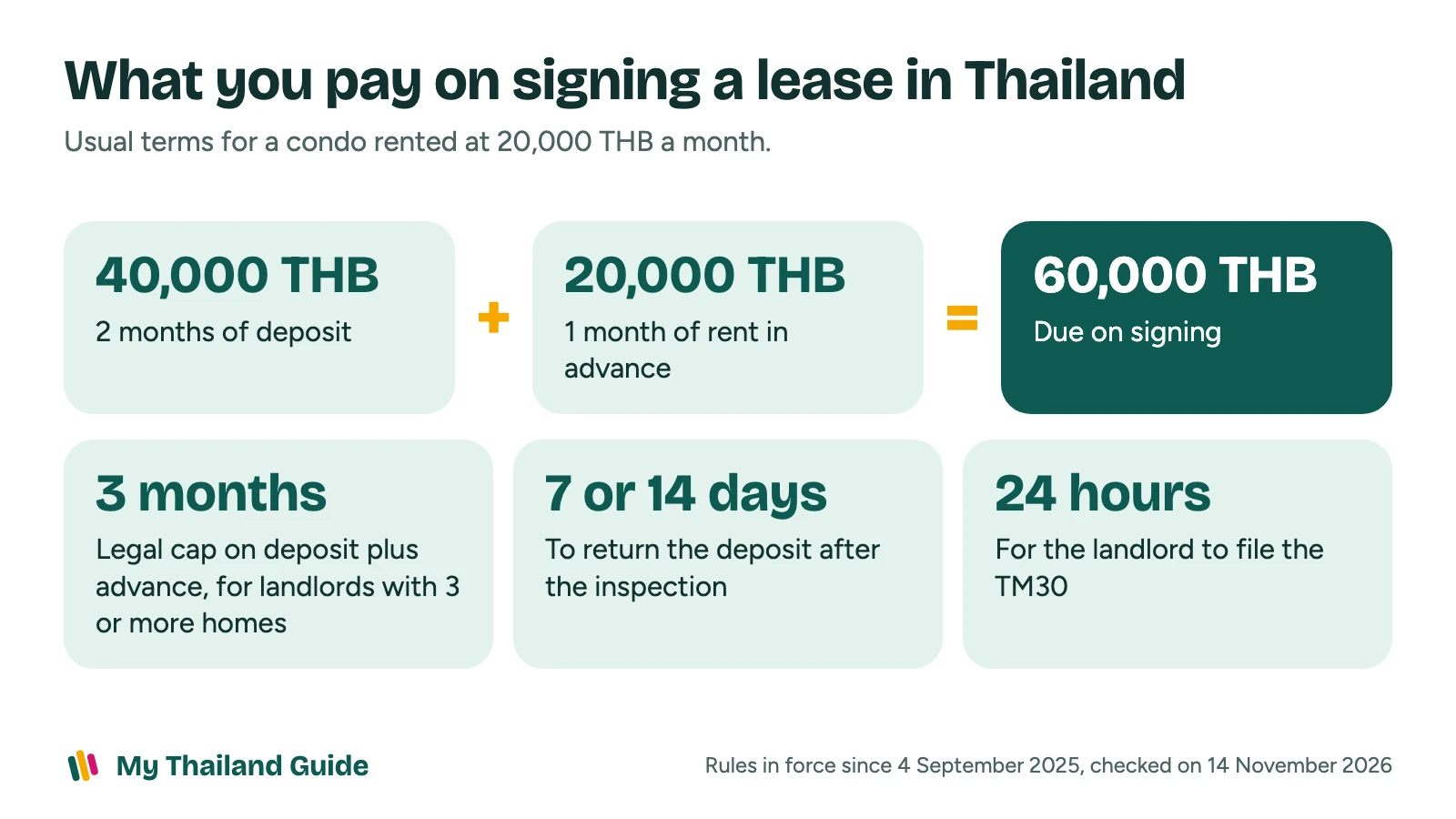
A new consumer rule on residential leases has applied since 4 September 2025. It covers any landlord who lets three or more homes, including through online platforms. The threshold was five before. Leases signed before that date keep the old terms until they end.
| Point | Rule for a landlord with 3 or more homes |
|---|---|
| Deposit plus advance rent | 3 months of rent at most in total, for a lease of up to 3 years |
| Return of the deposit | At the end of the lease, or within 7 days of the inspection, 14 days if there is damage |
| Tenant leaving early | Allowed after half of the term, with 30 days of written notice and rent paid up |
| Landlord ending the lease | 30 days of written notice |
| Electricity | Billed at the official rate, with no mark-up, and the bill sent at least 3 days before it is due |
| Entering the home | No visit without notice, except in an emergency |
| Also banned | Renewal fees, locking a tenant out, seizing belongings |
Banned clauses are void, and a landlord who uses them risks up to a year in prison and a fine of up to 200,000 THB. An owner who lets one or two units, which describes many condo landlords, is outside this rule. With them, the contract is all you have, so read it.
What a normal lease looks like
The standard is a one-year lease, two months of deposit and one month in advance. For a condo at 20,000 THB, that is 60,000 THB on signing. Six-month leases exist at a higher rent. A lease of more than three years must be registered at the Land Office.
If your job in Thailand could move you, ask for an early exit clause in writing: for example the right to leave after six months with two months of notice. It is a matter of negotiation, not a right, apart from the half-term rule above.
Electricity, water and internet in a Thai rental
Ask one question before signing: who bills the electricity, and at what rate. In a condo you normally pay the utility directly at the official tariff. In apartment buildings the landlord reads a private meter, and expat blogs report rates of 7 to 9 THB a unit, about double the official price. Landlords covered by the 2025 rule may now charge the official rate only.
For bills from September to December 2026, the first 200 kWh are capped at 3 THB a unit, and the cap was extended to rented homes and apartments. What happens after December is not confirmed. Above 200 kWh the rate rises to about 4.16 THB, then 4.36 THB beyond 400. By our estimate for Bangkok, 150 kWh costs about 500 THB and 300 kWh about 1,130 THB. Numbeo reports all basic utilities for an 85 m² flat at 3,560 THB in Bangkok and 2,068 THB in Chiang Mai.
- Water. A small bill. The Bangkok water authority charges homes 8.50 THB a cubic metre, and buildings that resell it are reported at 10 to 25 THB.
- Internet. 500 to 1,200 THB a month for fibre. Check whether the unit already has a line.
- Building fees. The common area fee is normally the owner's cost. Make sure the lease does not pass it on to you.
TM30: the form your landlord must file
Thai law requires the owner or manager of a property to report a foreign occupant to immigration within 24 hours of arrival. The form is the TM30, and it can be filed online. The duty and the fine, reported at 800 to 2,000 THB, fall on the landlord.
It still matters to you. Some immigration offices ask for the TM30 receipt before they accept a 90-day report or a visa extension, and practice varies from one office to the next. Write the TM30 into the lease, and ask for a copy of the receipt in your first week.
Renting for a week or a month: the hotel licence rule
Thai hotel law is generally read as exempting accommodation charged by the month or longer. Letting a condo by the night or the week without a hotel licence is an offence for the owner, with fines of up to 20,000 THB plus a daily penalty, and many buildings ban it in their own rules. Two bills to regulate short lets were still not adopted in 2026.
For a tenant the consequence is practical: a booking for a few nights in a condo can be refused at the lobby. For less than a month, book a hotel or a licensed serviced apartment. From one month, a condo lease is legal.
Rental scams in Thailand and getting your deposit back
- Never pay before a visit, in person or on a live video call that shows the unit and the building. Agencies report listings with edited photos and fake landlords who are in fact subletting.
- Check who you are paying. Ask for the owner's ID and a copy of the title deed, and compare the names.
- Photograph everything on day one, with dates, and have the inventory signed by both sides.
- Keep every receipt for rent and bills.
The deposit is where most disputes happen. Normal wear is not a reason to keep it. Give notice in writing, ask for the inspection before you hand back the keys, and remind a covered landlord of the 7 and 14 day deadlines. The Consumer Protection Board, reported on hotline 1166, takes complaints.