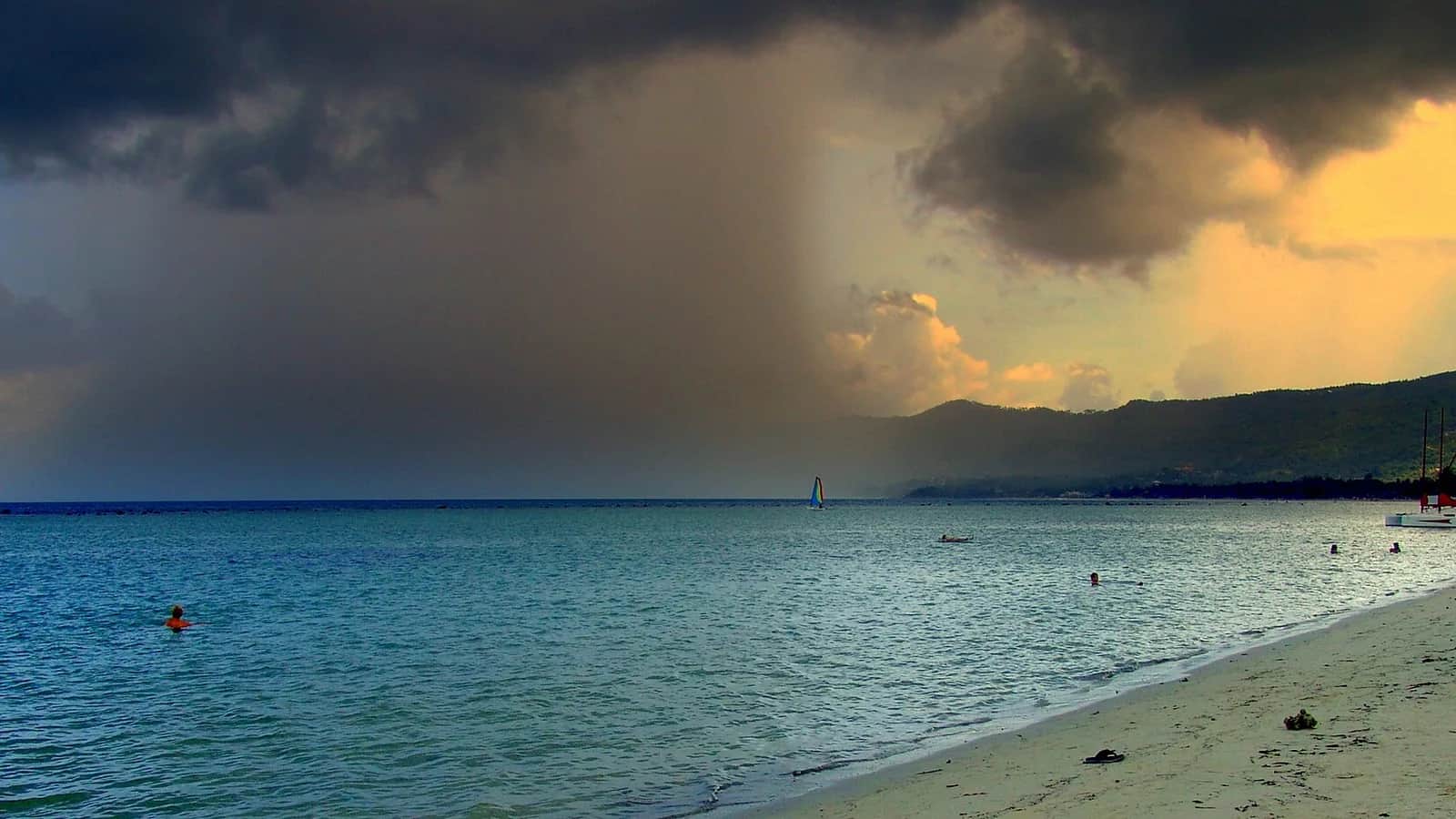
The Thailand rainy season runs from mid-May to mid-October. In 2026 the Thai Meteorological Department (TMD) declared it on 15 May, and it declared the cool season, the best time to visit Thailand, on 9 November. Koh Samui and the Gulf islands work the other way round: their rain falls from October to December. Thailand holidays in these months are worth it if you pick the right coast and keep your plans flexible. Dates, closures and figures checked on 14 November 2026.
Thailand rainy season dates: when it starts and ends
On paper the rainy season lasts from mid-May to mid-October, when the south-west monsoon blows in from the Indian Ocean. In practice the TMD announces the real dates each year, once its weather criteria are met. The start depends on the monsoon winds and steady rain over the country.
The end is declared indirectly. The TMD announces the start of the cool season when three conditions hold: minimum temperatures in upper Thailand stay below 23°C (73°F), winds turn north-east or east, and the rain clearly drops. That announcement closes the rainy season for Bangkok, the centre and the north.
Thailand rainy season on the islands: Andaman coast or Gulf of Thailand
Two monsoons hit the two coasts at different times, and this is what makes a rainy-season beach trip possible. From May to October, rain and rough sea are on the west coast. From October to December, they move to the east coast. Among the best islands in Thailand, Koh Samui and Koh Tao suit the first period, Phuket and Koh Lanta the second.
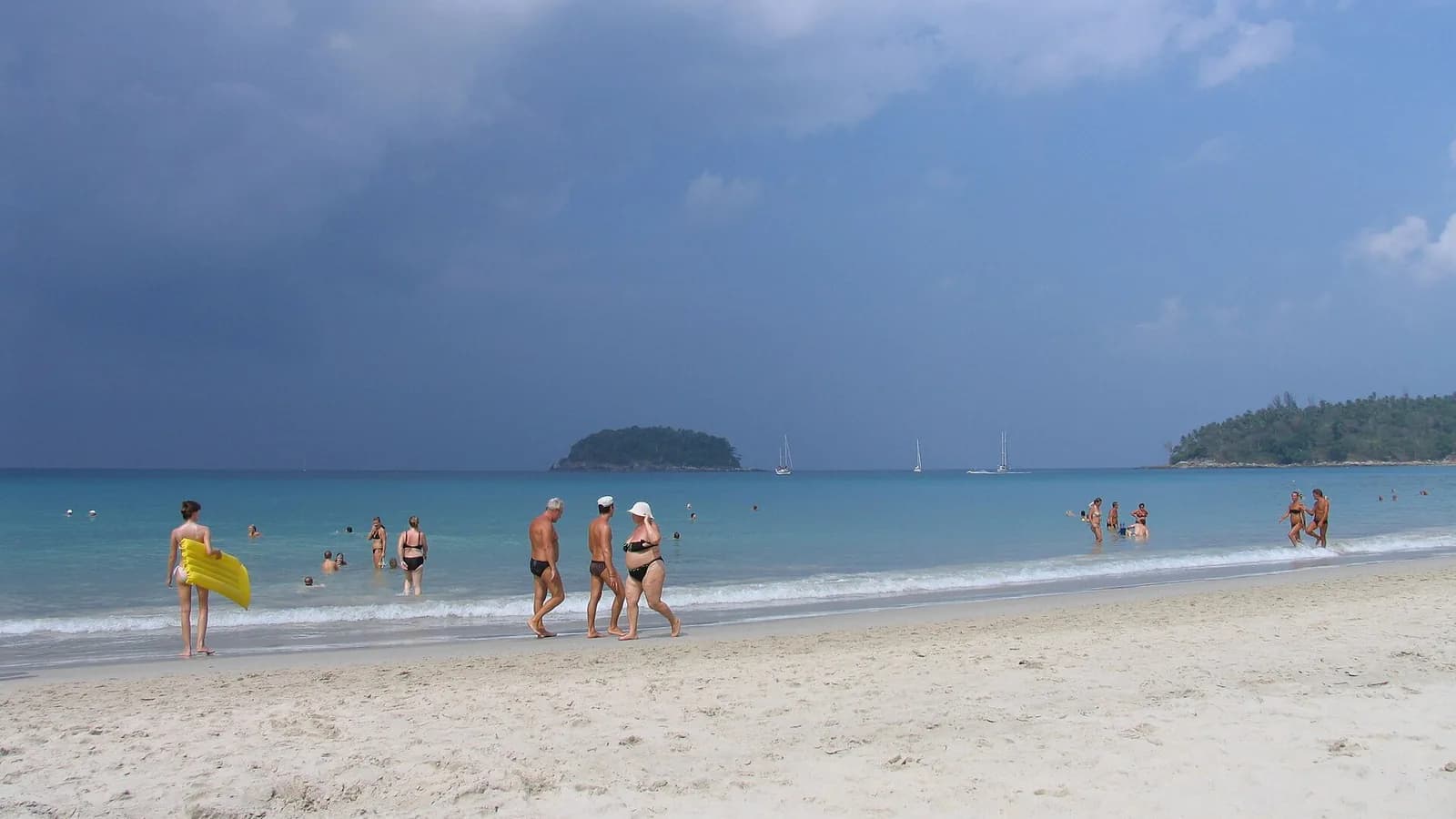
Andaman coast: Phuket, Krabi, Koh Lanta, May to October
The south-west monsoon brings rain and swell to the Andaman Sea. Phuket averages 309 mm in August and 350 mm in September, against 24 mm in February. The bigger problem is the sea: high waves, rip currents and red flags on the west-facing beaches of Phuket.
Many small resorts and bars close for the low season, mostly on the smaller islands. On Koh Lanta, the boat trips to Koh Rok stop in June and only come back when the national park reopens.
Gulf of Thailand: Koh Samui, Koh Phangan, Koh Tao, October to December
The Gulf islands are sheltered from the south-west monsoon. Koh Samui gets about 100 to 135 mm a month from May to September, less than half of Phuket. Then the north-east monsoon arrives: 295 mm in October and 445 mm in November.
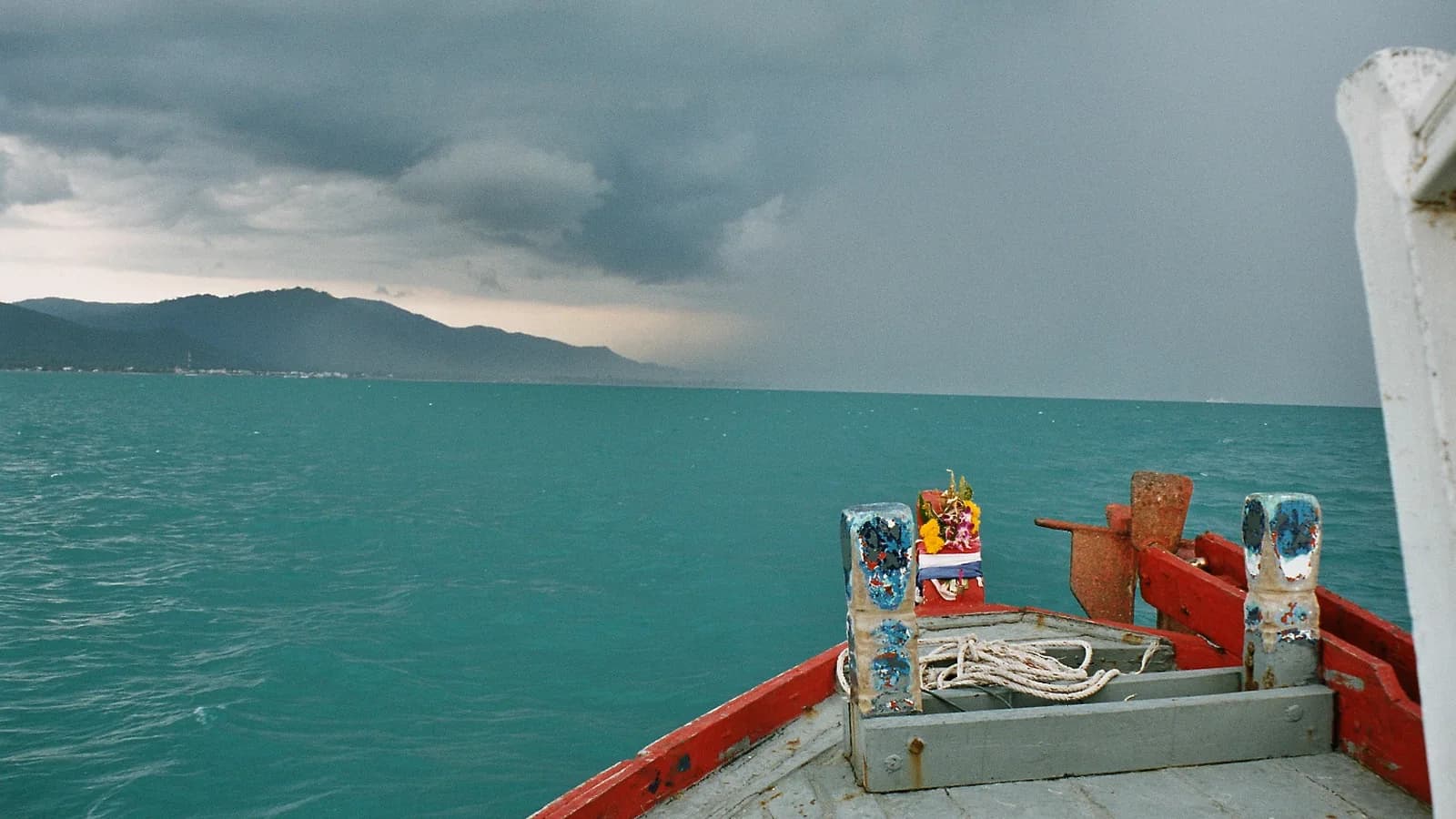
So the rule is simple. In July or August, go to Koh Samui, Koh Phangan or Koh Tao. In November, go to the Andaman side, which starts to dry out.
East coast: Pattaya, Koh Samet, Koh Chang
The east coast, from Pattaya to the islands, follows the Andaman pattern, with rain from May to October. On Koh Chang the wettest months are July to September, some resorts close and several speedboats to the nearby islands stopped from 1 June to 30 September 2026. Koh Samet is one of the driest islands in the country and stays a fair choice for a weekend.
How bad is monsoon season in Thailand? A rainy day, hour by hour
Less bad than the word monsoon suggests. Mornings are often sunny and humid. Clouds build after lunch, then a heavy storm falls for an hour or two in the late afternoon or the evening. The streets dry quickly and the air feels cooler afterwards.
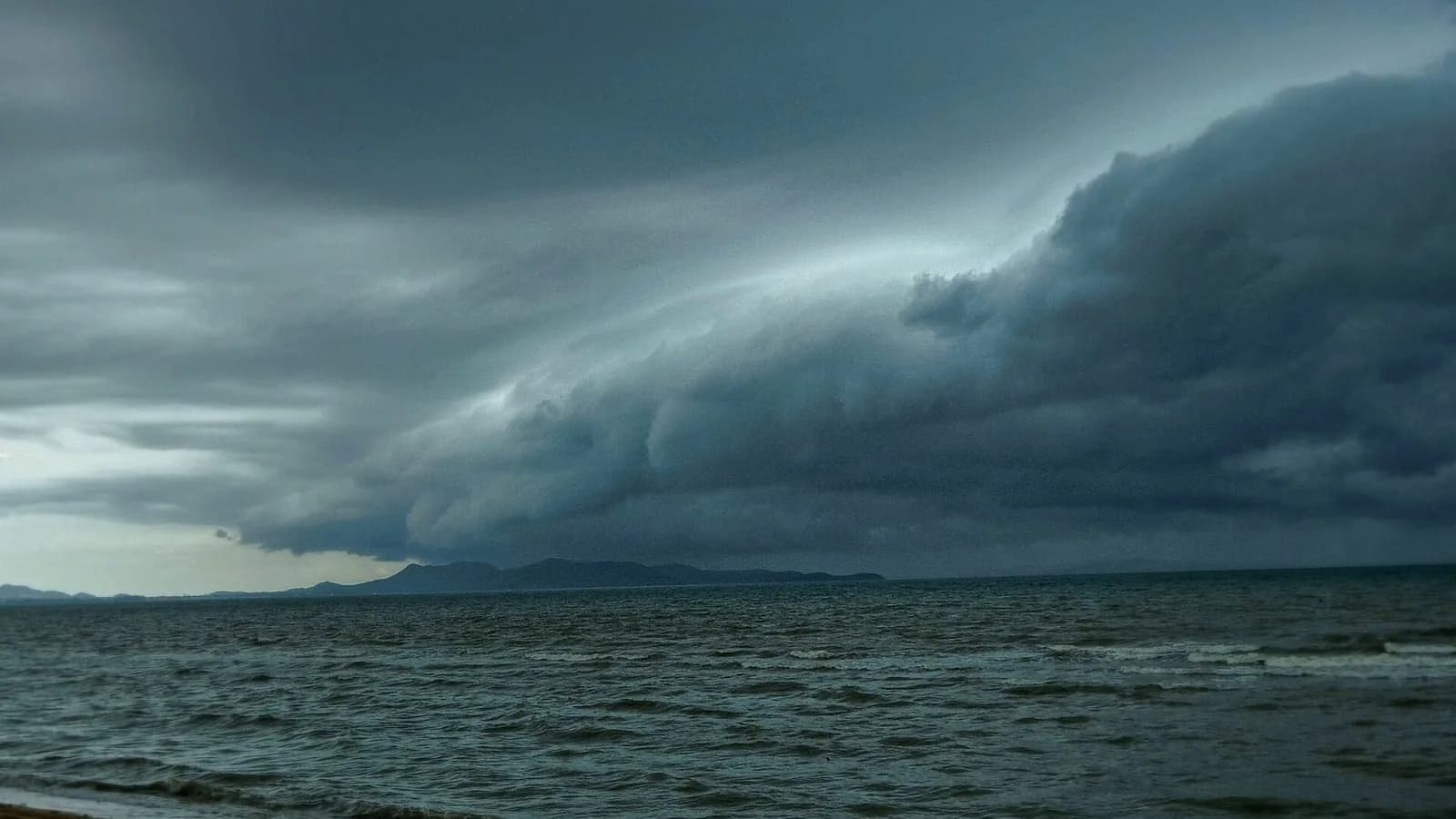
It gets worse as the season goes on. In May and June many days stay dry. By September the rain lasts longer, falls at night too, and the sun shows less: Phuket gets 108 hours of sunshine in September, against 279 in January. When a tropical storm passes, it can rain for two or three days in a row.
Rainy season in Bangkok
Bangkok gets rain on about 18 days in September, 336 mm in the month. Plan the Grand Palace and the temples for the morning. Keep malls, museums, a massage or a cooking class for the afternoon. Use the BTS and MRT when storms hit, because taxis are hard to find and traffic stops.
Is it worth going to Thailand in rainy season?
Yes, for most trips that are not only about the beach. You get lower prices, fewer people at the big sights and a country that is green again after the dry months. A trip built around one Andaman beach in September is the one we would not book.
Lower prices and fewer crowds
Arrivals drop sharply. About 2.27 million foreign visitors came in May 2025, against about 3.7 million in January. Hotels on Phuket and Krabi cut their low-season rates, and you can book the good rooms late. Queues at the Grand Palace and on boat tours are shorter.
Green rice fields and full waterfalls
The rain turns the rice fields bright green in the north and the centre, from about July. Waterfalls that are a trickle in April are full in August and September. In Chiang Mai, Doi Inthanon and its waterfalls are at their best, and the air is clean, unlike the smoke season of March and April.

The jungle of Khao Sok is also at its greenest, and Cheow Lan Lake is quieter. Expect leeches on the trails and slippery paths.
Thailand rainy season downsides: rough sea, cancelled ferries and closed parks
The rain itself rarely ruins a trip. The sea does. On the Andaman coast, the worst months for swimming and boat trips are June to September.
Red flags and rip currents
A red flag means no swimming, and lifeguards will whistle you out of the water. Drownings happen every monsoon season. On 15 May 2026, the first day of the season, a man was swept away at Nai Thon beach on Phuket in waves over 2 metres, and two British tourists had to be rescued at the same beach in July after swimming past the red flags.
Ferries and speedboats cancelled
When the TMD warns of waves over 2 to 3 metres, the provinces can order small boats to stay ashore. Speedboat day trips to the far islands are cancelled first. Big ferries and catamarans usually keep running, but late or rough.
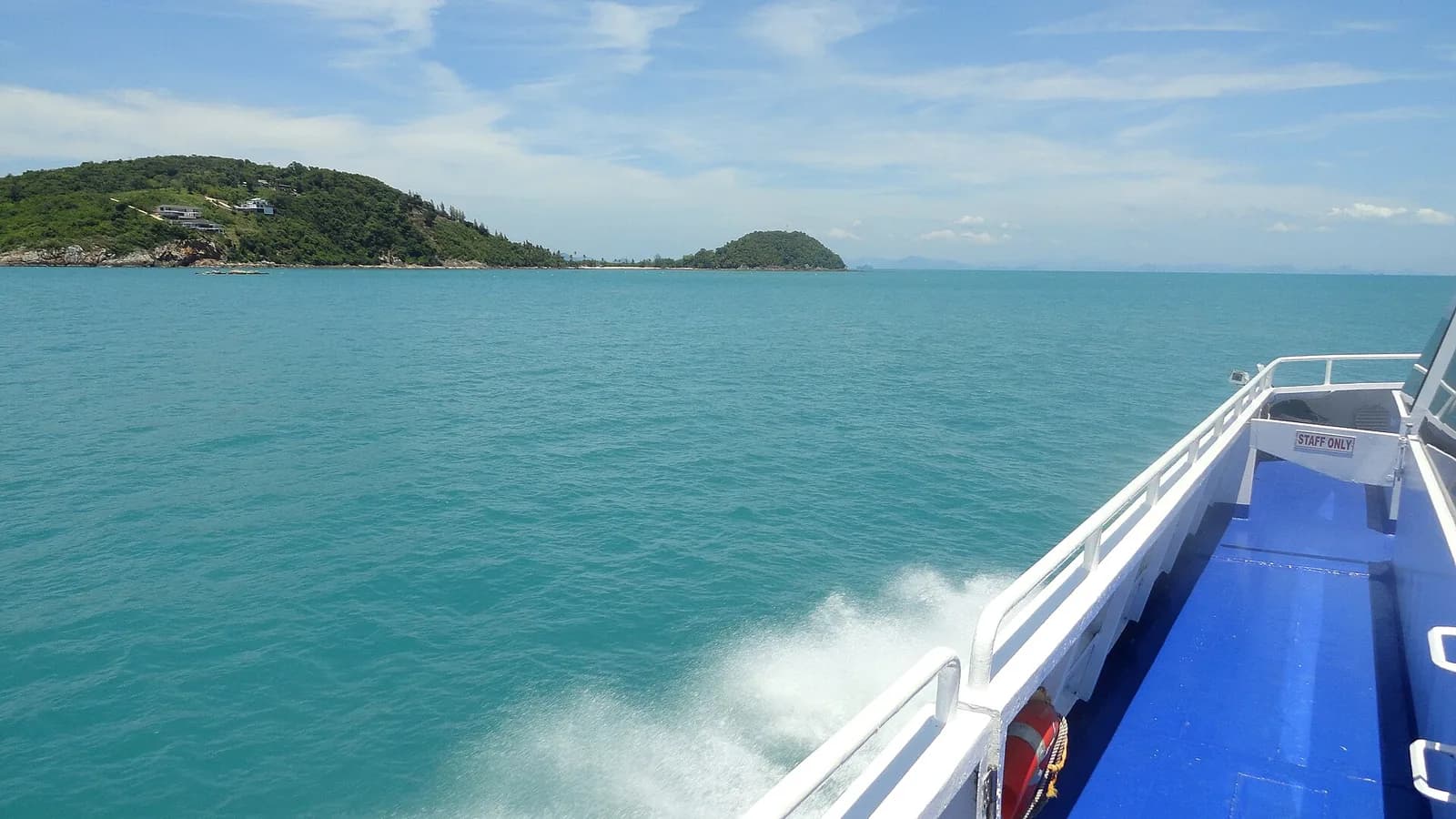
Some routes stop for the whole season. The speedboats between Koh Lanta and Koh Lipe only run from mid-October to about 20 May.
National parks closed for the monsoon
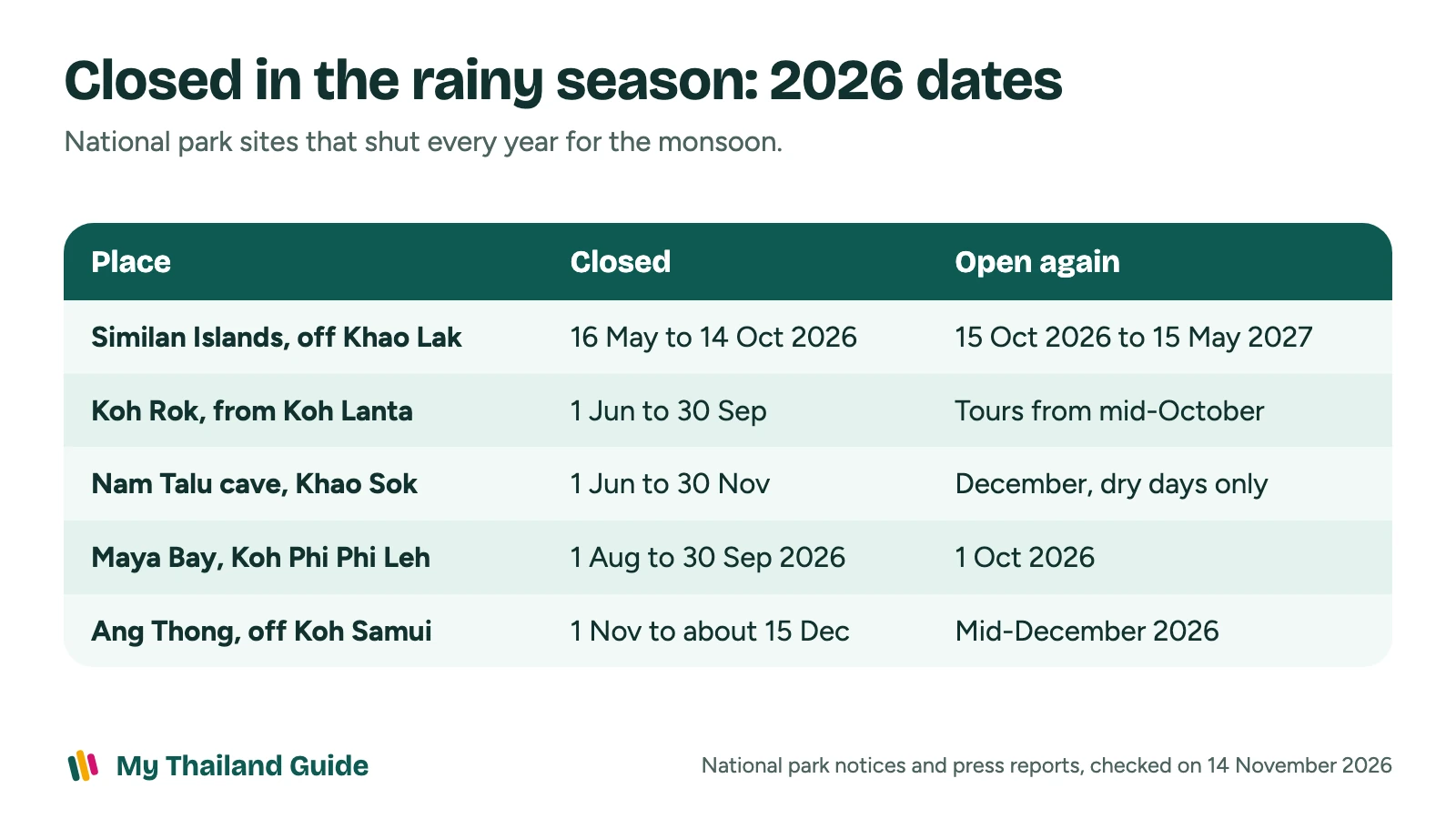
Several of the most booked marine parks close every year to protect the reefs and the visitors. These are the 2026 dates.
| Place | Closed in 2026 | Notes |
|---|---|---|
| Similan Islands, off Khao Lak | 16 May to 14 October | Open from 15 October 2026 to 15 May 2027, day trips only |
| Koh Rok, from Koh Lanta | 1 June to 30 September | Most small islands of Mu Koh Lanta park close from 16 May to 14 October |
| Nam Talu cave, Khao Sok | 1 June to 30 November | Some sources give 14 December as the opening date |
| Maya Bay, Koh Phi Phi Leh | 1 August to 30 September | Other Phi Phi tour stops stay open |
| Ang Thong Marine Park, Koh Samui | 1 November to about 15 December | The park booking page gives 30 November as the end date |
Thailand floods 2025 and 2026: Hat Yai and Bangkok
Most travellers never see a real flood, but the last two seasons ended with serious ones. Both came late in the year, when the rainy season was supposed to be ending.
Hat Yai, November 2025
Hat Yai, the big city of Songkhla province in the far south, received a reported 335 mm of rain on 21 November 2025 and about 630 mm in three days. The government confirmed 145 deaths across the south by 28 November, 110 of them in Songkhla. More than 33,000 homes were damaged around Hat Yai.
Bangkok, September 2026
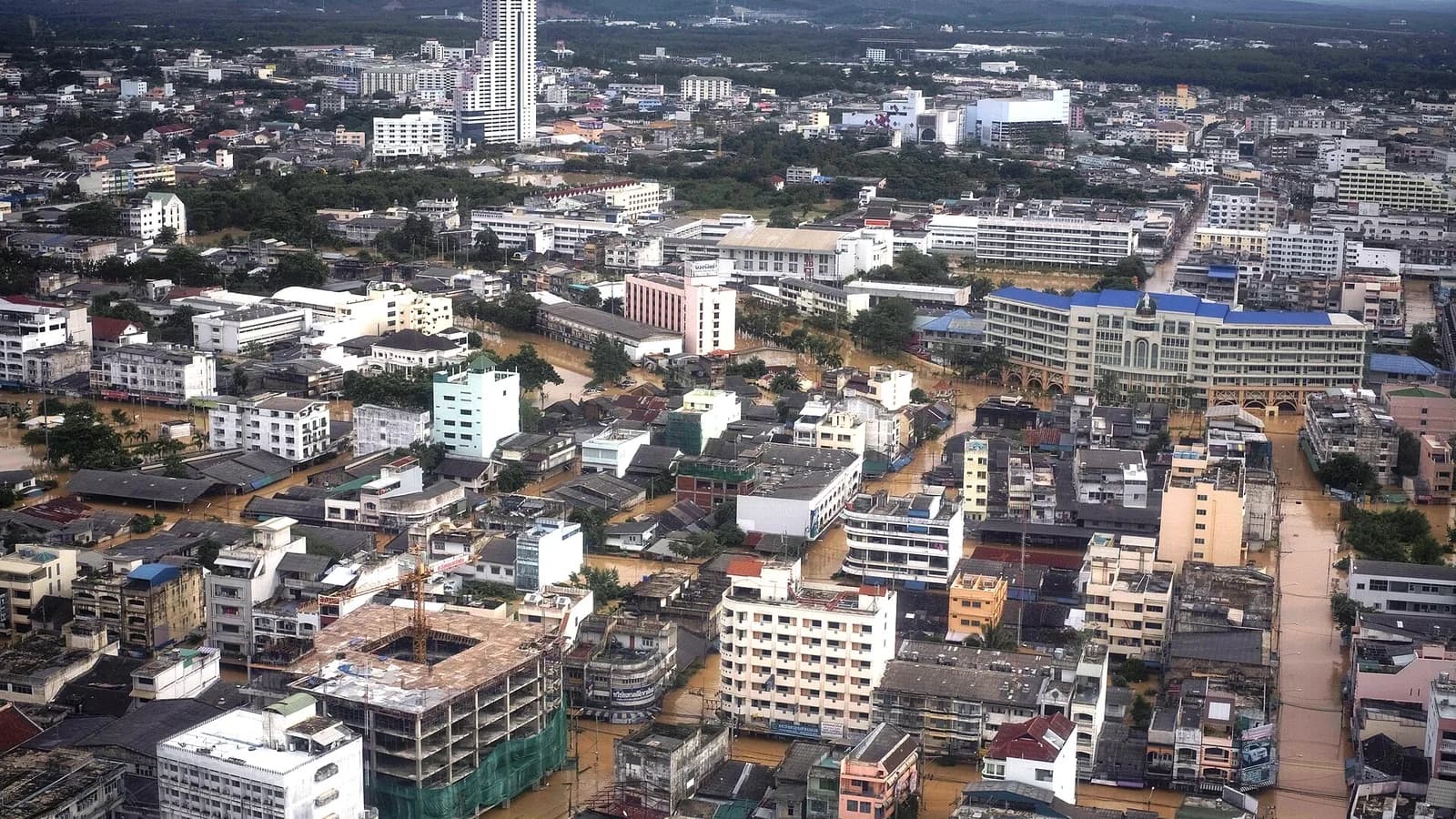
Rain fell almost without a break from 24 to 27 September 2026, nearly 300 mm in 48 hours. Bangkok declared a disaster in all 50 districts and about 4,200 people slept in shelters. Across 29 provinces, more than 2.6 million people were affected and more than 20 died, according to official counts at the time.
Suvarnabhumi airport stayed open, but the Tourism Authority of Thailand told travellers to allow two or three extra hours to reach it, and Thai Airways reportedly cancelled eight flights on 29 September. The water started to drop on 28 September, and the government expected to clear it within two or three days.
What to do: before a trip in September, October or November, check the TMD warnings, the news for your provinces and whether Thailand is safe to visit that week. If a flood hits, stay in your hotel, avoid walking in floodwater and move by BTS or MRT, not by road.
Thailand typhoon season: tropical storms, rarely typhoons
Thailand has no real typhoon season. Typhoons form over the Pacific and the South China Sea and usually hit the Philippines, Vietnam or southern China. By the time they reach Thailand, most have weakened into tropical storms or depressions.
Their rain still matters. When Tropical Storm Maysak headed for southern China in early July 2026, the TMD warned of very heavy rain in 15 provinces. In November 2025 the remains of Typhoon Kalmaegi crossed the north-east as a depression and brought flood alerts. Expect two or three wet days, not a direct hit.
Dengue and health in the Thai rainy season
Mosquitoes breed in standing water, so dengue fever peaks in the rainy season. The Department of Disease Control counted 21,620 cases and 31 deaths in Thailand from 1 January to 19 August 2026, fewer than in the same period of 2025. Bangkok had 1,785 of them.
The mosquito that spreads dengue bites by day, in towns as much as in the jungle. Use a repellent with DEET or picaridin, wear long, light clothes at dawn and dusk and pick rooms with screens or air conditioning. A high fever with headache and body pain is a reason to see a doctor quickly.
Where to go in Thailand in the rainy season, May to November
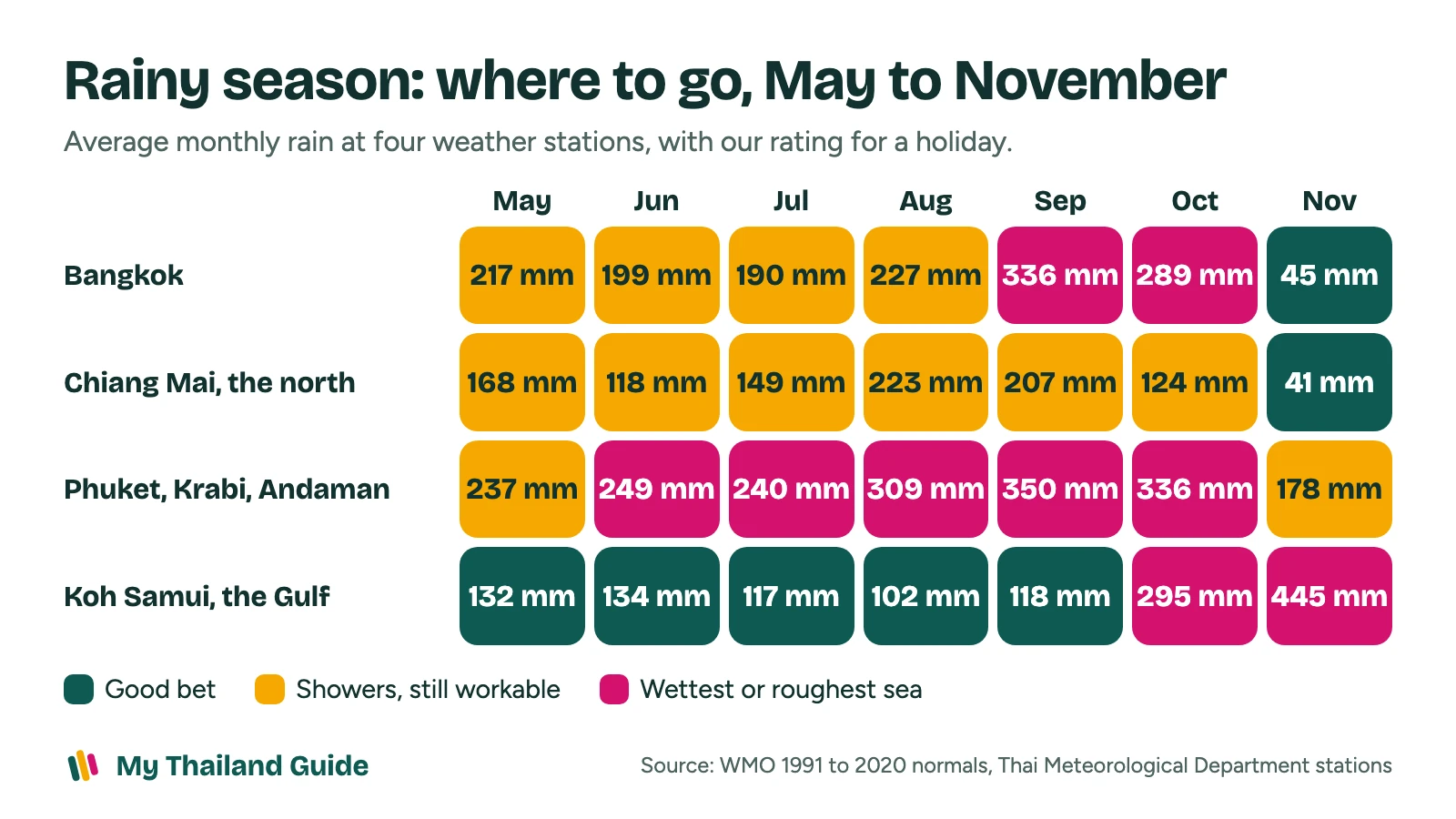
Rain is the monthly average in millimetres at four TMD stations, over 1991 to 2020. A single year can be wetter or drier.
| Month | Rain, mm (Bangkok, Chiang Mai, Phuket, Koh Samui) | Best bet | Skip |
|---|---|---|---|
| May | 217, 168, 237, 132 | Gulf islands, last days of the Similans before 16 May | Swimming on Andaman beaches with red flags |
| June | 199, 118, 249, 134 | Koh Samui, Koh Tao, Bangkok at low prices | Koh Rok and Andaman speedboat trips |
| July | 190, 149, 240, 117 | Gulf islands, Chiang Mai, Khao Sok | Andaman beaches for swimming |
| August | 227, 223, 309, 102 | Gulf islands in their driest rainy month | Maya Bay, closed from 1 August |
| September | 336, 207, 350, 118 | Gulf islands | Bangkok and Phuket in their wettest month |
| October | 289, 124, 336, 295 | Chiang Mai late in the month, Similans from 15 October | Gulf islands from mid-October |
| November | 45, 41, 178, 445 | Bangkok, the north, Andaman coast later in the month | Koh Samui, Koh Phangan, Koh Tao and Ang Thong |
For a first trip of two weeks in July or August, a good route is a few days in Bangkok, three or four in Chiang Mai, then the Gulf islands. Switch the islands to Phuket, Krabi or Koh Lanta from late November.
How to plan a Thailand rainy-season trip: flexible bookings and insurance
A rainy-season trip is cheap when it stays flexible. A few rules make the difference.
- Book hotels with free cancellation and pay for boat tours the day before, once you have seen the forecast.
- Keep a spare day before any flight after an island stay, in case a ferry is cancelled.
- Check the TMD warnings on tmd.go.th or its app before every boat trip.
- Choose a hotel with a pool on the Andaman coast, where the sea can stay closed for days.
- Pack a light rain jacket, sandals that grip and a waterproof phone pouch. All are sold in any 7-Eleven.
- Take travel insurance that covers trip changes caused by weather and medical costs, including dengue.
Since 15 September 2026, visitors from 60 countries get 30 days without a visa instead of 60. For a longer and cheaper low-season stay, apply for a Thailand tourist visa before you leave.